· Updated

Joaquín Trapero in Founder of Nonimo, writing on AI and privacy.
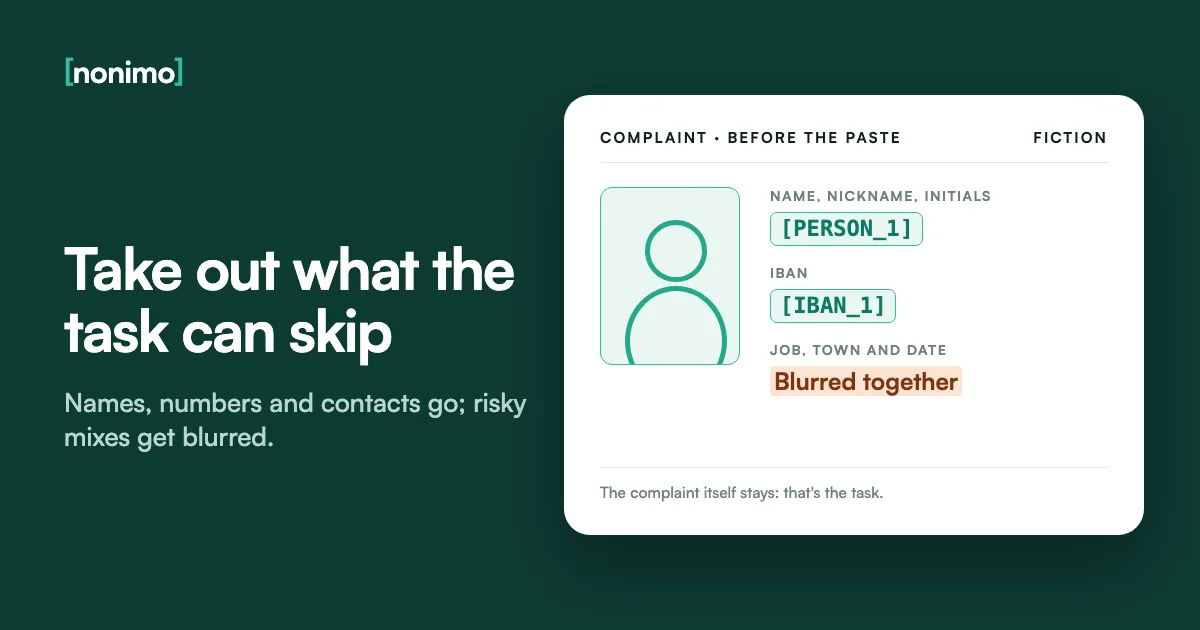
Before a contract, a complaint or a case note goes into ChatGPT, Claude or Copilot, somebody has to decide which details come out. Leave too much in and a client’s name ends up in a provider’s records, which raises the question of whether that paste was a breach.
The box above redacts text you paste. Below is the sorting list for everything else: what to remove, what to blur and what to leave alone. I’d put more care into the blurring than the removals, since software handles fixed-format numbers well; our overview of redaction products for AI work compares the options.
Remove anything that points to one person and that the task can do without. That means names in every form, ID and account numbers, contact details, reference numbers, faces and file metadata. Then blur risky combinations such as job, town and date. Keep the facts the model is there to work on.
What counts as personal data? Four definitions, one test
Article 4(1) of the GDPR is the definition most organisations meet first: any information relating to an identified or identifiable person. It names the handles that do the identifying, such as a name, an identification number, location data, an online identifier, or factors specific to someone’s physical, economic, cultural or social identity.
NIST’s guide to PII, written for US federal agencies, splits it in two: details that distinguish or trace a person, such as a name or Social Security number, and details linked or linkable to them. California’s CCPA reaches further: anything that could reasonably be linked with a consumer, or even a household.
The wording differs; the working test hardly does. Could someone holding this text, plus what they could reasonably find, tell who it is about? I trust that question more than any list. A label in place of a name doesn’t end it, as our page on de-identified and anonymous data explains.
Four definitions side by side
Different words, the same practical question: could this lead back to someone?
| Source | What it covers | Examples it gives |
|---|---|---|
| GDPR, Article 4(1) | Information about a person identified or identifiable directly or indirectly | Name, identification number, location data, online identifier |
| NIST SP 800-122 | Information that can distinguish or trace a person, and information linked or linkable to them | Name, SSN, passport and driver's licence numbers, account and card numbers, email, photo, handwriting |
| CCPA (California), Civil Code 1798.140(v) | Information that identifies, relates to or could reasonably be linked with a consumer or household; publicly available information is excluded, and the formats listed include AI systems able to output personal information | Real name, alias, IP address, account name, geolocation, inferences used to build a profile |
| OAIC (Australia) | Information or an opinion about someone reasonably identifiable | Signature, address, date of birth, IP address, mobile location information, voice print |
GDPR Article 4(1) on EUR-Lex; NIST SP 800-122, sections 2.1 and 2.2; California Civil Code 1798.140(v), in the CCPA text posted by the CPPA, effective 1 January 2025; OAIC, "What is personal information?".
Direct identifiers: one name, many disguises
A direct identifier points to someone without help: a name, a face, a signature, a personal email address or mobile number. NIST’s examples of PII include full name, maiden name and alias, street and email addresses, and personal characteristics such as a photograph, fingerprints or handwriting.
Names are slippery, because files rarely call a person the same thing twice. Ireland’s Data Protection Commission warns that a search finds only what you type, and one person may appear as a first name, a title, a relationship or initials. Decks make it worse: see the spellings a name picks up across slides.
Faces and signatures arrive as images, which text search cannot read. If a scanned card or a signed letter sits inside the file, I’d lift the picture out rather than cover it. A photo uploaded to a chatbot raises its own retention question: what happens to images you give an assistant.
One employee, seven ways a file can name her
Would a search for her surname catch each one?
| How she appears | Where | Surname search finds it? |
|---|---|---|
| Marguerite Oyelaran | Letter heading | Yes |
| Ms Oyelaran | Body of a reply | Yes |
| Maggie | Manager's email | No |
| M.O. | Rota and handwritten note | No |
| moyelaran@pendleburyseeds.example | Forwarded chain | Only if the search matches inside words |
| Rufus Kettering's sister-in-law | Witness statement | No |
| The only woman driving a forklift at the Saltrey depot | Occupational health referral | No |
Fictional employee, colleague and employer. The variety of mentions follows the Data Protection Commission's warning that one person can be referred to in different ways.
ID numbers, bank details and card numbers
Numbers issued to one person are the easy call: they go every time. NIST’s list includes Social Security, passport, driver’s licence and taxpayer identification numbers, plus financial account and card numbers. Every country has its own national number, with its own rules on who may use it.
A photocopy of an ID brings the number plus a face, a signature and a date of birth. Unless the task concerns the document, my advice is to leave it out. When a copy must go to a person, a watermark naming the recipient limits reuse, as with stamping an Irish passport card copy.
Money follows the same logic. An IBAN or account number belongs to someone, and a bank export names the other party on every line, which is why masking a CSV statement goes column by column. Keep an amount only when the sum is the question.
The national number, country by country
Our country guides go deeper on each number and on ID copies.
| Country | National number | Worked guide |
|---|---|---|
| United States | Social Security number | Taking an SSN out of a prompt |
| United Kingdom | National Insurance number | NI numbers and AI tools |
| Australia | Tax file number | TFNs before a document goes to AI |
| Ireland | PPS number | Who may use a PPSN, and when |
| Ireland, ID copies | Passport, passport card, driving licence, residence permit | Passport photo page, passport card, licence copy, IRP card |
Each linked guide cites the official source for its own number.
Fixed formats are what software spots best. The box below checks an invented signature block in your browser; edit it or paste your own. Look at what it lists and at what it passes over: the first line, which identifies her better than anything else, goes unflagged.
What a pattern check catches, and what it misses
Invented details. The name, job and town on line one are never flagged.
The check happens on this page and nothing is sent. It recognises card numbers that pass the Luhn check, IBANs with valid check digits, US SSNs and UK NI numbers by format, IPv4 addresses, API keys with common prefixes, emails and phone numbers written with a country code. Names and street addresses are beyond it.
Quasi-identifiers: when ordinary details add up to one person
Some details identify nobody alone and almost anybody together. NIST gives ZIP codes and dates of birth as data that can indirectly identify people or sharply narrow a dataset, and cites an MIT study in which 97% of names and addresses on a voting list were identifiable from ZIP code and date of birth.
Rulebooks answer by generalising. HIPAA’s Safe Harbor method keeps only the year of dates tied to a patient, and the first three ZIP digits only where that area holds more than 20,000 people. Spreadsheets need the same move per column: banding ages and postcodes in Excel.
In prose the trap reads “the only woman driving a forklift at the Saltrey depot”: no name, one person. I prefer to generalise the one detail the task needs least, since blurring all three wrecks the prompt. Small places shrink the crowd fastest, which our page for Irish council staff keeps in view.
Blur one detail, then reread the sentence
Pick which detail to generalise. The best choice depends on what you are asking the AI to do.
[PERSON_1], the only woman driving a forklift at the Saltrey depot, has been off with a back injury since 14 March 2026.
The name is gone, yet anyone at the depot knows who this is.
[PERSON_1], a forklift driver at a regional depot, has been off with a back injury since 14 March 2026.
Good for a return-to-work plan: the depot was never the point, and "the only woman" goes with it.
[PERSON_1], the only woman driving a forklift at the Saltrey depot, has been off with a back injury since March 2026.
Barely helps. The phrase that singles her out is still there.
[PERSON_1], a warehouse employee at the Saltrey depot, has been off with a back injury since 14 March 2026.
Hurts the task: an occupational health reply needs to know the work involves lifting.
Fictional example. Generalising rather than deleting follows the approach of NIST SP 800-122, section 4.2.4, and the Safe Harbor rule in 45 CFR 164.514(b).
Sensitive information: special categories and their equivalents
Every regime marks some data as more harmful to expose. GDPR Article 9 lists racial or ethnic origin, political opinions, religious or philosophical beliefs, trade union membership, genetic data, biometric data used to identify someone, health, and sex life or sexual orientation. Criminal convictions sit apart, in Article 10.
Australia’s Privacy Act calls it sensitive information, and the OAIC’s list adds criminal record. The US has no single list: health records fall under HIPAA, and NIST rates Social Security numbers, medical history and account data as more sensitive fields. Our Irish page on Article 9 data traces the categories through office paperwork.
Here the sensitive detail is often why you are writing the prompt: a return-to-work letter needs the injury. I’m comfortable leaving a diagnosis in once nothing around it points back to the patient. General practice lives with this on every referral, the subject of patient data and AI in an Irish practice.
Sensitive data in two rulebooks
Where the two lists part company, the row is highlighted.
| Kind of data | GDPR | Australian Privacy Act (OAIC) |
|---|---|---|
| Health | Article 9 | Sensitive information |
| Genetic | Article 9 | Sensitive information |
| Biometric | Article 9, when used to identify someone | Some biometric information |
| Racial or ethnic origin | Article 9 | Sensitive information |
| Political opinions | Article 9 | Political opinions or associations |
| Religious or philosophical beliefs | Article 9 | Sensitive information |
| Trade union membership | Article 9 | Sensitive information |
| Sex life or sexual orientation | Article 9 | Sexual orientation or practices |
| Criminal record | Separate rules, Article 10 | Sensitive information |
GDPR Articles 9(1) and 10 on EUR-Lex; OAIC, "What is personal information?". Two examples among many regimes, not a full survey.
Third parties: witnesses, relatives and colleagues in the text
A file about one client names plenty of other people: a former employer, a witness, a partner, a child, a colleague who complained. Each is protected in their own right, and none agreed to anything. Even the AI clause an Irish firm puts in its engagement letter speaks only for the client who signed it.
Rulebooks expect this. HIPAA’s Safe Harbor list covers identifiers of the patient’s relatives, employers and household members as well as the patient’s own. Under GDPR Article 15(4), giving someone a copy of their data must not adversely affect others, and that is the case the DPC’s redaction note was written for.
Roles beat blanks. [CLAIMANT], [WITNESS 1] and [MANAGER] keep a chronology readable. Fix the labels once per matter so every paste uses the same ones; that consistency matters more to me than the labels you pick. Court papers bring duties of their own, such as the Irish High Court’s AI declaration.
Does this person belong in the prompt?
Is the task about this person?
Does the answer need their real name?
Does their part in events matter to the task?
Where personal details hide in everyday files
Reference numbers feel internal, which is exactly the risk. The EDPB’s guide for small businesses counts a client number or a booking reference as personal data, and a claim or case number exists to open one person’s record. None of them improves a summary, so they go.
IP addresses belong here too. The GDPR’s Recital 30 names them, with cookie identifiers, among online identifiers that can be used to profile and identify people. A pasted server log hands over every one, and what OpenAI does with the text you type depends on the account.
Pick your kind of file below. The entries I’d test first are reference numbers: they survive quick redaction passes because nobody reads them as personal.
Identifiers by kind of file
Filter by the document on your desk.
| File | Look for | Sector page (Ireland) |
|---|---|---|
| Payroll export | National number, bank account, salary, absence codes | Accountants |
| Insurance claim | Policy and claim numbers, number plate, driver number, injury | Insurance brokers |
| Property sale file | Buyer and seller names, land registry folio, mortgage account | Estate agents |
| Patient letter | Hospital or record number, date of birth, diagnosis | GP practices |
| Legal matter | Court or tribunal reference, opposing party, witnesses | Solicitors |
| Council case note | Resident address, housing reference, household members | Local authorities |
| Server or VPN log | IP addresses, user IDs, email addresses | None |
Our own summary of typical contents, not an exhaustive list. The sector pages are written for offices in Ireland.
Metadata, comments and the data you can’t see on screen
A file carries more than its visible text. The DPC’s note lists hidden columns and worksheets, revision histories and comments, file properties holding the author’s name and dates, and email metadata showing sender, recipients, times and even the sender’s IP address. Stripping author names and dates from PDF and Word covers the properties.
Photos add a layer: the same note mentions phones and cameras recording the date, time, place and the username of whoever took the picture. Pasting plain text sidesteps most of this; uploading the file brings it along. Settle tracked changes and comments in Word before anything else.
Recolouring text is not redaction either. The DPC warns that text hidden by highlighting or a change of colour can still be copied out as plain text, even after export to PDF. I’d insist on a select-all and paste into a blank file before trusting any redaction; the PDF redaction steps include that test.
Before the file itself leaves your computer
Tick what you have checked. The Word-specific places are in our Word redaction walkthrough.
0 of 7 checked
Not yet. Paste plain text instead of uploading, or finish the list first.
One left. Check it before anything is uploaded.
The file is clean of hidden layers. Now check the visible text.
Places drawn from the Data Protection Commission's note "Redacting documents and records", August 2021.
What can stay, and why over-redacting backfires
Data minimisation cuts both ways. GDPR Article 5(1)(c) asks for data that is adequate, relevant and limited to what is necessary. Adequate matters: strip a lease dispute of its dates, sums and clauses and the model has nothing left to work on.
Over-redaction has a second cost. A page of black bars teaches staff that the safe version is useless, so next time they paste the original. For me, a labelled document with its facts intact beats a perfect blackout nobody uses. Where a file carries legal risk, have someone qualified read the redacted version first.
Some tasks need the identifier itself, such as reconciling an account number. Those belong in systems built for the job, or on a model running on your own hardware.
One sentence, redacted three ways
The middle row keeps what the model needs and loses who it is about.
| Version | What the AI receives | What it can do with it |
|---|---|---|
| Too much removed | [REDACTED] has been off since [REDACTED] with [REDACTED]. | Nothing useful |
| Labelled and blurred | [PERSON_1], a forklift driver, has been off since March 2026 with a back injury. | Draft a return-to-work plan |
| Too little removed | Marguerite Oyelaran, Saltrey depot, off since 14 March 2026 with a back injury. | The same plan, with her name, workplace and health sent to the provider |
Fictional example.
Tools that keep originals to restore them later deserve a question about where those copies sit, as with the vault LLM Guard used.
Choosing the assistant is a separate decision from cleaning the text; for firms in Ireland, an assistant-by-assistant GDPR comparison takes it up.
Putting the list to work on your next paste
A list helps only if it runs every time, so write it down in a template for your office’s AI rules. For text you have now, the box at the top of this page covers names, ID numbers, addresses and contact details, then hands back a redacted copy. We don’t keep it.
For daily work, the Nonimo app on a Mac or Windows PC swaps those details for labels on your own computer before ChatGPT, Claude or Copilot sees them, then restores them in the answer. The Nonimo home page has the download; the next file headed for an AI tool makes a fair first test.
We ran an invented Irish occupational health referral through the app on 6 October 2026. It labelled the name, PPS number, address with Eircode, passport and driver numbers, IBAN and hospital number. Job, workplace and date were left for a person to judge, which I think is the right split.
Who does which part
Pattern work goes to the software; judgement stays with you.
The app
Names become [PERSON_1], [PERSON_2]ID, bank and card numbers become labelsAddresses, emails and phones become labelsReal details go back into the AI's answerYou
Blur the job, place or date the task needs leastGive other people in the file a rolePaste text, not the file with its hidden layersFrom our test of 6 October 2026, with an invented referral note and numbers chosen so they cannot belong to anyone.
Teams sending documents through the OpenAI API can mask them before the request leaves their network.
Sources
- GDPR, Regulation (EU) 2016/679 (EUR-Lex): Article 4(1) definition, Article 5(1)(c) data minimisation, Articles 9 and 10, Article 15(4), Recitals 26 and 30 on identifiability and IP addresses.
- NIST SP 800-122, Guide to Protecting the Confidentiality of PII: PII definition, linked and linkable information, ZIP code and date of birth, the 97% voting-list study.
- California Consumer Privacy Act, as posted by the CPPA (PDF), effective 1 January 2025: Civil Code 1798.140(v), the definition of personal information, including households and AI systems.
- EDPB, Data protection basics for SMEs: examples of personal data, including reference numbers and photos; special categories.
- OAIC, What is personal information?: reasonably identifiable test; IP addresses; the sensitive information list, including criminal record.
- 45 CFR 164.514, HIPAA de-identification (eCFR): Safe Harbor identifiers, including those of relatives, employers and household members; year-only dates; three-digit ZIP rule.
- Data Protection Commission (Ireland), Redacting documents and records: search limits, one person named several ways, hidden content and metadata, recoloured text, work on a copy.
Accessed 10 November 2026.
Common questions
Do IP addresses in a log need redacting?
Yes, treat them as personal data. The GDPR's Recital 30 names IP addresses among online identifiers, and Australia's OAIC lists them as personal information. A pasted server log can hold hundreds.
Is a job title personal data?
It can be, once it points to one person. A common title says little. A rare role at a named workplace, in a small town, often fits exactly one employee. Blur the title or the workplace.
What is a quasi-identifier?
A detail that identifies nobody alone but narrows the field when combined. Postcode and date of birth are typical: NIST cites a study in which 97% of names and addresses on a voting list were identifiable from those two.
Do I need to redact other people named in a document?
Yes, unless the task needs them. Witnesses, relatives and colleagues are protected in their own right, and your client's consent doesn't cover them. Give each a consistent role label, such as [WITNESS 1].
Is redacted text still personal data?
Usually, for whoever can reverse it. If your office can put the names back, the text is still personal data in your hands. It is anonymous only when nobody can reasonably re-identify the people in it.
Should dates be removed before using AI?
Dates of birth, always. Other dates can stay when the task turns on them, such as a deadline. Otherwise a month, a year or an interval like six weeks later gives the model enough.
Does the tool on this page keep my text?
No, we don't keep the text you give it. You get the redacted version back to copy. For documents you handle every day, the Nonimo app makes the same swap on your own computer.