AI for councils: what a stage 1 complaint carries
In a council, what ends up in ChatGPT is rarely a whole case file. It is the stage 1 response to a housing complaint, a summary of a case for the manager, or the reply to a council tax query that has sat in the queue since Monday.
Nearly all of them carry the same things: the resident’s name, their address, a mobile and an email, the tenancy reference or council tax account number, and the complaint reference. A benefits query adds a claim number and a date of birth.
What an officer may and may not put into a chat, and which rules decide it, is set out in our guide to AI in local government.
A damp and mould complaint in the chat, with the tenant as placeholders
The housing officer highlights the complaint, presses the key and pastes it into ChatGPT, Claude or Copilot. The chat receives the version with placeholders, and nothing about the tenant reaches us.
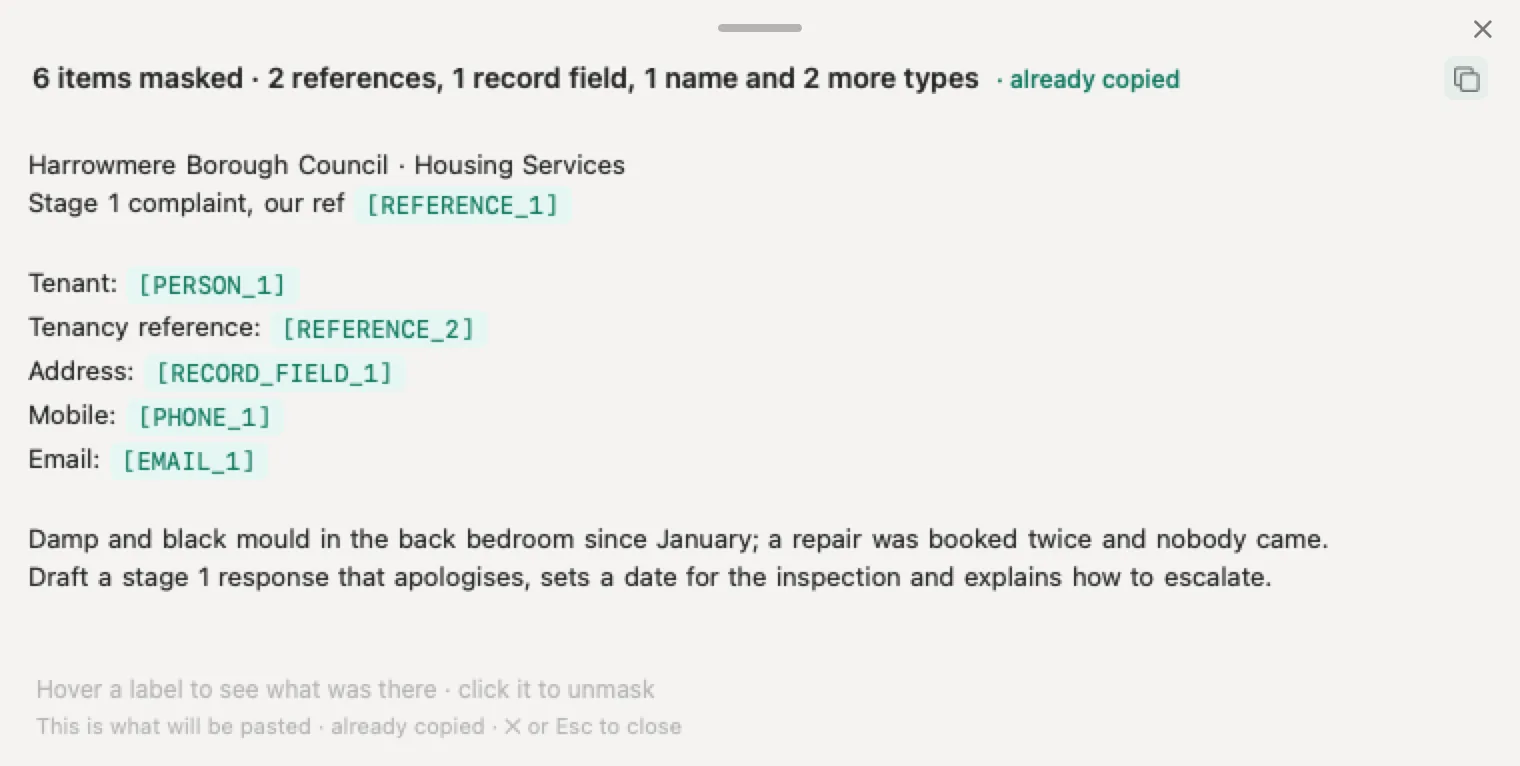
In the invented complaint below, Nonimo has masked six details: the complaint reference, the tenant’s name, the tenancy reference, the address, the mobile and the email. The damp, the dates and the missed repairs stay whole, which is all the AI needs to draft the response.
The AI writes to [PERSON_1]. The officer copies the reply, presses the key again and the tenant’s real name returns on screen, ready to check and send from the housing system.
Before: what gets pasted
Harrowmere Borough Council · Housing Services
Stage 1 complaint, our ref 2026/004512

Tenant: Mr Joe Bloggs
Tenancy reference: 000000
Address: Flat 0, 0 Example Road, Harrowmere
Mobile: 07700 900787
Email: j.bloggs@example.net

Damp and black mould in the back bedroom since January; a repair was booked twice and nobody came.
Draft a stage 1 response that apologises, sets a date for the inspection and explains how to escalate.
After: what the AI receives
Harrowmere Borough Council · Housing Services
Stage 1 complaint, our ref [REFERENCE_1]

Tenant: [PERSON_1]
Tenancy reference: [REFERENCE_2]
Address: [RECORD_FIELD_1]
Mobile: [PHONE_1]
Email: [EMAIL_1]

Damp and black mould in the back bedroom since January; a repair was booked twice and nobody came.
Draft a stage 1 response that apologises, sets a date for the inspection and explains how to escalate.
The council as controller: the pseudonymisation UK GDPR names
The council is the controller for its residents’ data, and Article 25 of UK GDPR asks controllers for technical measures such as pseudonymisation, which is exactly what replacing a resident’s identifiers with placeholders does.
For the data protection officer, that is a measure explained in one sentence: what identifies the resident becomes a placeholder before it leaves the officer’s computer. There is no server in the middle to assess, because nothing is uploaded to be cleaned, and our security page lists what stays on the machine.
What pseudonymised data still is in law, and why it still counts as personal data for the council, is worked through in our guide to pseudonymisation under UK GDPR.
The council’s name, readable on purpose
Nonimo masks who the case is about, not who is writing: the council, the directorate and the service stay readable, because they are the context the AI needs to answer well.
What leaves no doubt, such as an email address or a mobile number, is replaced straight away. What Nonimo recognises from its label, like the tenant or the tenancy reference, is replaced too, and everything shows on screen before you paste.
It helps to write down what each officer may paste and into which chat, and our model AI policy gives the council a starting point.
Nonimo for councils: price and where to start
ChatGPT for councils with Nonimo needs a PC with Windows 10 or 11, or a Mac with macOS 14 or later.
Nonimo’s free plan stops at a set number of words each month. Leave an email address on our licence page and a free licence file comes back that removes the cap until 31 January 2027, with no account to set up. The first desk is usually housing, council tax or the complaints team, the ones that write to residents all day.
To cover every desk without anyone pressing a key, IT deploys the browser extension by policy, and a dashboard receives counts by category only. Our page for organisations explains how, and what OpenAI keeps of what it does receive is in our ChatGPT guide.
- Free plan, on Mac and Windows
- With a monthly word allowance
- The free licence lifts it until 31 January 2027, no account needed
Questions councils ask
Can council staff use ChatGPT with residents' personal data?
That is the council's decision as controller, and the sensible version keeps what identifies the resident out of the chat. Nonimo replaces the name, address, tenancy reference, council tax account number and contact details with placeholders on the officer's own computer, and the AI still drafts the response.
Is the text sent anywhere to be cleaned?
No. The masking happens on each officer's Mac or Windows PC, with no gateway or cloud service in between. The only text that leaves the computer is the placeholder version the officer pastes into the chat, and it keeps working with the Wi-Fi turned off.
Does Nonimo see what our officers write?
Not a word. The masking happens on each officer's own computer, and your officers do not open an account with us.
What happens to the council's name and the service?
They stay readable, on purpose. The council, the directorate and the service are the context the AI needs to write a good reply, not details about a resident. What Nonimo masks is who the case is about: their name, address, phone, email and the references that lead back to them.
Can the reply go out with the resident's real name?
Yes. The AI writes to [PERSON_1], the officer copies its reply, presses the key again and the real name and details come back in place on screen, ready to check and send from the council's own system.
Where does a council start?
With the desk that writes to residents most, usually housing, council tax or the complaints team. Install the app, press the key on a made-up case like the one on this page and see what is masked. To cover every desk, IT deploys the browser extension by policy.