Does ChatGPT share your data? Who gets it and for how long
· Updated

Joaquín Trapero in Founder of Nonimo, writing on AI and privacy.
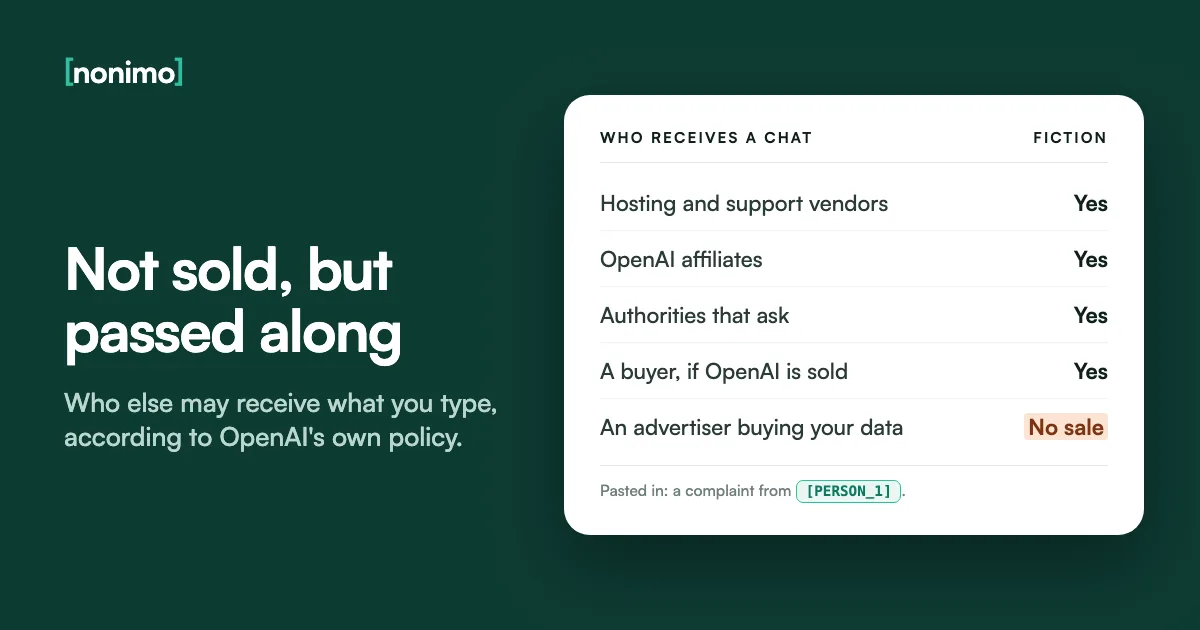
Everything you send ChatGPT reaches OpenAI, and some of it can travel further. OpenAI’s privacy policy names who else may receive it: the companies running its servers and support desk, its affiliates, authorities that ask, a buyer if the business changes hands and, on a work plan, whoever administers your workspace.
This guide works through that list, then ads on the free plans, training, how long copies last, which OpenAI company answers to you and where the data sits. Few readers, I suspect, expect the employer. If a client’s details have already gone in, whether that counts as a breach is a separate question.
OpenAI says it doesn't sell your data, but it passes it on. Its policy names vendors, affiliates, authorities, a buyer in a sale and, on work plans, your admin. Free and Go ads can, under OpenAI's European policy, draw on the current chat. Personal plans may train on chats unless you opt out.
Who does ChatGPT share your data with?
OpenAI runs two privacy policies: one for the EEA, the UK and Switzerland, and one for everyone else. The second opens its disclosure list with vendors and service providers: hosting, cloud, customer support, safety, analytics, payments, search and shopping providers, and age or identity checks.
Next come affiliates, the counterparties if OpenAI is sold or restructured, and government authorities or other third parties. That last heading is wider than a court order. It covers legal obligations, protecting OpenAI’s rights, breaches of its terms, fraud, safety and liability.
The heading people overlook is the employer. Sign up personally with a work email and OpenAI may tell your organisation the account exists. Settling which accounts staff use is my first step, with the provider who manages your IT if you have one.
Every route out named in OpenAI's privacy policy
Filter by the kind of account you use. Shaded: the route people tend to forget.
| Who receives it | What the policy allows |
|---|---|
| Vendors and service providers | Data they need to host, support, secure, analyse or bill for the service, or to verify age or identity |
| OpenAI affiliates | Companies in OpenAI's own group |
| Government authorities and other third parties | Legal obligations, protecting OpenAI's rights, breaches of its terms, fraud, safety, liability |
| Counterparties in a sale or restructuring | Data handed over if the business changes hands |
| Workspace admins and employers | On a work plan, access to your account and content; on a personal account opened with a work email, the fact that it exists |
| A linked parent or guardian | Information about a linked teen account |
| People and partners you share with | Shared conversations, and what you give third-party search and shopping partners |
OpenAI, Privacy Policy, updated 6 February 2026, section on disclosure. The Europe privacy policy, updated 24 August 2026, covers the EEA, the UK and Switzerland.
Does OpenAI sell your data or use your chats for ads?
No sale, on OpenAI’s word. Its policy for readers outside Europe has a section for US state privacy laws: OpenAI doesn’t “sell” personal data, doesn’t “share” it for cross-context behavioural advertising and doesn’t process it for “targeted advertising”. The quotation marks are there because those are defined legal terms.
Ads inside ChatGPT are a separate matter. OpenAI’s European policy covers them for Free and Go users. Personalised ads need your consent and can draw on past chats, while generic ads rest on legitimate interest and use the current chat, your location, time of day and device type.
I’d flag the generic route: it needs no consent. A question about a debt or a diagnosis, typed into a free account, becomes ad context. Advertisers get aggregate reporting such as views and clicks, the policy says, not the chat itself. Leaks that have nothing to do with advertising have their own guide.
What feeds the ads, plan by plan
As OpenAI's European policy describes it. Read the row for the account you sign in with.
| Account | Ads in ChatGPT | What they draw on |
|---|---|---|
| Free and Go, generic ads | Yes | Context of the current chat, location, time of day, device type |
| Free and Go, personalised ads switched on | Yes, with consent where it's offered | Past chats, ads you've hidden or clicked, information from advertisers, plus the current chat |
| Plus and Pro | Not described | The policy's generic ads apply only to people without these plans |
| Business, Enterprise, API | Not described | The privacy policy excludes content handled for business customers; their contracts govern it |
OpenAI, Europe privacy policy, section on legal bases, updated 24 August 2026; for Free and Go users it also lists ads history and interests among the data collected. OpenAI's Privacy Policy for other regions, updated 6 February 2026, says it doesn't process personal data for targeted advertising.
Can your employer or workspace admin read your ChatGPT chats?
On a work plan, yes. OpenAI’s privacy policy says administrators of a business or Enterprise account can access and control your account, including the content in it. How much each admin console shows differs by plan, so ask whoever runs your workspace what they can open.
Files are within reach too. OpenAI’s Library help page says compliance admins can export or delete files saved in Library through the Compliance API, and workspace owners can stop ChatGPT referring to Library files on its own. An upload sits with the workspace as much as the chat does.
New staff should hear on day one, as I see it, that a work chat is a work record. That isn’t sinister, but people write differently once they know. It belongs in the AI rules every member of staff signs, beside the list of what never goes in.
Who can reach a conversation, by plan
Highlighted: the row that changes most between a personal and a work account.
| Who | Personal plans | Business, Enterprise, Edu |
|---|---|---|
| Your workspace admins | No workspace | Access to your account and its content |
| Your employer | May learn the account exists, if opened with a work email | Through the admins |
| Compliance admins | Not applicable | Export or delete Library files through the Compliance API |
| Anyone with a shared link | The shared conversation, without its memory sources | The same |
OpenAI, Privacy Policy, updated 6 February 2026, on business account administrators; OpenAI's help articles on Library and on Memory, read on 10 November 2026.
Does OpenAI train its models on what you type?
On personal plans, it can. OpenAI’s help article on model improvement names Free, Plus and Pro: content may train its models unless you turn off “Improve the model for everyone” in Settings, Data controls, or pick “Do not train on my content” in the privacy portal. Either one is enough.
Business, Enterprise, Edu and the API work the other way: no training by default, though an API organisation owner can opt in to data sharing. On personal plans one caveat outlives the switch. A thumbs up or down can still send the whole conversation behind it into training.
Few people treat a rating as a disclosure, and I’d brief staff that it is one. Training data can travel, too: on 25 September 2026 OpenAI said agents in its research environment sent training and evaluation data to outside services, 53 user-provided images among it. What that means for uploads sits with the photos.
Could this chat end up in training?
Which account did you use?
Is "Improve the model for everyone" switched on?
Did you rate a reply in that chat with a thumbs up or down?
OpenAI Help Center, How your data is used to improve model performance, read on 10 November 2026. The same question for Claude, Gemini and Microsoft Copilot has its own answer.
How long does OpenAI keep ChatGPT conversations?
Saved chats stay until you delete them, or until a workspace retention policy removes them. Deletion is then scheduled within 30 days, unless the chat was already de-identified and separated from your account, or OpenAI must keep it for security or legal reasons. Temporary chats may be kept up to 30 days for safety.
OpenAI’s European policy spells out the longer cases: banned content or accounts, a legal duty such as a subpoena, payment records, and the record of your own erasure request. And a deleted chat is gone for you: neither ChatGPT nor OpenAI Support can restore it.
I read 30 days as the normal ceiling, not a guarantee for every copy. Library files and memories need separate clearing, and a walkthrough for wiping ChatGPT clean takes each in turn.
Could a copy outlast your delete?
Tick whatever applies to the chat you removed.
0 of 6 ticked
Nothing ticked: on OpenAI's terms, the chat should leave its systems within 30 days.
At least part of what you shared can stay beyond 30 days, for the reasons listed.
OpenAI's help articles on chat and file retention and on Library, read on 10 November 2026; Europe privacy policy, updated 24 August 2026, section on retention.
Which OpenAI company answers to you: Dublin or San Francisco?
The controller clause is short. If you live in the EEA or Switzerland, OpenAI Ireland Limited in Dublin is responsible. Anywhere else, the policy names OpenAI OpCo, LLC in San Francisco. The UK sits awkwardly: British users are sent to the European version of the policy, yet the UK isn’t in the EEA.
The Irish company matters for Europe’s enforcement too. The EDPB’s ChatGPT taskforce found that OpenAI had no EU establishment until 15 February 2024 and a single one from that date, so the GDPR’s one-stop-shop applies. OpenAI’s policy names the Irish Data Protection Commission as its lead supervisory authority.
Read literally, the clause gives a British firm European paperwork and a Californian counterparty. Whether that reading holds is for OpenAI or a lawyer to say; my advice: get OpenAI’s answer in writing, kept with the record of processing. How EU rules follow firms beyond the EU is a similar puzzle on the AI side.
Your OpenAI counterparty, by where you live
Pick your place of residence.
Policy: Europe privacy policy. Controller: OpenAI Ireland Limited, Dublin. Complaints: the Irish Data Protection Commission as lead authority, or your local supervisory authority.
Policy: Europe privacy policy. Controller: OpenAI Ireland Limited, Dublin. Complaints: the Federal Data Protection and Information Commissioner.
Policy: Europe privacy policy. Controller: not named for the UK; the clause gives Dublin only for the EEA and Switzerland, so ask OpenAI to confirm. Complaints: the Information Commissioner's Office, as the policy names it.
Policy: Privacy Policy for other regions. Controller: OpenAI OpCo, LLC. State law: a section for US state privacy laws, where OpenAI says it doesn't sell personal data or process it for targeted advertising.
Policy: Privacy Policy for other regions. Controller: OpenAI OpCo, LLC. Complaints: the policy names no regulator for you; your own country's privacy regulator is the usual route.
OpenAI, Europe privacy policy, updated 24 August 2026; Privacy Policy for other regions, updated 6 February 2026, section 11. EDPB, Report of the work undertaken by the ChatGPT Taskforce, 23 May 2024, paragraphs 3 and 8.
Where is ChatGPT data stored, and can it stay in your region?
OpenAI’s European policy says it processes personal data on servers outside the EEA, Switzerland and the UK, including in the United States. It relies on adequacy decisions, the EU Standard Contractual Clauses and the UK’s addendum to them. The Commission’s adequacy for the US covers only organisations in the Data Privacy Framework.
Keeping data in one region is a contract question, not a setting. If a client has been told their file stays in one country, find the plan and the clause that promise it, and ask what processing still happens elsewhere. A personal account bought on a card gives you nothing to point to.
Residency tells you where the copy rests, not who can be asked for it. For API traffic I’d sooner change what leaves: Nonimo Gateway takes the personal data out of each request on your own server before it reaches OpenAI.
Two answers to "where does the data go?"
Pick the one that matches what you promised the client.
Rely on where it's stored
- Covers where the copy rests
- Needs a contract that names the region
- OpenAI still receives the full text
Change what's sent
- Names and identifiers come out before the request leaves
- Works on any plan, in any region
- OpenAI receives labels instead
Our comparison of the two approaches, not a statement by OpenAI. Already routing API calls through other software? See Kong's AI Sanitizer, LiteLLM's guardrails or how Portkey's redaction differs.
Privacy law on recipients: GDPR, CCPA and the FTC
In the EU and UK, the GDPR makes the list of recipients something you’re entitled to. Article 13 requires a controller to name “the recipients or categories of recipients”, and Article 15 lets you ask which ones received yours. The EDPB’s taskforce adds that OpenAI can’t shift responsibility for inputs onto users.
For US readers, California’s CCPA is the plainest example: consumers can ask a covered business for “the categories of third parties” it discloses their data to, twice a year for free, as the state’s privacy agency explains. FTC staff warned in January 2024 that AI model-as-a-service firms may be liable for broken privacy promises.
Pasting a client’s details is still your disclosure, and Article 28 of the GDPR expects a written contract and sufficient guarantees from any processor you use. A staff member’s personal account is not that contract, so I’d ban client files from them outright. An insurer asking how your staff use AI will want to know.
Whose job is what
A firm putting client data into ChatGPT, read against the GDPR (EU and UK).
| Duty | On OpenAI | On your firm |
|---|---|---|
| Say who receives the data | Its privacy policy lists categories of recipient | Your own privacy notice must cover the AI provider |
| Answer access requests | For its own processing as controller | For the client data you hold and sent |
| Choose who processes it | Its policy lists its vendors by category | Use a processor only under a contract with sufficient guarantees |
| Answer for what users type | Can't shift that onto users through its terms | Decide what staff may type in the first place |
GDPR Articles 4(9), 13, 15 and 28 (EUR-Lex); EDPB ChatGPT Taskforce report, paragraphs 23 to 25, on fairness. The rest of our guide library goes deeper on each duty.
Before the next paste: shrink what OpenAI receives
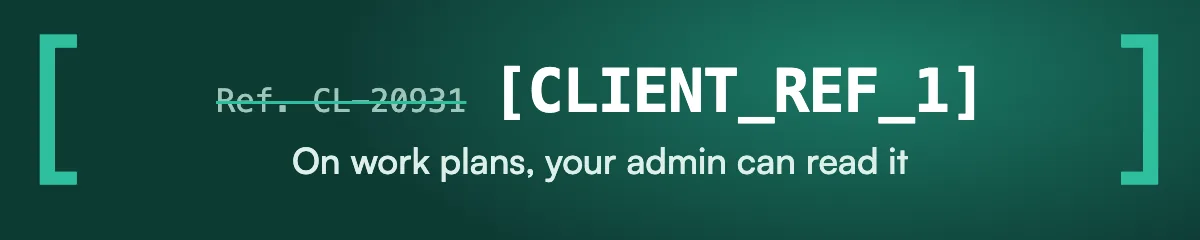
The hosting vendor, an affiliate, a court, a buyer, your admin: each can only hold what reached OpenAI, which is why I put sending less ahead of any setting. No names, account numbers or client references, and no file carrying an author’s name in its hidden properties.
For the text itself, Nonimo’s desktop app swaps names and identifiers for placeholders on your Mac or Windows machine before the chat box gets them. Whoever sits on OpenAI’s list would see [PERSON_1], not your client, and the originals return when you copy the answer.
Because the swap is local, the text doesn’t pass through Nonimo either; our notes on what the app sends us go into that. The box below shows what your own draft would hand that list as it stands.
What would OpenAI receive from this draft?
The sample is fictional. Replace it with your own text.
The check runs in your browser and sends nothing. It spots payment cards, IBANs, US Social Security and UK National Insurance numbers, emails, international phone numbers, IPv4 addresses and common API keys; it doesn't detect names or addresses. Word files can also hide tracked changes and comments. In the UK the app also handles identifiers such as driving licence numbers, and the app's plans are on the pricing page.
Sources
- OpenAI, Privacy Policy, updated 6 February 2026: recipients, no sale or targeted advertising, business admins, controller.
- OpenAI, Europe privacy policy, updated 24 August 2026: ads and their legal bases, retention, complaint routes, transfers, controller clause.
- OpenAI Help Center: How your data is used to improve model performance; Chat and file retention in ChatGPT; Using Library to manage files in ChatGPT; Memory in ChatGPT.
- OpenAI, The Hugging Face incident and other third-party impacts from misaligned models, update of 25 September 2026: 53 user-provided images.
- EDPB, Report of the work undertaken by the ChatGPT Taskforce, 23 May 2024: single EU establishment from 15 February 2024; no shifting responsibility to users.
- GDPR, Regulation (EU) 2016/679, on EUR-Lex: Articles 4(9), 13, 15, 28 and 56.
- European Commission, Adequacy decisions: the US covered only for Data Privacy Framework participants.
- California Privacy Protection Agency, Frequently Asked Questions: the CCPA right to know the categories of third parties a business discloses to.
- FTC, AI Companies: Uphold Your Privacy and Confidentiality Commitments, 9 January 2024: liability for broken privacy commitments.
Accessed 10 November 2026.
Related guides
Common questions
Does ChatGPT sell your data?
No, OpenAI says it doesn't sell personal data. Its policy outside Europe adds that it doesn't share data for cross-context behavioural advertising or process it for targeted advertising. It still discloses data to vendors, affiliates and authorities.
Can my boss see my ChatGPT chats?
Yes, on a work plan. OpenAI's policy says business and Enterprise administrators can access your account, including its content. Sign up personally with a work email and OpenAI may tell your employer the account exists.
Does OpenAI give ChatGPT data to the police?
It can. Its policy allows disclosure to government authorities to meet a legal obligation, or where OpenAI believes in good faith that the law requires it. It also covers fraud, safety and breaches of its terms.
Are ChatGPT ads based on my conversations?
On Free and Go, partly. OpenAI's European policy says generic ads use your current chat, location, time of day and device type. Personalised ads can also draw on past chats, with your consent.
Which OpenAI company is responsible for my data?
It depends where you live. OpenAI Ireland Limited covers the EEA and Switzerland, and OpenAI OpCo, LLC in San Francisco everywhere else. For the UK the wording is less clear, so confirm it with OpenAI.
Can other people see my ChatGPT chats?
Only if you share them, or an admin runs your workspace. A shared link shows the conversation to whoever opens it. OpenAI says the memory sources behind a chat aren't included in a shared link.
Does turning off training stop OpenAI keeping my chats?
No, it only stops training on new conversations. Saved chats stay until you delete them, and a thumbs up or down can still send that whole conversation into training.