Does the EU AI Act apply to you if you are outside the EU?
· Updated

Joaquín Trapero in Founder of Nonimo, writing on AI and privacy.
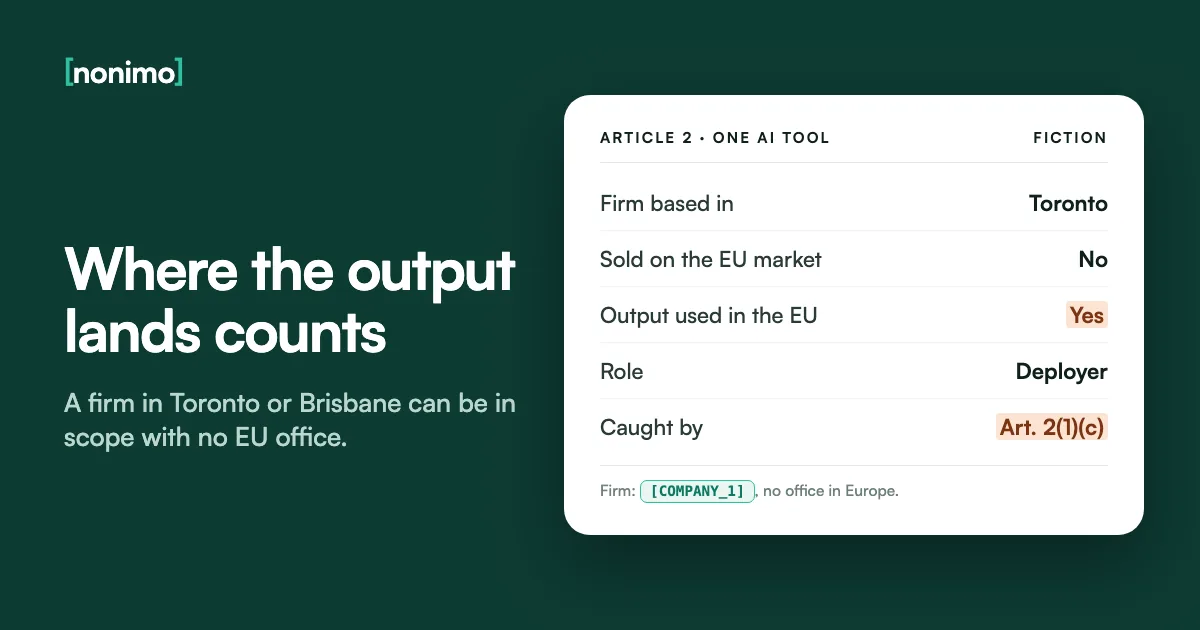
Yes, quite often, even if your company has never had an office, a bank account or a signed contract in Europe. The EU AI Act decides who it covers by looking at the AI system and where its output ends up, so a firm in Toronto, Austin or Brisbane can sit inside it.
I think the alarm is out of proportion for most readers abroad: coverage usually means a short list of duties, not a compliance programme. The duty likelier to hurt a small firm sits in privacy law, which is why whether a pasted client record counts as a breach has a guide of its own.
Yes, when you supply an AI system to the EU market or what it produces is used inside the Union. Article 2(1)(a) and (c) of Regulation (EU) 2024/1689 reach providers and deployers anywhere. A firm whose AI output never reaches the Union is outside it, though its home privacy law still applies.
Does the EU AI Act apply to non-EU companies? Article 2’s three routes
Article 2(1) lists seven groups the Regulation applies to, and three settle the question for a business abroad. Point (a) covers any provider that puts an AI system or a general-purpose model on sale in the Union, whatever country it calls home. Point (b) covers deployers established or located in the Union.
Point (c) is the long arm. It reaches providers and deployers in a third country whenever the output produced by the AI system is used in the Union. Recital 22 gives the reason: without it, an EU company could hand a high-risk task to a contractor abroad and import only the result.
That recital speaks of output “intended” for use in the Union, but the Regulation never says where incidental use ends. Nobody can safely plan on that line, as I read it. Ask the question separately for each tool and each client, and note the answer beside that tool in your staff AI rules.
Seven businesses outside the EU, one test
Filter by result, then find the row closest to your own work.
| Business and what it does | Result | Why |
|---|---|---|
| Corriemoor Labs, Toronto, sells a CV-ranking service to employers in Lyon | Caught, as provider | 2(1)(a): placed on the EU market. Recruitment is an Annex III high-risk use |
| Pashley Ridge Consulting, Austin, delivers AI-drafted market reports to a client in Milan who acts on them | Likely caught, as deployer | 2(1)(c): the client in Milan relies on what the system produced |
| Tarnbrook Translations, Singapore, translates a supplier contract with an AI tool for a buyer in Hamburg | Arguably caught, as deployer | 2(1)(c), if a translator-checked text still counts as the system's output. Untested; duties would be light, since translation is not high risk |
| Sable Point Models, San Francisco, offers a general-purpose model that EU developers can call | Caught, as provider | 2(1)(a): a general-purpose model placed on the EU market |
| Halvergate Lettings, Auckland, screens tenants, some of them EU citizens, for flats in Auckland | Not caught | The output is used in New Zealand. Citizenship of the tenant is irrelevant |
| Wenlow Dental, Brisbane, runs a booking chatbot for its own patients in Queensland | Not caught | Nothing placed on the EU market and no output used there |
| A Vancouver accountant uses a chatbot to plan a family holiday in Portugal | Not caught | 2(10): purely personal, non-professional use |
All businesses are invented, and the results are our reading, not a ruling. Article 2(1)(a) to (c), Article 2(10) and recital 22 of Regulation (EU) 2024/1689; Regulation (EU) 2026/1744 left Article 2(1) as it was. If you are in Britain, our UK guide adds what applies at home.
Deployer vs provider: the Article 3 definitions behind the quiz question
A quiz statement doing the rounds says a deployer is any person or organisation that develops or commissions an AI system and places it on the market under its own name or trademark. True or false? False. That sentence paraphrases Article 3(3), which defines the provider.
Article 3(4) is shorter. A deployer is any person, company or public body using an AI system under its authority, unless the use is personal and non-professional. The Commission’s own illustration: whoever develops a CV-screening tool is its provider, and a bank using that tool is its deployer.
Roles can change hands. Under Article 25(1), a deployer that brands a high-risk system, substantially modifies one, or turns another system to a high-risk use inherits the provider’s duties. A thin app sold under your brand on someone else’s model worries me more: every request that app sends is now part of your product.
True or false? Four quiz statements on AI Act roles
Pick a statement to see the answer and the article behind it.
"A deployer develops or commissions an AI system and places it on the market under its own name." False. That is the provider, Article 3(3). A deployer uses a system under its own authority, Article 3(4), whoever built it.
"A company whose staff use a chatbot for client work is a deployer." True. Professional use under the company's authority is enough. Nobody has to buy the licence in their own name for the role to attach.
"You are only a provider if you charge for the system." False. Article 3(3) says "whether for payment or free of charge". A free tool placed on the market still has a provider.
"Wrapping a model's API in your own app and selling it under your brand keeps you a deployer." False. You are the provider of that AI system. If personal data flows through it, a redaction proxy in front of the model's API is one control.
Articles 3(3), 3(4) and 25(1) of Regulation (EU) 2024/1689, unchanged by Regulation (EU) 2026/1744. The CV-screening and bank example is the European Commission's, from its Navigating the AI Act questions and answers.
Who has to appoint an EU authorised representative?
Only some providers do, and the AI Act asks it of no deployer. Article 22 tells a provider established outside the Union to appoint one, by written mandate, before making a high-risk AI system available on the EU market. Article 54 sets the same rule for providers of general-purpose AI models.
Article 3(5) requires the representative to be located or established in the Union. It keeps the documentation for ten years, answers authorities’ reasoned requests and can be addressed instead of the provider. Should it conclude the provider is in breach, Articles 22(4) and 54(5) oblige it to walk away and report its reasons.
Article 54(6) spares open-source model providers who publish weights, architecture and usage information, unless the model carries systemic risk. I distrust any representative that promises to ask no questions; the Regulation expects it to read your file. IT providers who set these tools up for clients have a programme of their own with us.
Who must appoint an EU representative
Find the row that describes you. Deployers never need one.
| You are, outside the EU | Article | Representative needed? | From |
|---|---|---|---|
| Provider of an Annex III high-risk system (hiring, credit, education) | 22 | Yes, before it is made available in the EU | 2 December 2027 |
| Provider of high-risk AI inside a regulated product (Annex I) | 22 | Yes | 2 August 2028 |
| Provider of a general-purpose AI model | 54 | Yes, unless open source under 54(6) without systemic risk | Since 2 August 2025; 2 August 2027 for models already on the market before then |
| Provider of another AI system, such as a customer chatbot | None | No | Articles 4, 5 and 50 still apply |
| Deployer whose output is used in the EU | None | No | Articles 4, 5 and 50 still apply |
Articles 3(5), 22, 54, 111(3) and 113 of Regulation (EU) 2024/1689, with the dates as amended by Article 1(40) of Regulation (EU) 2026/1744. The GDPR has a separate representative rule in its Article 27.
What a business outside Europe owes today: literacy, bans and labels
If Article 2 catches you, Articles 4, 5 and 50 bind you now. Of the Article 5 bans, the one an office could meet is software reading the emotions of staff or students, allowed only for medical or safety reasons. Article 50, on AI notices and labels, has applied since 2 August 2026.
Article 4 reaches every provider and deployer. Regulation (EU) 2026/1744 replaced it in July 2026: providers and deployers must take measures that help their staff, and others running AI for them, build AI literacy. The new text adds that no one has to guarantee a particular level in any individual.
That rewrite reads to me as relief, not repeal. The duty survives, with proportion written in, and the Commission must publish practical examples. A deployer labels deepfakes and AI text published to inform the public; the text duty lapses once someone with editorial responsibility has reviewed it.
Live duties for a deployer outside the EU
Tick each line that is already true for the tools whose output reaches the Union.
0 of 6
Gaps remain. Article 4 and the Article 5 check cost the least to close.
One line open. Close it before an EU client asks.
The duties already in force are covered. Revisit when a new tool arrives.
Articles 4 (as replaced by Article 1(5) of Regulation (EU) 2026/1744), 5(1)(f) and 50(3) and (4) of Regulation (EU) 2024/1689. The session content can come from our editable AI policy.
EU AI Act timeline after Regulation (EU) 2026/1744
The AI Act entered into force on 1 August 2024 and applies in stages under Article 113. The Digital Omnibus on AI, Regulation (EU) 2026/1744 of 8 July 2026, appeared in the Official Journal on 24 July and took effect three days later, on 27 July 2026.
It moved the high-risk dates and added two bans from 2 December 2026: AI that generates non-consensual intimate imagery of an identifiable person, and AI that generates child sexual abuse material. It left Article 2(1), the general-purpose model rules and the August 2026 start of Article 50 where they were.
For a firm abroad, 2 December 2027 is the date I’d plan around, because that is when the Annex III rules for hiring, credit and education begin. Anyone still selling an August 2026 high-risk deadline is quoting the 2024 text, and I’d treat the rest of their pitch with the same caution.
The AI Act calendar as amended
2 December 2027 is shaded: the high-risk start for hiring and credit tools.
| Date | What starts | Set by |
|---|---|---|
| 2 February 2025 | Definitions, AI literacy, prohibited practices | Art. 113(a) |
| 2 August 2025 | General-purpose model rules, penalties, national authorities | Art. 113(b) |
| 2 August 2026 | General application, Article 50 transparency, enforcement | Art. 113 |
| 2 December 2026 | Bans in Art. 5(1)(ba) and (bb); Art. 50(2) marking for generators already on the market before 2 August 2026 | 2026/1744, Art. 1(40)(a); Art. 111(4) added by Art. 1(39)(b) |
| 2 August 2027 | General-purpose models placed on the market before 2 August 2025 must comply | Art. 111(3) |
| 2 December 2027 | High-risk rules for Annex III systems | 2026/1744, Art. 1(40)(b)(i) |
| 2 August 2028 | High-risk rules for Annex I products | 2026/1744, Art. 1(40)(b)(ii) |
| 2 August 2030 | Existing high-risk systems meant for public authorities (one example: our guide for Irish councils) | Art. 111(2), replaced by 2026/1744, Art. 1(39)(a) |
Article 113 and Article 111 of Regulation (EU) 2024/1689 as amended by Regulation (EU) 2026/1744, both on EUR-Lex. The Commission's own implementation timeline gives the same dates up to 2 August 2028.
Can the EU fine a firm based abroad? Article 99 in numbers
In law, yes. Article 99 sets ceilings for any operator in scope, wherever it sits, and Member States’ national authorities enforce them. The ceiling for a banned practice is EUR 35 million or 7% of total worldwide annual turnover; for most other duties, Articles 26 and 50 included, EUR 15 million or 3%.
A large company is exposed to whichever figure is greater. For SMEs, start-ups included, Article 99(6) flips that to whichever is lower, though whether a firm abroad fits the EU’s SME definition is still an open question. Paragraph 6a, from the omnibus, gives small mid-caps the lower figure in the two lower bands only.
Collecting from a firm with no EU assets is a separate problem, but I see that gap as luck, not protection. The likelier pressure arrives through EU clients writing these articles into contracts, and through the questions underwriters now put about staff and AI.
Your fine ceilings under Article 99
Enter last year's worldwide turnover in millions of euros and pick your size.
Small mid-caps get the lower figure in the two bottom bands only; a banned practice still uses the higher one.
The inputs are an example, not a real firm, and the results are not legal advice. Ceilings from Article 99(3) to (6) of Regulation (EU) 2024/1689 and paragraph 6a added by Article 1(38) of Regulation (EU) 2026/1744. These are maximums: Article 99(7) lists what an authority weighs when setting the amount.
GDPR and the AI Act abroad: two reach tests that don’t line up
The GDPR has a long arm too, and it works differently. In the EDPB’s reading of Article 3, it reaches a firm outside the Union that offers goods or services to people in the EU or monitors their behaviour there. The AI Act asks a different question: where is the output used?
So the two can split. A Toronto firm sending AI market reports to a Paris company, with no personal data on anyone in Europe, can sit inside the AI Act and outside the GDPR. Article 2(7), as amended, still keeps the GDPR intact, bar narrow exceptions such as the new Article 4a on bias testing.
Home law keeps running too. The FTC said in 2024 there is “no AI exemption from the laws on the books”; Canada’s privacy commissioners and Australia’s OAIC say much the same about privacy law. Running a small firm abroad, I’d fix what goes into each prompt before reading any AI Act article.
Same firm, two extraterritorial tests
Each row compares one point of the two regimes.
| EU AI Act | EU GDPR | |
|---|---|---|
| What pulls you in from abroad | An AI system placed on the EU market, or its output used in the Union | Offering goods or services to people in the Union, or monitoring their behaviour there |
| What the test is applied to | Each AI system and your role in it | Each processing activity, not the company as a whole |
| EU representative | Providers of high-risk systems and general-purpose models | Controllers and processors caught by Article 3(2), unless processing is occasional and low risk |
| Labels in place of names | No bearing on scope | Data you can re-identify stays personal for you: see where de-identified ends and anonymous begins |
Articles 2 and 2(7) of Regulation (EU) 2024/1689 as amended; EDPB Guidelines 3/2018 on the territorial scope of the GDPR, version 2.1. Each country's own privacy law sits alongside both; for Britain, we cover AI tools under UK GDPR.
A written rule rarely stops the late-evening paste on deadline day. That needs a control acting at the moment text leaves the screen.
Before choosing one, it helps to know the less obvious ways client data reaches a model.

Before December 2027: three moves for a firm outside Europe
Outside the EU, I’d keep the whole job to three moves that fit on a card. Test every AI tool against Article 2 and write your role beside it, then file the literacy evidence. If anything you use touches hiring, credit or another Annex III area, ask the vendor now who carries the provider’s duties.
The AI Act won’t stop a client’s file reaching a chatbot. Nonimo replaces client names, identifiers and case numbers with labels before the text goes to the AI tool, and the mapping that restores them stays with you.
Teams putting that in place across several departments can start from Nonimo for organisations.
Three moves, in order
Each step builds on the one before it.
This month
List every AI tool whose output reaches an EU client or EU residentsMark provider or deployer beside each oneThis quarter
Run and date one AI literacy sessionCheck no tool reads staff emotionsBefore 2 December 2027
For Annex III tools, write the vendor's instructions and your access to logs into the contractIf you are a provider, sign an EU representative's mandateDrawn from Articles 2, 3, 4, 5, 22 and 26 of Regulation (EU) 2024/1689 and the dates in Regulation (EU) 2026/1744. How Nonimo handles the text you give it is on our security page.
This page explains the Regulation in general terms; a lawyer who knows your contracts should confirm your own role. Other questions about AI and client data are answered across our guide library.
Sources
- Regulation (EU) 2024/1689, the AI Act (EUR-Lex): Articles 2, 3(3) to (5), 4, 5, 22, 25(1), 50, 54, 99, 111 and 113; recital 22 on output used in the Union.
- Regulation (EU) 2026/1744, Digital Omnibus on AI (EUR-Lex): Article 1(2)(b), (5), (7), (38), (39) and (40); in force on the third day after publication on 24 July 2026.
- European Commission, AI Act Service Desk implementation timeline: the dates up to 2 August 2028.
- European Commission, Navigating the AI Act: the CV-screening provider and bank deployer example; omnibus in force on 27 July 2026.
- EDPB, Guidelines 3/2018 on the territorial scope of the GDPR, version 2.1: establishment and targeting criteria, assessed per processing activity; the Article 27 representative.
- FTC, Operation AI Comply, 25 September 2024: no AI exemption from existing law.
- Office of the Privacy Commissioner of Canada, principles for generative AI: generative AI works within existing privacy law.
- OAIC, guidance on privacy and commercially available AI products: privacy obligations apply to personal information put into AI systems.
Accessed 10 November 2026.
Common questions
Is a deployer someone who develops an AI system and sells it under their own name?
No, that describes a provider under Article 3(3). A deployer, under Article 3(4), is anyone using an AI system under its authority for professional purposes, such as a company whose staff use a bought chatbot.
Does the EU AI Act apply to US companies?
It can, wherever the company is incorporated. Article 2 catches a US provider selling AI in the EU, and a US firm whose AI output is used there. Work serving only clients and people outside the Union is not caught.
Is the EU AI Act extraterritorial?
Yes, on purpose. Article 2(1)(c) reaches providers and deployers in third countries whose AI output is used in the Union. Recital 22 explains why: otherwise high-risk work could be outsourced abroad to escape the rules.
Does a non-EU deployer need an EU authorised representative?
No, only certain providers do. Article 22 covers providers of high-risk AI systems established outside the Union, and Article 54 covers providers of general-purpose AI models.
When does the EU AI Act fully apply?
Its last main start date is 2 August 2028. That is for high-risk AI built into regulated products. Most rules have applied since 2 August 2026, and Annex III high-risk rules begin on 2 December 2027.
Did the Digital Omnibus remove the AI literacy duty?
No, it rewrote it. Since July 2026, Article 4 asks providers and deployers to take measures supporting AI literacy, and adds that nobody must guarantee a specific level in any individual.
Can a small company outside the EU get the maximum AI Act fine?
Probably not, if it meets the EU definition of an SME. Article 99(6) then caps every fine at the lower of the two figures. Whether a firm abroad qualifies is a question for a lawyer.