ChatGPT in a solicitor’s office: what the affidavit carries
Nobody in the firm pastes a whole file into ChatGPT. It’s the one paragraph that won’t come right: the facts in a grounding affidavit, a section of the pleadings, a letter to the other side that has to be firm without starting a row, or an attendance note that needs turning into advice the client will read.
That paragraph rarely travels light. Near the top sit the client’s PPS number and date of birth, further down the Eircode of the property, and at the end the IBAN the money is going to. A fee earner stops seeing those lines by the tenth draft; why a PPS number is more than a number is explained in our guide to the PPSN in Irish law.
This is a common law jurisdiction, so there’s no article of a penal code making it an offence to hand over a client’s confidences. What an Irish solicitor stands to lose is privilege, and for a litigator that’s worse. So can solicitors use ChatGPT on work like this at all? They can, provided the client’s numbers are gone before the paste.
Solicitors using ChatGPT: what reaches it after one key
Nonimo runs on the computer on the desk, not on a server of ours, and the details it covers never leave that machine; our security page lists what does. You select the passage and press one key. ChatGPT, Claude or Copilot, it makes no difference, and when the answer comes back the real details go back in.
It follows one rule. Where a check digit leaves no doubt about what a value is, it’s swapped for a marker without a question. Where a value could be something else, it’s covered in plain view, with its reason and a one-click undo. The PPS number sits on that second side, next to its label.
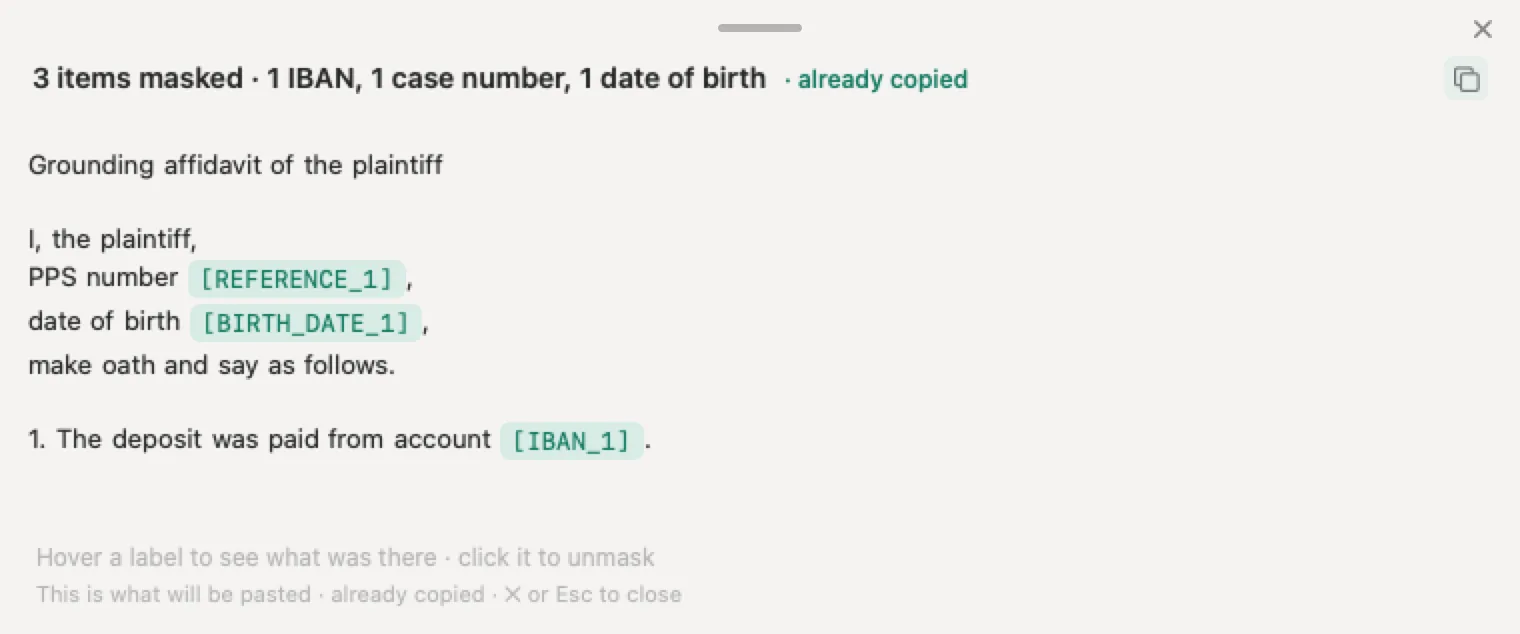
In the invented affidavit alongside, the PPS number and the date of birth are covered because each sits straight after its label, even though X is never a PPS check letter and there’s no 30 February. The account number is covered as well: its check digits settle that it’s an IBAN, so a marker takes its place without a prompt.
Before: what gets pasted
Grounding affidavit of the plaintiff

I, the plaintiff,
PPS number 0000000X,
date of birth 30/02/1981,
make oath and say as follows.

1. The deposit was paid from account IE29 AIBK 9311 5212 3456 78.
After: what the AI receives
Grounding affidavit of the plaintiff

I, the plaintiff,
PPS number [REFERENCE_1],
date of birth [BIRTH_DATE_1],
make oath and say as follows.

1. The deposit was paid from account [IBAN_1].
Can solicitors use ChatGPT under HC 142 and the Law Society guidance?
Since 1 September the High Court’s Practice Direction HC 142, issued by Mr Justice David Barniville on 29 July, has put the risk in writing, in the paragraph quoted here. It also requires affidavits and witness statements to declare that generative AI was not used to generate their substantive content. Covering a client’s numbers doesn’t change that answer. Telling your own client is for the terms and conditions letter.
Your Law Society’s guidance asks solicitors to “refrain from entering any personal, confidential or other data relating to a client” into a GenAI system unless there are appropriate safeguards in place with the provider. It lists four, and the first two are the provider’s own promise: a confidentiality contract with zero data retention, and a data protection agreement. We won’t argue; what ChatGPT keeps by default shows why.
The same page adds that solicitors “should never assume that using an enterprise-grade tool guarantees compliance”. So can solicitors use ChatGPT on a licence the firm pays for? Yes, but that contract doesn’t reach the trainee on a personal account at eleven at night. The fourth safeguard is running AI locally or in an environment the firm controls. Nonimo isn’t the AI; it’s the step before it.
A solicitors’ AI policy for ChatGPT: the step before the paste
The Law Society guidance closes by asking for a risk assessment before a tool is used, and for an office policy that sets out permitted uses, accountability and safeguards. A policy on paper tells people what not to paste. It doesn’t sit beside the fee earner at the moment of pasting.
That’s the gap the firm’s policy can point Nonimo at, and the two cards alongside are the whole of the rule: what can only be one thing is replaced, and what might be something else is covered where the person can see it and decide. The partner or principal signs off on it; in a mid-sized firm, usually the risk or compliance partner.
It takes the client’s numbers out of the paragraph; what privilege attaches to stays with the firm and with counsel. No log is kept of what was covered: the record of how the firm uses AI is the office policy, plus the dashboard’s counts. The EU AI Act duties for Irish firms sit beside the policy.
ChatGPT for solicitors: price, and how the firm starts
The app installs on Windows 10 and 11, and on Macs with Apple Silicon running macOS 14 or later. Nonimo’s free plan stops at a set number of words each month. Leave an email address on our licence page and a free licence file comes back that removes the cap until 31 January 2027, with no account to set up.
For every desk in the firm, IT deploys the browser extension by policy, and a compliance dashboard counts by category, never the text; email hello@nonimo.ai. The Law Society has said it will publish a list of potential providers to the legal profession, and there’s no approved name to point to yet, ours included.
One thing does leave each machine: a daily usage count with the allowance used, the app version and the platform. It can’t be switched off, on Windows or on the Mac, and not one word of what you write travels with it. The security page lists every field in that count, so the firm can check it against the office policy.
- Free today, on Mac and Windows
- With a monthly word allowance
- The free licence lifts it until 31 January 2027, no account needed
Questions solicitors ask us
Can solicitors use ChatGPT in Ireland?
Yes, but not with client data unless appropriate safeguards are in place with the provider. That's the Law Society's guidance, and since 1 September the High Court's HC 142 adds that privileged information entered into non-private GenAI tools or systems may lose its privileged status. Nonimo covers the client's PPS number, date of birth and IBAN on the firm's own computer before anything is pasted.
We have Copilot under the firm's Microsoft licence. Isn't that enough?
For the tool the firm pays for, the Law Society accepts the provider's contract as a safeguard, alongside a data protection agreement. The same guidance warns against assuming that “an enterprise-grade tool guarantees compliance”, and no contract follows a personal account opened in another tab. Nonimo works on the machine itself, whichever tool is open.
Could the firm lose privilege by pasting into ChatGPT?
It can. Whether it did in a given matter is for counsel, not software. HC 142 says privileged information entered into non-private tools may lose its privileged status, and the Law Society says the same of privileged communications given to a model without appropriate safeguards. Nonimo takes the client's numbers out of the paragraph; it doesn't make privileged material safe to paste.
Does Nonimo help with the HC 142 declaration on an affidavit?
No. Paragraph 27 of HC 142 asks for a declaration that generative AI has not been used to generate the substantive content of the affidavit or witness statement, and covering a PPS number doesn't change that answer. Nonimo's part is a different one: it keeps the client's identifiers out of whatever tool the drafting passes through.
Is the Law Society publishing a list of AI providers?
Not yet. Its guidance says further resources and a list of potential providers to the legal profession will be made available on its webpage, but as of today the Legal Tech Hub has no list, no directory and no approval scheme. Until there is one, the guidance itself is the test.