Is a PPSN personal data? What to take out before you use AI
· Updated

Joaquín Trapero in AI and privacy expert, and founder of Nonimo.
A PPS number looks like the dullest thing on a payslip: seven digits and a letter, printed in the corner. It is also the one identifier in an Irish file with its own criminal offence attached, which most people only find out when someone asks for it who shouldn’t.
That matters the moment a document goes into an AI tool. The number joins the name and the address, and the questions on whether a detail is special category data come later. First comes a simpler one: who is allowed to have this number at all.
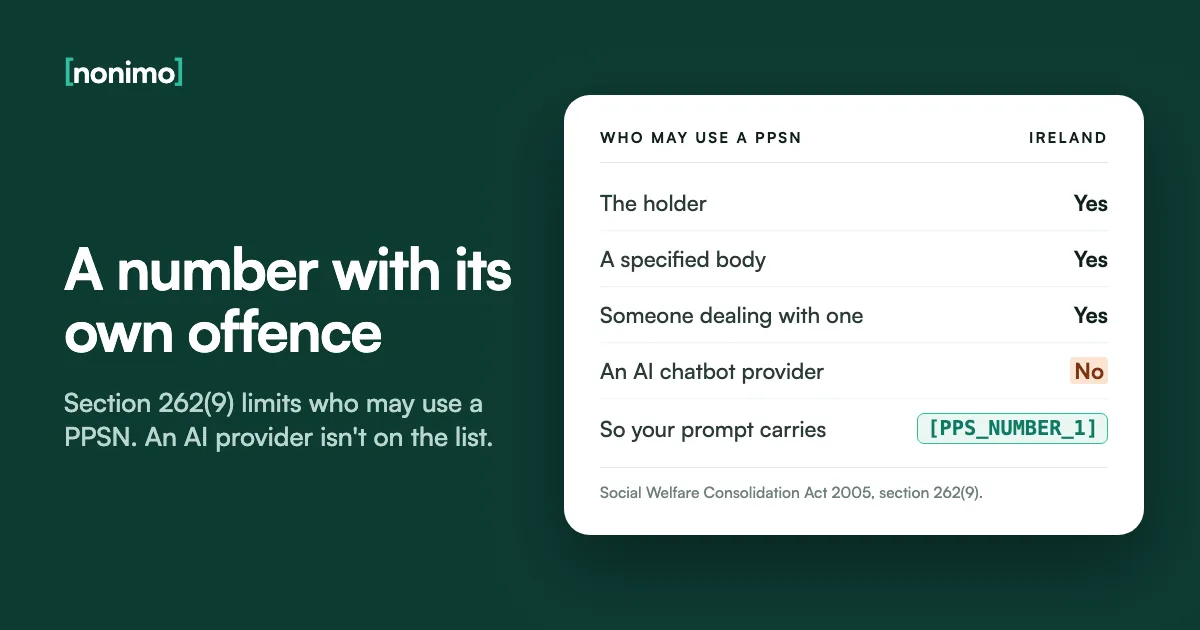
Yes, a PPSN is personal data, and Irish law restricts who may use it. Section 262(9) of the Social Welfare Consolidation Act 2005 allows the holder, specified bodies, people dealing with them and those covered by another Act. An AI provider is none of those, so the number comes out before you paste.
Is a PPS number personal data? Yes, and Article 87 lets Ireland add rules
Article 4(1) of the GDPR defines personal data by reference to identifiers, and the second example it gives is “an identification number”. A PPSN is allocated to one person for life. There is no reading of that definition under which it escapes.
The GDPR then steps back. Article 87 lets each member state set its own conditions for a national identification number, provided it is used only under appropriate safeguards. Ireland had those conditions long before 2018, in the social welfare code, and they still sit on top of the Regulation.
| The question | Where it is answered | For a PPSN |
|---|---|---|
| Is it personal data? | GDPR Article 4(1) | Yes, an identification number |
| Is it special category data? | GDPR Article 9 | No, it is not on the list |
| Who may use it at all? | Article 87, then sections 262 and 263 of the 2005 Act | Only the people the Act names |
| Is it still personal data once replaced by a label? | DPC guidance on pseudonymisation | Yes, while the original exists |
If an office manager remembers one row, I want it to be the third. It comes from social welfare law rather than data protection law, so GDPR training tends to skip it. The last row has its own page, on pseudonymised data and the firm that can reverse it.
PPS number format: seven digits, a check letter and sometimes a second letter
Citizens Information puts it in one line: a PPS number is always seven numbers followed by one or two letters. The first letter is not random. It is a check character calculated from the digits, so a mistyped number usually fails the sum and gives itself away.
Some numbers stop after the check letter; others carry a second one. A W in that second place is a relic: before 2000, some married women were given their husband’s number with a W added, and the Department says none have been issued since 1999. Those numbers are being phased out.
Reading a PPSN, piece by piece
The number below is invented. Its check letter is correct, so a format checker will treat it as real.
6403127
Seven digits, unique to one personIdentifies on its ownI
Check letter, worked out from the digitsCatches most typing errorsA
Second letter, on some numbersA W here marks an old spouse's numberFormat from Citizens Information; W numbers from the Department of Social Protection. The example is fictional.
Where it is printed matters more than how it is built. It sits on the front of the Public Services Card and on Revenue letters. In an office it lives in payroll exports, HR files and, in GP practices, referral letters. I assume any letter from a public body has one.
Who can ask for your PPS number in Ireland
The Department is blunt about it: only bodies specified in legislation, and their agents, can use the number. Those are the specified bodies, listed in Schedule 5 of the 2005 Act. They include Revenue, the HSE, listed voluntary hospitals, councils, ETBs, the Courts Service and the RTB, still listed under its old name.
Private businesses mostly hold PPS numbers through a door the Act leaves open: a transaction with a specified body where the number is relevant. Payroll is the classic case, since Revenue uses it.
That door is narrow. An employer may ask on your first day, not at interview, and a job application form or recruitment agency asking up front has no better claim.
Who is asking, and whether they can
| Who asks | Can they? | Why |
|---|---|---|
| Employer, once you take up the job | Yes | Payroll is a transaction with a specified body; firms that run payroll for clients hold it the same way |
| Employer while you are still a candidate | No | Citizens Information: employers should not ask when recruiting |
| Landlord registering your tenancy | Optional | The RTB recommends the tenant's PPSN but does not require it; letting agents often ask anyway |
| Letting agent before any offer | No basis I can see | No transaction with a specified body yet; see what to send a letting agent instead |
| Recruitment agency or application form, before any offer | No | Same Citizens Information rule; an agency that pays you needs it once your first assignment starts |
| Selling platform such as Vinted, from 30 sales or over €2,000 in a year | Yes | EU platform reporting rules (DAC7) make it collect a seller's tax number, and an Irish resident's is the PPSN |
| Bank or credit union lending to you | Yes | The Credit Reporting Act 2013 covers its use for the Central Credit Register |
| GP, hospital, pharmacy | Must record it | Health Information Act 2026, s. 12, since 17 August 2026 |
| Council, ETB, the NDLS | Yes | Specified bodies (the NDLS through the Road Safety Authority); councils hold it in housing and grant files, and AI in Irish councils starts there |
| Gym, phone network, a shop you buy from | No | Not specified bodies, and no relevant transaction |
| An AI chatbot provider | No | No entitlement under the Act; see Irish criteria for AI tools |
Schedule 5 and s. 262(9) of the Social Welfare Consolidation Act 2005 (revised), Citizens Information, RTB registration guidance, Health Information Act 2026, Directive (EU) 2021/514. The letting agent and recruitment agency rows are my reading, not rulings.
Is it safe to give out your PPS number?
To anyone on that list, for the reason they give, yes. Elsewhere the risk depends on what travels with it. Seven digits and a letter say little alone; beside your name, date of birth and address, they are what public bodies use to match your records to you.
Unlike a password, it can’t be reset. Ireland’s note to the OECD on tax numbers says a PPS number, once issued, is never changed. A number that leaks stays out there for life, so a photo of your card needs the care you would give a passport copy.
When a request doesn’t sit right, ring Client Identity Services in Carrick-on-Shannon, which Citizens Information names for exactly that question. The Department’s Register of Users also shows why many public bodies ask. I’d rather make that call than guess.
| Ask whoever wants it | An answer that holds up | An answer that should stop you |
|---|---|---|
| What is it for? | Payroll on your first day, a grant, your health record | "For our files", or "to verify you" |
| Which law or body is behind it? | Revenue, the HSE, a council, an Act they can name | None they can name |
| How should you send it? | The number alone, through their own form or portal | A photo of your Public Services Card by email |
Section 262(9): when using someone’s PPSN is an offence
The subsection names who may use a PPS number or seek its disclosure: the holder, a parent or guardian of a child holder, someone appointed to act for the holder, a specified body, a person in a relevant transaction with one, and anyone bound by sections 260, 261 or 261A. Anyone else commits an offence.
Sections 262 and 263 carry no penalty of their own, so section 257’s general one applies: up to €13,000 or three years on indictment. On summary conviction it is six months, or a fine the Act still prints as €1,500, now a class C fine of up to €2,500 under the Fines Act 2010.
That is how I read the sections together, and in a real dispute I would want a solicitor to confirm it before relying on it.
May you hold this PPS number?
Is it your own number, or your child's?
Are you a specified body, or acting as one's agent?
Is the number relevant to a transaction you have with a specified body, such as payroll?
Does another Act cover your use, such as credit reporting or health records?
Section 262(9) of the 2005 Act, with the carve-outs in s. 6(6) of the Credit Reporting Act 2013 and s. 12(6) of the Health Information Act 2026. General information, not legal advice on your case.
The carve-outs are worth reading closely, because none of them is general. The health one says a person using the number “in accordance with this Act” commits no offence. A GP practice now records every patient’s PPSN, and what that means for clinical letters is the job of a separate guide.
The Public Services Card and the DPC’s findings
Section 263 sets out what the card shows. On its face: name, PPSN, photograph, signature, issue number and expiry date. In the chip, readable electronically, the same items plus date of birth, place of birth, sex, nationality and former surnames, your own and your mother’s.
Even a photo of the front puts a face, a signature and the PPSN in one image, and I can’t think of a private business that needs all three.
The same section copies the rule for the number. Under section 263(4), anyone other than the holder, a specified body or a person in a relevant transaction who seeks to have the card produced commits an offence. A business that wants photo ID has other documents to ask for, listed further down.
| Date | What the Data Protection Commission did |
|---|---|
| 16 August 2019 | Found no legal basis for issuing the card for transactions with bodies other than the Department, and that blanket, indefinite retention of supporting documents was unlawful |
| 10 December 2021 | Appeal settled: the enforcement notice and the appeal were both withdrawn, and the Department acknowledged that, without legislation providing for it, other public bodies cannot compel anyone to get a card |
| 9 June 2025 | Decision on the facial matching in SAFE 2 registration: no valid lawful basis for the biometric templates, a reprimand, fines of €550,000, and nine months to stop unless a basis was found |
| July 2025 | The Department challenged that decision in the High Court, saying its biometric processing is lawful; no ruling had been reported when this page was checked |
If a body other than the Department says the card is the only way, ask which law says so. I’d never send a photo of the card outside that list, least of all a chatbot, where an uploaded image can outlive the conversation.
| Instead of the card | Before you send it |
|---|---|
| Irish passport | Black out the number and the coded lines |
| Passport Card | Redact the card number or watermark the card |
| Driving licence | Redact the driver number or watermark the copy |
| IRP card | Watermark the IRP card |
Can you paste a PPS number into an AI chatbot?
No Irish court has decided whether typing a number into a prompt is “use” within section 262(9). But the provider is not a specified body, has no transaction with the person, and appears in none of the carve-outs. Whatever entitlement you had to the number stayed with you when you pressed enter.
Holding data for a client brings in a second statute. Section 144 of the Data Protection Act 2018 makes it an offence for a processor to disclose data, knowingly or recklessly, without the controller’s prior authority: up to €50,000 or five years on indictment. A payroll bureau pasting a client’s staff list worries me most.
Which numbers would the chatbot get?
The note is invented. The second PPSN has a wrong check letter on purpose: watch it slip through.
The check runs in your browser and nothing you paste leaves it. It flags PPS numbers whose check letter adds up, IBANs, Eircodes, Irish phone numbers and emails. It does not catch names or addresses, and a mistyped PPSN gets past it.
That mistyped number is the trap. A format check skips it, yet it sits beside a name, and one corrected letter gives back the original. When in doubt, the whole field goes. Whether a paste like this must be reported is in our guide on client data in a chatbot as a breach.
| If the tool is | Read first |
|---|---|
| ChatGPT | What OpenAI keeps from your chats |
| Claude | Whether Anthropic trains on your conversations |
| Gemini | What Google does with Gemini prompts |
| Copilot | Which Copilot has your data |
None of those policies makes a pasted PPSN lawful in Ireland. They only tell you how long it stays. For a client who wants AI used on their files, the authority belongs in writing, and an AI clause in the letter of engagement is where I’d put it.
Finding and removing a PPSN in payslips, PDFs and spreadsheets
The number rarely sits alone in a neat field. It hides under a black box in a PDF’s text layer, in a Word comment, in a hidden column or in a scanned form’s file name. Each format needs its own method, and the identifiers that travel with it are more than most expect.
Replace it with a label rather than deleting it. A question about a payslip still reads properly when the model sees that a PPSN was there, and the label tells your colleague later what was removed.
| Where the PPSN is | What catches people out | How to take it out |
|---|---|---|
| Payslip or form as a PDF | A drawn box leaves the text underneath | Redact the PDF properly |
| Letter in Word | Comments and tracked changes keep old versions | Redact in Word |
| Payroll export in Excel | Hidden columns and other sheets | Redact names and numbers in Excel |
| CSV from an HR system | The whole column, in every row | Mask a CSV column |
| Already pasted into ChatGPT | Deleting the chat is not instant deletion | Delete your ChatGPT history |
| Your own app calling the OpenAI API | Every request carries it | Nonimo Gateway on your own server, or a build-it-yourself route such as Presidio, Skyflow's vault or Portkey's gateway |
Gráinne Kerrigan, PPSN 6403127IA, query about her first payslip.
[NAME_1], PPSN [PPS_NUMBER_1], query about her first payslip.
The second line answers the payroll question just as well. To my mind, nothing in a prompt gets better because the model can see the seven digits, which makes the PPSN the cheapest identifier in the file to remove.
Is a file with the PPSN removed still personal data?
Usually, yes. The DPC’s guidance on anonymisation says that where the original data is not deleted, the result is in most cases pseudonymised and still personal data. You kept the payslip. So the version with labels is a safer copy of personal data, not something outside the law.
None of that makes me skip the step. Pseudonymisation is a safeguard the GDPR names, and it cuts what a recipient can do with the text. The vocabulary trips people up, and deidentified versus anonymised sorts the three words out.
Leave the PPSN in
- Personal data, plus a restricted number
- Section 262(9) question for every recipient
- Nothing gained in the answer
Black it out on a copy
- Still personal data while you hold the original
- Fine on paper; check the text layer in a PDF
- The reader loses track of what was there
Replace it with a label
- Still personal data on your side
- The number never reaches the provider
- The text keeps its meaning
After the number, the Eircode is the detail I’d watch. Over 35% of Irish addresses are shared with at least one other property, so every address got its own code, and one left in a letter points to a single letterbox.
An employer and a start date can do the rest. If your office pastes documents often, a written rule on what goes in belongs in an AI policy for staff.

Before the number leaves your desk
The PPSN is the easiest call in the file: an Irish statute older than the GDPR already fences it in, and no AI tool needs it to answer a question. If one identifier always comes out, it’s this one. This page is a general reading of the 2005 Act, not advice on a particular request.
Insurers now ask about AI on proposal forms, and the AI questions on those forms are easier to answer when this step is routine.
The cover itself is another matter, and what a cyber policy in Ireland pays for is worth reading before an incident.
Before you paste anything with a PPSN in it
0 of 5
Not yet. The unticked boxes are where a number escapes.
One left. Fix it before the text goes anywhere.
Ready. The model gets the question, and the number stays with you.
The AI Act adds duties of its own for firms using these tools, set out in the EU AI Act guide for Irish businesses. They sit beside the 2005 Act rather than replacing it.
Nonimo does the label step on your own machine. It swaps the PPS number, and the name and Eircode beside it, for labels before you send, marks every change so you can undo it, and puts your details back when you copy the answer. Your text never reaches us, as our security page explains.
If payroll notes and tenancy files cross your desk every week, Nonimo for Ireland is built for exactly that paste.
Sources
- GDPR, Articles 4(1) and 87. An identification number as an identifier; member states may set conditions for a national identification number. eur-lex.europa.eu
- Social Welfare Consolidation Act 2005, section 262 (revised). Allocation, the offence in subsection (9) and its carve-outs; Schedule 5 and the section 257 penalty, with its Fines Act 2010 note, read in the same revised Act. revisedacts.lawreform.ie
- Social Welfare Consolidation Act 2005, section 263 (revised). What the Public Services Card shows and holds, and the offence in subsection (4). revisedacts.lawreform.ie
- Health Information Act 2026, section 12. Duty to record the PPSN; no refusal of care; subsection (6). Commenced 17 August 2026 by S.I. No. 360 of 2026. irishstatutebook.ie
- Data Protection Act 2018, section 144. Disclosure by a processor without authority, and its penalties. irishstatutebook.ie
- Department of Social Protection, Who can use my PPS Number. Only specified bodies and their agents; the Register of Users and why bodies ask. gov.ie
- Department of Social Protection, Phasing out of W numbers. Not issued since 1999. gov.ie
- Directive (EU) 2021/514 (DAC7). Platforms collect a seller’s tax number; sellers under 30 sales and €2,000 excluded; applies from 1 January 2023. eur-lex.europa.eu
- OECD, Ireland: information on tax identification numbers. The PPS number identifies individual taxpayers and is never changed once issued. oecd.org
- Eircode, What is Eircode. A unique code for each address; over 35% of addresses shared with another property. eircode.ie
- Citizens Information, Personal Public Service (PPS) number. Seven numbers and one or two letters; where it is printed; employers not to ask when recruiting; Client Identity Services. citizensinformation.ie
- Residential Tenancies Board, how to register a tenancy. Tenant’s PPSN optional but highly recommended. rtb.ie
- Data Protection Commission, statement on the Public Services Card, 16 August 2019. The findings on legal basis and retention; the 10 December 2021 resolution is on the same site. dataprotection.ie
- Data Protection Commission, inquiry concerning the Department of Social Protection, decision of 9 June 2025. SAFE 2 biometrics, €550,000 in fines, the nine-month order. dataprotection.ie
Checked on 7 November 2026.
Common questions
Is a PPS number personal data?
Yes, a PPS number is personal data. It is an identification number tied to one person, the very example the GDPR's definition gives, and Irish statute then limits who may use it.
Is it safe to give out my PPS number?
Yes, to a body entitled to it, for the reason it gives. Anyone else should be able to say which law lets them ask; if they can't, keep it to yourself.
What can someone do with my PPS number?
On its own, little. Next to your name, date of birth and address it links you across public records, and since a PPS number is never changed, a leaked one stays leaked.
Can a recruitment agency or job application form ask for my PPS number?
Not while you are applying. Citizens Information says an employer should ask only when you are actually taking up the job, and an agency needs it when it starts paying you.
Why is Vinted asking for my PPS number?
Because of EU platform reporting rules known as DAC7. Once a seller reaches 30 sales or passes €2,000 in a year, platforms must collect a tax number, and an Irish resident's is the PPSN.
Is my PPS number on my passport?
No. Citizens Information lists where it is printed: the Public Services Card, your tax assessment, the PAYE Notice of Tax Credits and the Temporary Payment Card.
Is it illegal to ask for someone's PPS number?
It can be, if you have no entitlement to it. Section 262(9) of the Social Welfare Consolidation Act 2005 makes using or seeking a PPSN an offence for anyone outside the listed categories.
Who do I contact about a PPS number query?
Client Identity Services in the Department of Social Protection, in Carrick-on-Shannon. It manages how PPS numbers are allocated and used, and answers whether an organisation may ask for yours.