Does Claude train on your data? How to opt out
· Updated

Joaquín Trapero in Founder of Nonimo, writing on AI and privacy.
Whether Anthropic learns from your Claude conversations comes down to the contract behind your login. A personal Free, Pro, Max or Ultra account works one way; a company seat, an API key or a cloud marketplace works another. OpenAI draws a similar line, and the ChatGPT side of that comparison is set out separately.
This page sticks to what Anthropic publishes today: the consumer change of 28 August 2025, the switch it created, the retention behind it, the exceptions that survive opting out, then the business side. Paying for Pro doesn’t buy business terms, and I think that’s the first thing to know.
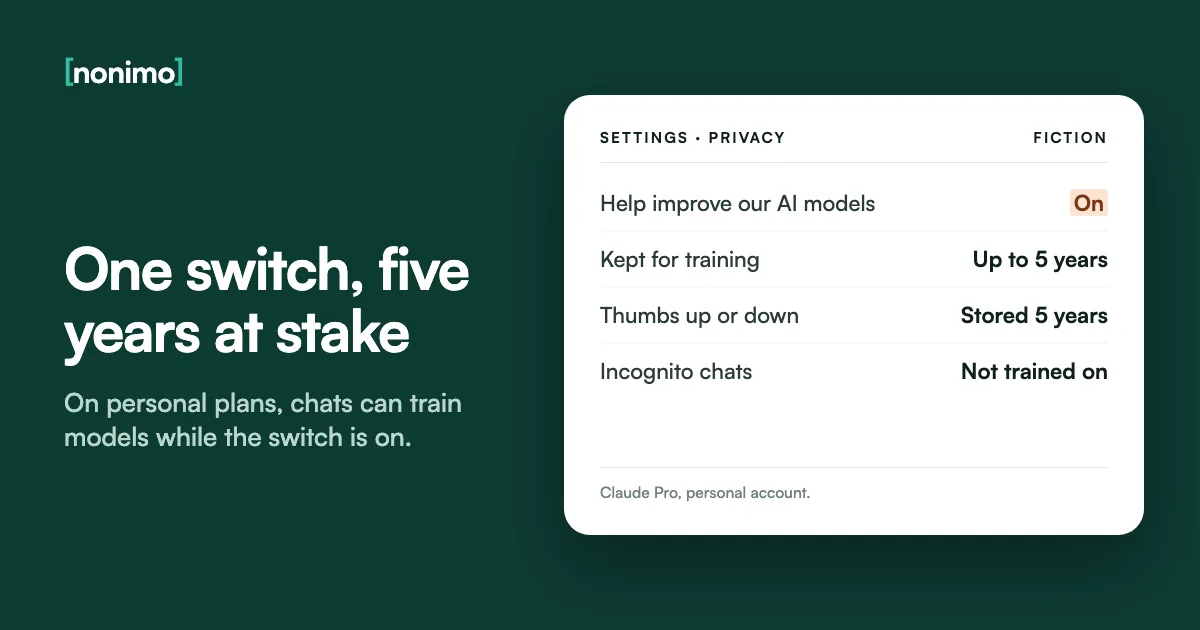
On Free, Pro, Max and Ultra, yes, while your privacy switch is on. Anthropic can then keep those chats in its training pipelines for up to five years. Team, Enterprise, the API, Amazon Bedrock and Google Cloud's Vertex AI sit outside that switch, though feedback you send can still be kept and used.
Which accounts can Anthropic train on: personal or business?
Two sets of documents split the answer. The consumer privacy policy, in force since 10 September 2026, says inputs and outputs may train Anthropic’s models unless you opt out. Claude’s pricing page marks training as opt-out on all four personal plans, Ultra too. The commercial terms say Anthropic may not train models on customer content.
Claude Code is where people get caught. Anthropic’s August 2025 notice says the choice covers Claude Code used from a Free, Pro or Max account. A developer on a personal subscription is on consumer terms, whatever the company assumes. A line in a staff AI policy naming which logins are allowed settles that.
By my reading, the plan name tells you little. Pro, Max and Ultra cost money and feel professional, yet all three are consumer contracts. The question to ask is who signed: you, with a card, or an organisation, with terms.
Which Claude terms cover your account?
How do you reach Claude?
Who holds the plan?
Anthropic's consumer terms notice of 28 August 2025, privacy policy of 10 September 2026, commercial terms of 17 June 2025 and privacy centre pages for commercial products; Claude pricing page, which lists Ultra's model training as opt-out; AWS Bedrock documentation.
What Anthropic’s consumer terms update of August 2025 changed
Until the update, consumer chats ran on a 30-day retention period. On 28 August 2025 it asked Free, Pro and Max users to choose whether their chats and coding sessions could improve Claude, with 8 October 2025 as the deadline for an answer.
Two things came with a yes. Retention went from 30 days to five years, and feedback got the same five years. Only new or resumed chats counted. As one regulator’s view, the US FTC had warned in February 2024 that quietly and retroactively loosening terms to train AI can be unfair or deceptive.
Anthropic asked instead of slipping it in, and drew the line at new activity. That is the sensible way to change a privacy promise. The word I’d watch is “resumed”: one more message in an old thread brings the whole conversation, with every identifier it holds, under your current setting.
The consumer change, date by date
The highlighted row is the one that still bites today.
| Date | What happened | What it means for you |
|---|---|---|
| 28 August 2025 | Anthropic announces the training choice for Free, Pro and Max | A pop-up asks each user to decide |
| 8 October 2025 | Deadline to make the choice | Since then every consumer account has a setting in place |
| From the choice onwards | Applies to new or resumed chats and coding sessions only | Reopening an old thread brings it under your current setting |
| 1 July 2026 | Retention article updated in the privacy centre | Sets out the 30-day, five-year, two-year and seven-year periods |
| 10 September 2026 | Current consumer privacy policy takes effect | Training unless you opt out, with two exceptions |
Anthropic, "Updates to Consumer Terms and Privacy Policy", 28 August 2025; privacy centre retention article, updated 1 July 2026; privacy policy effective 10 September 2026. The FTC warning is its Office of Technology post of 13 February 2024.
How to opt out of Claude training on desktop and mobile
The switch is called Help Improve our AI models, under Settings, then Privacy. On the web and the desktop app you open it from the menu under your name. The phone apps use the same path. It can be changed at any time, and each person sets it for their own account.
Anthropic’s retention article says that once it’s off, it won’t use your previous or new chats or coding sessions for future training. Training runs already in progress, and models already trained, keep what they had. Gemini and Copilot handle this differently, which the Gemini guide on what Google keeps covers for Google.
Off before you paste anything you’d regret, not after: that’s the sequence I’d stick to. A switch that works for the future is useful; one flipped the morning after a client file went in is mostly paperwork.
Turning model improvement off
Same setting on every device; it follows your account.
Web or desktop app
Click your name, then SettingsOpen PrivacySwitch off Help Improve our AI modelsPhone app
Tap your name, then SettingsTap PrivacySwitch off Help Improve our AI modelsWhat the switch can't undo
Training runs already under wayModels already trainedChats flagged for safety, and feedback you sendAnthropic privacy centre, "How do I change my model improvement privacy settings?", updated 3 August 2026, and the retention article of 1 July 2026. Microsoft's equivalent controls are in our Copilot training page.
How long Anthropic keeps chats, and deleting them
Deleting a conversation removes it from your history straight away and from Anthropic’s backend storage within 30 days. Anthropic also says a deleted conversation won’t be used for future training. The same 30-day clock appears in our steps for clearing a whole ChatGPT account, so it’s an easy number to remember.
Longer periods depend on what happened to the chat. With model improvement on, it may stay up to five years in training pipelines, de-identified, which still falls short of anonymous. A chat flagged for breaking the usage policy keeps its text two years and its classifier scores seven.
The seven years give me more pause than the five. It covers scores, not your words, but no setting of yours shortens it. The bars below line up every period Anthropic lists; the longest that fits a given chat is how long some trace of it may last.
Every retention period Anthropic lists for consumer chats
A chat lasts as long as the longest bar that applies to it.
Bar length in days, against 7 years. Anthropic privacy centre, "How long do you store my data?", updated 1 July 2026; Claude help page "Use incognito chats". An ordinary chat you never delete stays in your history until you do. Uploaded images follow the same rules, as our guide to photos sent to AI assistants shows.
Does the thumbs up or down button send your chat for training?
It can, on any plan. Anthropic’s training article says a thumbs press stores the entire related conversation, including custom styles and preferences, for up to five years. It strips the link to your user ID first and may use the material to train models where the law allows.
On consumer plans this survives the privacy switch: feedback is a named exception. On commercial products the same five years apply. Team and Enterprise owners can block it with the Rate chats control, under Organization settings, then Data and Privacy. A clause in your written rules for staff using AI covers the rest.
A thumbs-down feels like a shrug, not a disclosure. For anything with a client in it, I’d treat the button as sending the full thread to Anthropic, because that is what it does. If it were my firm, an owner would switch Rate chats off on day one.
What one thumbs press hands over
Personal and business accounts side by side.
| Free, Pro, Max | Team, Enterprise, API | |
|---|---|---|
| What is stored | The entire related conversation | The entire related conversation |
| How long | Up to 5 years | Up to 5 years |
| Link to you | User ID removed before use | User and customer IDs removed first |
| Stopped by the privacy switch? | No, it's a named exception | Team and Enterprise owners can switch off Rate chats |
Anthropic privacy centre, "Is my data used for model training?" for consumer plans (16 March 2026) and for commercial products (18 August 2026). What to do if a client file already went out is in our breach guide for pasted client data.
Are Claude incognito chats used for training?
No. Anthropic says incognito chats aren’t used to improve Claude, even with model improvement switched on. They aren’t saved to your chat history, they don’t read or add to memory, and Claude won’t find them when it searches earlier conversations. You start one with the ghost icon, outside a project.
They aren’t invisible, though. Anthropic keeps them 30 days by default, longer where an Enterprise organisation set its own retention, and Team and Enterprise data exports include them. Projects have no incognito mode. Files you attach carry hidden extras too, covered in our walkthrough for scrubbing Word and PDF properties.
Incognito is the right mode for a one-off question about something personal. I see no reason to treat it as a confidentiality tool at work, because the employer’s export can still see it.
Three ways to open a Claude chat
History: saved until you delete it. Memory: on by default on personal plans; owners decide on Team and Enterprise. Training: follows your privacy switch on a personal plan. Kept: 30 days after deletion, or up to five years if model improvement was on.
History: not saved, can't be reopened. Memory: not read, not added to. Training: never. Kept: 30 days by default; Enterprise can set its own period. Visible in Team and Enterprise exports.
Incognito: not available. Memory: switch it off from the plus menu before the first message. Training: follows your privacy switch, as a normal chat does.
Claude help pages "Use incognito chats" and "Use Claude's chat search and memory", read 10 November 2026; retention from the privacy centre article of 1 July 2026.
Claude for Work, the API and cloud platforms: what businesses get
For organisations the default flips. Anthropic doesn’t train on inputs or outputs from commercial products unless you send feedback or otherwise agree. API data leaves its backend within 30 days; Claude for Work chats stay until deleted. The cyber insurance form’s AI questions now ask about exactly this.
The commercial terms bring in Anthropic’s data processing addendum, the processor contract Article 28(3) of the GDPR demands, EU and UK versions alike. On Amazon Bedrock, AWS says model providers can’t reach customer prompts and completions. The EU AI Act adds duties of its own, which our page on its reach beyond Europe explains.
No training doesn’t mean nothing leaves. Australia’s OAIC recommends keeping personal information out of publicly available generative AI tools, a fair rule anywhere. For a ten-person office, I can live with a Team plan plus one page of rules; our organisations page covers firms wanting more control.
What a business contract with Anthropic settles, and what it leaves open
The highlighted row is the one a personal subscription paid on a company card doesn't get.
| Question | Team, Enterprise or API | Who acts |
|---|---|---|
| Training on your content | Not by default; terms say Anthropic may not train on customer content | Nobody, unless you opt in |
| Retention | API: 30 days. Claude for Work: until deleted. Enterprise: custom retention available | Your admin |
| Zero data retention | Available, by separate agreement only | Whoever negotiates the contract, often your IT partner |
| Feedback buttons | Kept up to 5 years if used | Owners, via Rate chats |
| Processor contract | Data processing addendum built into the terms | Your data protection lead |
| Names leaving your network | Not addressed: the provider still receives the text | You, before sending, or a masking layer such as Protecto's, self-hosted only on Enterprise |
Anthropic commercial terms (17 June 2025) and privacy centre articles for commercial products (1 July and 18 August 2026); GDPR Article 28(3). Developers behind Kong can add Kong's AI Sanitizer plugin.
For apps your team builds on Claude’s API, the masking can happen in the request itself. Teams routing through LiteLLM have guardrails that strip PII before the call.
Nonimo Gateway works with Claude’s own API by changing the base URL, on your own servers; the Gateway page explains the set-up.

Taking the client out before the prompt leaves
The five-year training copy, the feedback exception and the seven-year flag all hold whatever text reached Anthropic. Old threads deserve care: resume one that names a client and the whole conversation falls under today’s setting. The other assistants set their clocks differently.
On a Mac or Windows machine, Nonimo’s app puts markers in place of the names and numbers it recognises before you paste into Claude, and Claude answers with the originals back in place. Your text never reaches us; our security notes explain why.
The app finds names and numbers. A detail like a street, a rare job or a family situation can still point to one person, and only someone who knows the file can judge it. I’d read the masked version once before sending, every time it holds a client.
One request to Claude, sent two ways
Invented client and details.
| As typed | What Claude receives after Nonimo |
|---|---|
| Draft a payment reminder to Wilhelmina Castellane of Orrinvale Glazing about invoice 7719. | Draft a payment reminder to [PERSON_1] of [ORGANISATION_1] about invoice [NUMBER_1]. |
| Her email is w.castellane@orrinvale.example and her mobile is +1 202 555 0147. | Her email is [EMAIL_1] and her mobile is [PHONE_1]. |
| Mention that she's the only glazier in the village with a sea-view workshop. | Unchanged: a detail like this still points to her, so cut it yourself. |
Fictional person, company and numbers; the phone number is in the 555-0100 to 0199 block kept for fiction. Marker names are illustrative.
Sources
- Anthropic, Updates to Consumer Terms and Privacy Policy: 28 August 2025; Free, Pro and Max (Claude Code included) asked to choose by 8 October 2025; five years if allowed, 30 days if not; Claude for Work, Government, Education and API use, including Bedrock and Vertex AI, excluded.
- Anthropic privacy centre, How long do you store my data?: updated 1 July 2026; 30 days after deletion, five years de-identified with model improvement, two and seven years when flagged, five years for feedback.
- AWS, Data protection in Amazon Bedrock: model providers have no access to Bedrock logs or customer prompts and completions.
- FTC, AI (and other) companies: quietly changing your terms of service could be unfair or deceptive: 13 February 2024.
- OAIC, Guidance on privacy and the use of commercially available AI products: recommends not entering personal information into publicly available generative AI tools.
- EUR-Lex, General Data Protection Regulation: Article 28(3), a contract governing processing by a processor.
Accessed 10 November 2026.
Related guides
Common questions
Can I stop Claude from training on my chats?
Yes, under Settings, then Privacy. Switch off Help Improve our AI models. Anthropic says it then won't use your previous or new chats for future training, though runs already under way keep what they had.
Does Claude Pro train on your data?
It can, exactly like Free, Max and Ultra. Paying doesn't change the contract: Pro is a consumer plan, so your privacy switch decides. Team, Enterprise and API use sit under the commercial terms instead.
Does Anthropic train on API data?
No, not by default. Anthropic doesn't use inputs or outputs from its commercial products, the API included, unless you send feedback or otherwise allow it. API data leaves its backend within 30 days.
Are deleted Claude chats used for training?
No, not for future training. A deleted conversation leaves your history at once and Anthropic's backend within 30 days. A training run that had already started is not unpicked.
Is Claude incognito mode private?
Partly. Incognito chats skip your history, memory and model training. Anthropic still keeps them for 30 days by default, and on Team or Enterprise they appear in the organisation's data exports.
Does Claude Code train on your code?
Yes on a personal plan, if your privacy switch is on. Coding sessions follow the same setting as chat on every personal plan. Under Team, Enterprise or an API key, the commercial terms rule out training by default.
How long does Anthropic keep chats used for training?
Up to five years, in de-identified form, inside its training pipelines. The period only covers chats started or resumed after you allowed model improvement.