AI for local government: what a complaint carries
In a city or county office, what ends up in ChatGPT is rarely a whole file. It is the reply to a code enforcement complaint, a summary of a permit file for the planning manager, or the answer to a 311 request that has been open since last week.
Nearly all of them carry the same details: the resident’s name, the property address, a phone and an email, and the case number. A utility billing question adds an account number, and a benefits or licensing file adds a date of birth, a copy of a driver’s license or an SSN.
Why a prompt at a public agency can become a public record, and what records officers have already had to release, is set out in our guide to AI in local government.
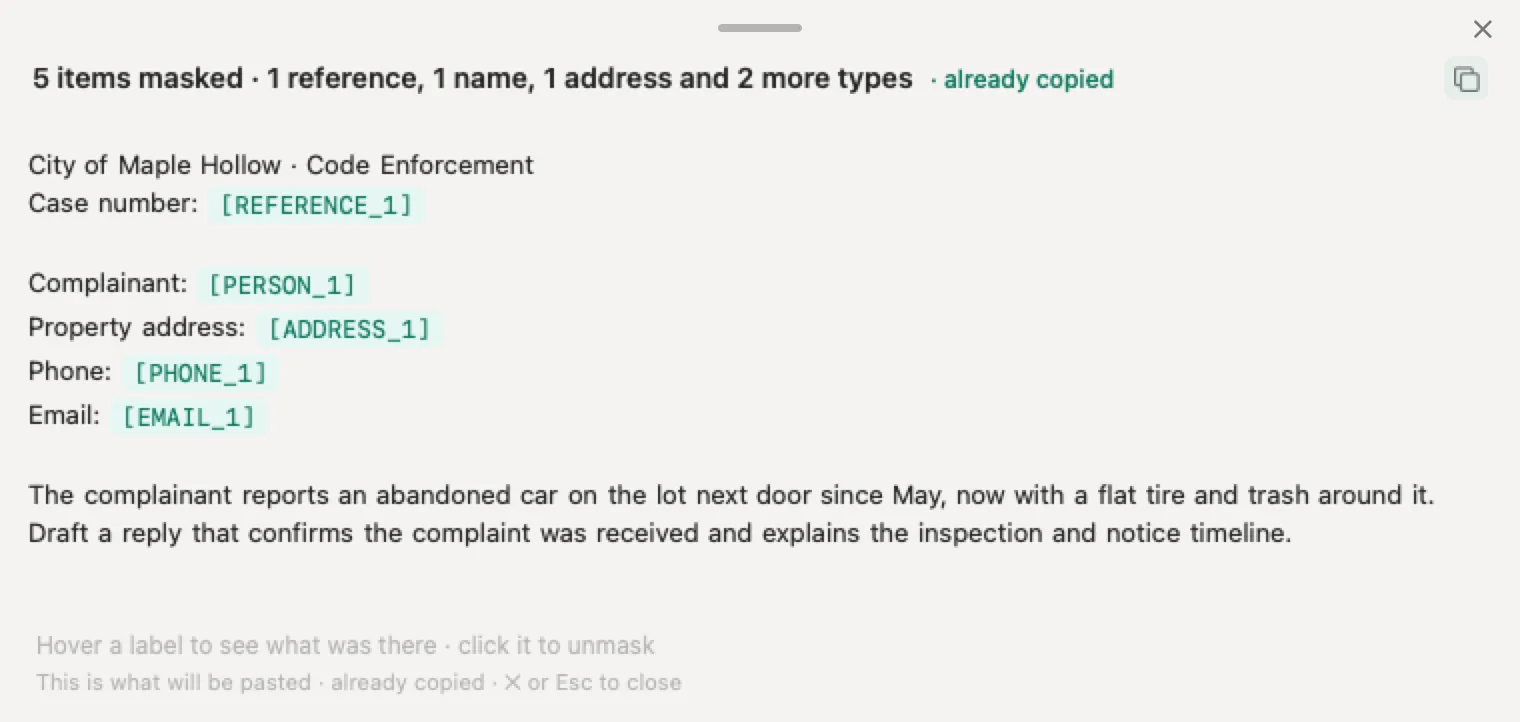
A code enforcement complaint in the prompt, with the resident as placeholders
The employee highlights the complaint, presses the key and pastes it into ChatGPT, Claude or Copilot. The chat receives the version with placeholders, and nothing about the resident reaches us.
In the invented complaint below, Nonimo has masked five details: the case number, the complainant’s name, the property address, the phone and the email. The abandoned car, the dates and the trash stay whole, which is all the AI needs to draft the reply.
The AI writes to [PERSON_1]. You copy the reply, press the key again and the resident’s real name comes back on screen, ready to check and send from the city’s own system.
Before: what gets pasted
City of Maple Hollow · Code Enforcement
Case number: 2026-004512

Complainant: Jane Doe
Property address: 0 Example Ave, Maple Hollow 00000
Phone: 202-555-0147
Email: jdoe@example.com

The complainant reports an abandoned car on the lot next door since May, now with a flat tire and trash around it.
Draft a reply that confirms the complaint was received and explains the inspection and notice timeline.
After: what the AI receives
City of Maple Hollow · Code Enforcement
Case number: [REFERENCE_1]

Complainant: [PERSON_1]
Property address: [ADDRESS_1]
Phone: [PHONE_1]
Email: [EMAIL_1]

The complainant reports an abandoned car on the lot next door since May, now with a flat tire and trash around it.
Draft a reply that confirms the complaint was received and explains the inspection and notice timeline.
When the prompt is a public record
In Washington, the State Archives has said it plainly: a generative AI interaction that relates to public business is a public record, input and output, and a personal account does not change that.
That turns masking into records hygiene. A prompt that only ever held placeholders can be retained, requested and produced without a resident’s name, address or phone inside it, and nobody has to redact it later.
The masking itself happens on the employee’s computer, with no server in the middle: nothing is uploaded to be cleaned, and our security page lists what stays on the machine.
The city’s name, readable on purpose
Nonimo masks who the case is about, not who is writing: the city, the department and the program stay readable, because they are the context the AI needs to answer well.
What leaves no doubt, such as an email address or a phone number, is replaced right away. What Nonimo recognizes from its label, like the complainant or the case number, is replaced too, and everything shows on screen before you paste.
It helps to write down what each employee may paste and into which chat, and our model AI policy gives the agency a starting point.
Nonimo for local government: price and where to start
ChatGPT for local government with Nonimo needs a PC with Windows 10 or 11, or a Mac with macOS 14 or later.
Nonimo’s free plan stops at a set number of words each month. Leave an email address on our license page and a free license file comes back that removes the cap through January 31, 2027, with no account to set up. The first desk is usually 311, code enforcement or permitting, the ones that write to residents all day.
To cover every desk without anyone pressing a key, IT deploys the browser extension by policy, and a dashboard receives counts by category only. Our page for organizations explains how, and what OpenAI keeps of what it does receive is in our ChatGPT guide.
- A free plan on Mac and Windows
- With a monthly word allowance
- The free license lifts it through January 31, 2027, no account needed
Questions from city and county staff
Can city staff use ChatGPT with resident information?
That depends on your agency's policy. San Francisco's guidelines, for one, tell staff never to enter personal information into public or consumer AI tools. Nonimo makes a rule like that easy to follow: the resident's name, address, phone, email and case number become placeholders on the employee's own computer before anything is sent.
Are ChatGPT prompts public records?
Often, yes. Washington State Archives says a generative AI interaction that relates to public business is a public record, whether the account is personal or issued by the agency. If the prompt only ever held placeholders, the record that gets requested does not hold the resident.
Is the text sent to a server to be cleaned?
No. The masking happens on each employee's Mac or Windows PC, with no gateway or cloud service in between, and it keeps working with the Wi-Fi off. The only text that leaves the computer is the placeholder version pasted into the chat.
Does Nonimo see what our staff write?
Not a word. The masking happens on each employee's own computer, and your staff don't open an account with us.
Can the reply go out with the resident's real name?
Yes. The AI writes to [PERSON_1], you copy its reply, press the key again and the real name and details come back in place on your screen, ready to check and send from the city's own system.
Where does a city start?
With the desk that writes to residents most, usually 311, code enforcement or permitting. Install the app, press the key on a made-up complaint like the one on this page and see what gets masked. To cover every desk, IT deploys the browser extension by policy.