· Updated

Joaquín Trapero in AI and privacy expert, and founder of Nonimo.
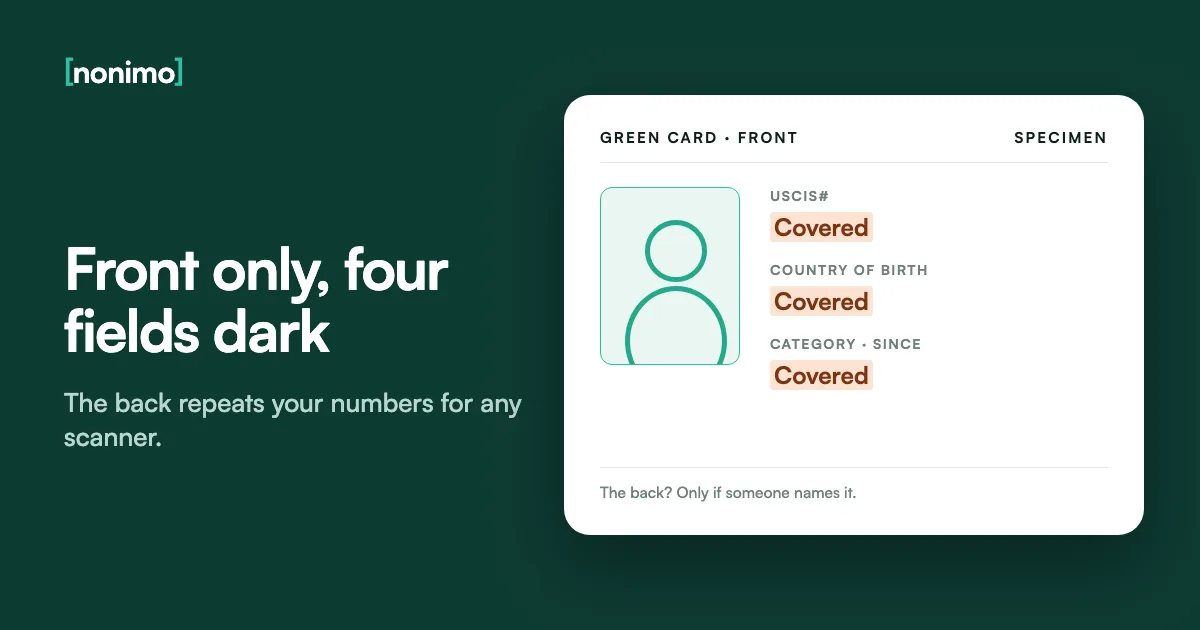
A Green Card copy travels further than the card ever should, from leasing offices to a new bank. Next to your name sit two immigration numbers, your country of birth and a code for how you got residence, and the coded lines on the back repeat most of it for any scanner.
The tool above blacks out what you pick and builds a fresh image inside your browser, with no account. When the recipient should see every field and you only want a record of who got it, put their name across the copy with a watermark instead.
Send the front only, with the USCIS#, Country of Birth, Category and Resident Since covered. If someone needs the back, cover all three coded lines at the bottom too, because they hold the USCIS#, the card number and your birth date. Leave the card whole for Form I-9, USCIS filings and a REAL ID appointment.
How to redact a Green Card copy
1. Add one side of the card
Photograph the card flat in even light, or drop in a scan: JPG, PNG, WebP, HEIC or PDF. Rotate and Adjust crop fix a tilted shot. Do the front first. Unless someone named the back, I wouldn’t photograph it at all: a picture you never took can’t end up in the wrong inbox.
2. Tap the fields to hide
The tool reads the card in your browser and puts a chip on each field it recognizes. One tap turns it black, a second brings it back, and Show everything clears the lot. A Green Card isn’t one of the layouts it knows field by field, so expect some fields with no chip.
Redact by hand fills those gaps: drag a box over the area, or your finger on a phone. A box drawn this way becomes part of the image, which a rectangle in a PDF editor often isn’t, as the guide on how to redact a PDF properly shows.
Before you press Download
Zoom in on the preview and tick what is already black.
0 of 6 checked
Not yet. Each unticked line is something a reader can still copy down.
Ready to download. Sending only the front? The last four lines count as done.
Positions from USCIS's 2023 specimen. Your card's design may place them differently.
3. Save the redacted copy
Pick PNG, JPG or PDF. The black goes into a newly built image, and the camera and location details of the original photo stay behind, the hidden layer explained in why a phone photo of an ID can carry its location.
What information is on a Green Card, field by field
USCIS calls it the Permanent Resident Card, Form I-551, and has issued the current design since January 30, 2023. Earlier designs stay valid until the date they expire, and USCIS uses up old card stock first, so a recently issued card can still look like the 2017 version.
The table reads USCIS’s 2023 specimen, issued to TEST V SPECIMEN, so every value is fictional. Of the nine labeled fields on the front, three concern your immigration file and a fourth says where you were born. Those four I would keep away from anyone who only needs to know it’s you.
A copy headed into an AI tool rather than to a person gets every row covered, name and photo included, as in the list of identifiers to strip before a file reaches a chatbot.
The 2023 Green Card, read off USCIS's specimen
| Field | Specimen shows | What it gives away | On a rental copy |
|---|---|---|---|
| Surname, Given Name | SPECIMEN, TEST V | Who you are | Leave |
| Photo | Front, plus a second one on the back | Your face | Leave |
| Country of Birth | Mexico | National origin | Cover |
| USCIS# | 123-456-789 | The number your immigration file is kept under | Cover |
| Category | IR1 | How you became a resident; IR1 is the visa symbol for a US citizen's spouse | Cover |
| Date of Birth, Sex | 20 OCT 2002, F | Age and sex | Cover the date unless they check age |
| Card Expires | 10/26/32 | Whether the card is current | Leave |
| Resident Since | 10/25/20 | The date your residence began, which Form N-400 asks for | Cover |
| Back, top edge | FORM I-551 Rev (12-2021), a serial, a barcode | Card stock details; I found no USCIS description of the barcode | Cover the barcode |
| Back, beside the photo | 20 OCT 2002 F, in the hologram | Birth date and sex, again | Cover |
| Back, bottom | Three coded lines | The USCIS#, the card number and most of the front | Cover, or don't send the back |
USCIS, Redesigned Green Card 2023 (specimen front and back), and M-274 section 13.1 for the issue date. Category meaning from 22 CFR 42.11; Resident Since from the N-400 instructions. The last column is my own call, not a rule.
USCIS number vs card number on a Green Card
The front prints one number, labeled USCIS#. That’s your A-number: USCIS’s glossary calls it a unique seven-, eight- or nine-digit number DHS assigned to you. The N-400 instructions add that its length depends on when your record was created, and that forms want it padded with zeros to nine digits.
The card number is a different thing. USCIS’s SAVE tutorial for agencies says it’s printed on the back, is also called the document number, and runs 13 characters: three letters, then ten digits. On the 2023 specimen it’s MSC0000000110, and it never appears on the front.
The receipt number on a Form I-797 and the USCIS online account number get mixed up with these, and neither is on the card. When a form only says “Green Card number,” I would ask which one they mean before writing anything. A passport number has its own spots on a US passport copy.
Which number are you looking at?
Front of the 2017 and 2023 designs; the 2010 design also prints it on the back. Repeated in the first coded line. Seven to nine digits, padded to nine on forms. Used on every USCIS filing and by SAVE, and printed on a naturalization certificate, so it stays with you after citizenship.
Back only. On the 2017 and 2023 specimens it sits inside the first coded line, right after the USCIS#. Three letters and ten digits, for example MSC0000000110 on the 2023 specimen. SAVE accepts it to look up your status.
Not on the card. Top left of a Form I-797, Notice of Action, one per application or petition. Same 13-character shape as the card number, which is why people swap them on forms.
Not on the card. Found in your online account profile or on the Account Access Notice. You only have one if a receipt number of yours starts with IOE, and the I-90 instructions say it is not an A-number.
USCIS: A-Number glossary entry, SAVE Tutorial (April 2025), Form N-400 and I-90 instructions (01/20/25), M-274 section 13.1, Policy Manual volume 12, part K, chapter 3.
Which Green Card number is more sensitive to share?
A common answer online says the card number is the one to hide and the USCIS number is safer to show. USCIS’s own pages don’t rank the two that way, and what they do say points the opposite way.
The I-90 instructions say USCIS uses your A-number to identify your immigration records, and the Policy Manual prints it on the Certificate of Naturalization, so it outlasts the card and even your status. The card number identifies one document. SAVE will take either to look a person up.
So the USCIS# is the one I would cover first, and it stays readable only for someone who has to record it. The card number goes black too: nobody matching your face to a photo needs it. A bank can often use your SSN instead, which has its own rules for redacting.
Is the copy going to USCIS or DHS, or to an employer completing Form I-9?
Is it a bank or credit union opening an account, or an airline taking passenger details for an international flight?
Did they say they will record your Green Card number, rather than a passport number or an SSN?
Banks: 31 CFR 1020.220 allows an alien identification card number, a passport number or a taxpayer ID for a customer who isn't a US citizen. Airlines: 19 CFR 122.49a.
Machine-readable lines on the back of a Green Card
The bottom of the back holds three lines of 30 characters in the TD-1 layout from ICAO Doc 9303 Part 5, the card-size format also used on the back of a US passport card. A Green Card fills the slots its own way.
ICAO names positions 6 to 14 of the first line the document number. On both USCIS specimens, 2023 and 2017, that slot holds the USCIS#, and the check digit that follows matches it. The card number, which USCIS itself calls the document number, sits further along in the optional data.
Line 1 alone gives away both numbers; line 2 adds birth date, sex, expiry and a code matching Country of Birth on both specimens. If the tool puts a Machine-readable lines chip on them, make sure it’s black; if not, drag one box over all three. I wouldn’t leave one character of them readable.
The three lines on USCIS's 2023 specimen
C1USA1234567897MSC0000000110<<0210203F3210260MEX<<<<<<<<<<<4SPECIMEN<<TEST<V<<<<<<<<<<<<<<
| Line | Positions | Specimen | What it is | On the front as |
|---|---|---|---|---|
| 1 | 1 to 5 | C1USA | Document code and issuing country | United States of America |
| 1 | 6 to 15 | 123456789 7 | USCIS# and its check digit | USCIS# |
| 1 | 16 to 28 | MSC0000000110 | Card number | Not on the front |
| 2 | 1 to 7 | 021020 3 | Date of birth, year first, and check digit | Date of Birth |
| 2 | 8 to 15 | F 321026 0 | Sex, card expiry and check digit | Sex, Card Expires |
| 2 | 16 to 18 | MEX | ICAO's nationality slot, holding the birth country code | Country of Birth |
| 2 | 30 | 4 | Check digit over lines 1 and 2 | Nothing |
| 3 | 1 to 30 | SPECIMEN<<TEST<V | Surname, then given names | Surname, Given Name |
Characters from USCIS's 2023 specimen, positions from ICAO Doc 9303 Part 5, section 4.2.2. The 2017 specimen follows the same pattern: 000000310, then LIN0000000310, then BHS for the Bahamas. Every check digit on both specimens matches the ICAO formula.
When not to redact a Green Card: I-9, USCIS filings and the DMV
Some readers need the card whole. For Form I-9 your employer examines the original, and an E-Verify employer copies both sides for photo matching. What HR keeps, and for how long, is laid out in the guide to watermarking a Green Card, so I won’t go through it twice.
USCIS wants it unaltered too. The I-751 instructions ask for copies of both sides with a petition to remove conditions, and an I-90 for a card with a DHS error needs the original card itself. A DMV issuing a REAL ID checks DHS documents through SAVE, which runs on those numbers.
All of this is my reading of the form instructions in force in November 2026, and your own file can call for something they don’t cover. When a USCIS notice asks for more than the instructions do, follow the notice and check it with an immigration lawyer.
Who gets the card whole, and who gets a redacted copy
| Who | What they do with it | Send |
|---|---|---|
| Employer, Form I-9 | Examines the original; E-Verify employers copy the front and back | Nothing redacted |
| USCIS, Form I-751 | Copies of both sides go in with the petition | Nothing redacted |
| USCIS, Form I-90 for a DHS error | Wants the original card, not a copy | The card |
| DMV, REAL ID | Checks a DHS-issued document through SAVE | The original, at the counter |
| Bank or credit union | May record an alien ID card number and keep that description five years | Ask which number first |
| Airline, international flight | Passenger data includes an alien registration number where applicable | Type the A-number |
| Landlord or property manager | Confirms who you are | Front, four fields covered |
| Clinic or gym front desk | Matches a name to a face | Front, four fields covered |
| AI chatbot | Needs the layout, not you | Every field covered |
USCIS I-751 (04/01/24) and I-90 (01/20/25) instructions, E-Verify photo matching, 6 CFR 37.13, 31 CFR 1020.220 and 19 CFR 122.49a.
With a landlord, Country of Birth is the field I would never leave readable: the Fair Housing Act protects national origin, and a copy that never showed it keeps the question out. If the office will take a redacted driver’s license copy instead, your immigration file stays out of the application altogether.

Front only, or both sides covered: the copy that does the job
Most requests are met by the front alone, with the USCIS#, Country of Birth, Category and Resident Since covered. If someone insists on the back, every box you drew on the front needs a twin on the coded lines, or the copy hands back what you hid.
The same care applies to the other IDs that travel with a Green Card. Someone without a license can black out a state ID card for the same application, where the barcode plays the part of the coded lines.
If I could send only one image, it would be the front with those four boxes. The redaction tool at the top is free and keeps the card on your device. For an office whose staff type clients’ A-numbers into AI-drafted letters and forms, Nonimo’s desktop app handles the text side of the same problem.
What a reader can still learn from your copy
| What you send | Still readable |
|---|---|
| Front only, four fields covered | Name, photo, date of birth, sex, card expiry |
| Front covered, back sent untouched | All of that, plus the USCIS#, the card number and the birth country code, from the coded lines |
| Both sides, front fields, hologram date and coded lines covered | Name, both photos, date of birth and sex from the front, card expiry |
Based on the 2023 specimen and the coded-line table above.
Sources
- USCIS, Redesigned Green Card 2023. Specimen front and back behind the field table and the coded lines. uscis.gov
- USCIS, Instructions for Form N-400 (01/20/25). A-number length, zero padding, front or back placement, and the permanent resident date. Also read on USCIS: M-274 section 13.1, SAVE Tutorial (April 2025), I-90 (01/20/25) and I-751 (04/01/24) instructions, Policy Manual vol. 12 part K ch. 3, A-Number glossary. uscis.gov
- ICAO Doc 9303 Part 5, eighth edition (2021). TD-1 machine-readable zone, character by character. icao.int
- 22 CFR 42.11. Immigrant visa symbols, including IR1 and CR1. law.cornell.edu
- 31 CFR 1020.220. Bank customer identification: which numbers a bank may record for a non-US person. Also read: 6 CFR 37.13 (SAVE for REAL ID) and 19 CFR 122.49a (airline passenger data). ecfr.gov
- E-Verify, Photo matching. A Green Card triggers it; employers copy the front and back. e-verify.gov
- HUD, Fair Housing Act overview. National origin as a protected characteristic. hud.gov
Checked on November 7, 2026.
Related guides
Common questions
Is the USCIS number on a Green Card the same as an alien number?
Yes, the USCIS# is your A-number without the letter A. USCIS forms want it as nine digits, so the N-400 instructions tell you to put zeros in front of a shorter one.
Where is the alien number on a permanent resident card?
On current cards, it's the USCIS# on the front. USCIS says the 2010 design prints it on the back as well, and USCIS's 2017 and 2023 specimens repeat it in the first coded line.
Is the USCIS online account number the same as the USCIS number?
No. The Form I-90 instructions say the online account number is not an A-number. You only have one if you filed a form whose receipt number starts with IOE, and it isn't printed on the card.
Can a US citizen have a USCIS number?
Yes, if they became a citizen by naturalization. USCIS's Policy Manual lists the A-number among the details printed on the Certificate of Naturalization.
What information is on the back of a Green Card?
A second photo, the card number and three machine-readable lines. On the 2023 design a hologram also repeats your birth date and sex, and the coded lines carry your USCIS# and card number.
Which Green Card number does an airline ask for?
The A-number, for passenger data on international flights. The CBP rule, 19 CFR 122.49a, lists an alien registration number where applicable, with document type A for an alien registration card.
What does the category code on a Green Card mean?
It records how you became a resident. The State Department's visa table, 22 CFR 42.11, defines IR1 as spouse of a US citizen and CR1 as the conditional version of the same.
Should I black out my Green Card before sending it to USCIS?
No. The I-751 instructions ask for copies of both sides of the card, and an I-90 for a card with a DHS error needs the original card itself.