Law firm AI policy and the intake notes: what the file carries
Nobody uploads the whole file. What goes into the chat is a piece of it: intake notes for the facts section of a complaint, a deposition summary that needs tightening, discovery responses to put in order, a demand letter to redraft. Those pieces carry the details that identify the client: Social Security number, date of birth, driver’s license, account numbers, the employer’s EIN and the case number.
A law firm AI policy can say, correctly, that client confidences stay out of public AI tools. But a policy lives on the intranet, and the associate finishing a draft at 11 p.m. lives at a keyboard. Between the two sits the one moment that matters: the paste. What that moment does and does not settle for privilege is laid out in our guide on redaction and privilege.
In a firm of one to twenty attorneys, the policy is usually the managing partner’s to write and to enforce, with no CISO down the hall to do it for them. In a large firm it goes to the general counsel or the director of risk, often because a corporate client asked. Either way, the person who signs the policy is rarely the one pasting.
Your AI policy at the keyboard: what the model receives
The attorney highlights the passage and presses one key. The swap happens on that Mac or PC, so ChatGPT, Claude or Copilot only ever receives the version with placeholders in it. When the draft comes back, Nonimo fills the real names and numbers in again. Whether the version with placeholders still protects privilege is a separate question, taken one duty at a time in our guide to redacting before AI.
How much it asks you depends on the evidence. Where arithmetic proves a number, the swap is quiet. A value spotted only because of the words in front of it, such as Client or Social Security number, is swapped as well, but flagged, with a one line reason and its own undo.
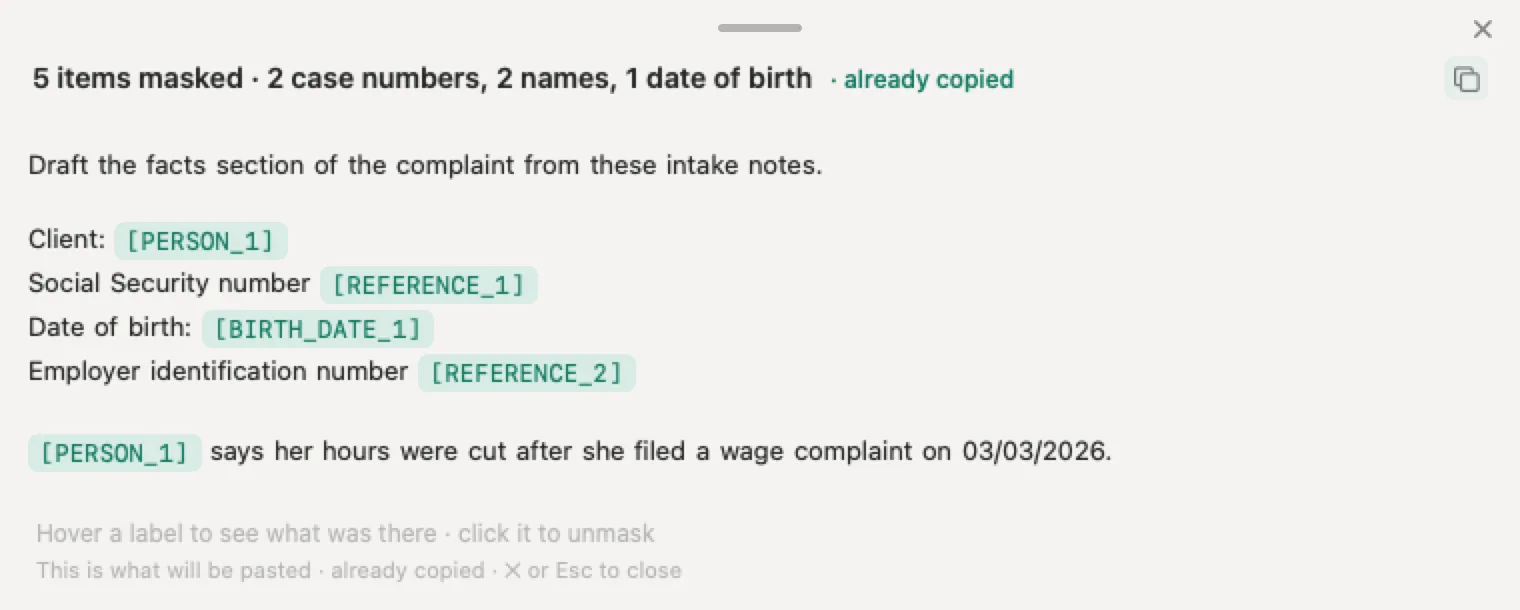
That is why the example hides an SSN no one could ever have been issued: the label vouched for it, and the date of birth and the employer identification number were caught by their field names. The client keeps one placeholder from the header to the last sentence, so the model reads one person throughout. The real names stay on the attorney’s machine, as our security page shows.
Before: what gets pasted
Draft the facts section of the complaint from these intake notes.

Client: Jane Doe
Social Security number 000-00-0001
Date of birth: 1970-02-30
Employer identification number 00-0000001

Jane Doe says her hours were cut after she filed a wage complaint on 03/03/2026.
After: what the AI receives
Draft the facts section of the complaint from these intake notes.

Client: [PERSON_1]
Social Security number [REFERENCE_1]
Date of birth: [BIRTH_DATE_1]
Employer identification number [REFERENCE_2]

[PERSON_1] says her hours were cut after she filed a wage complaint on 03/03/2026.
What the bar expects a law firm AI policy to cover
COPRAC wrote its 2026 guidance at the request of the California Supreme Court, replacing the 2023 version, and hangs the confidentiality duty on three rules: Business and Professions Code §6068(e), Rule 1.6 and Rule 1.8.2. It never uses the words redact or de-identify. What it asks a law firm AI policy to deliver is informed client consent and real diligence on the vendor. Consent needs its own engagement letter paragraph.
On diligence the committee is blunt: reasonable efforts “require more than reliance on generalized marketing assurances.” The ABA said the same about consent in Formal Opinion 512 on July 29, 2024: “merely adding general, boiler-plate provisions to engagement letters purporting to authorize the lawyer to use GAI is not sufficient.” Nonimo does not touch consent. It shrinks what you would be asking the client to consent to.
The Florida Bar, in Opinion 24-1 of January 19, 2024, says consent is not required where a generative AI program involves no disclosure of confidential information to a third party. We do not claim Nonimo puts you inside that sentence, since the facts of the matter still reach the vendor. No bar in the country endorses a product for this, ours included. Opinion 512 is unpacked in our redaction guide.
Putting the firm’s AI policy to work: price and getting started
The app runs on Mac and on Windows, and the installers for both systems sit in the header above. Nonimo’s free plan stops at a set number of words each month. Leave an email address on our license page and a free license file comes back that removes the cap through January 31, 2027, with no account to set up.
Every attorney who uses it installs it on their own machine. On every desk at once, IT deploys the browser extension by policy, which covers text unasked and, where the firm decides, blocks. What the policy can name is the step the app takes, on the machine, before the prompt travels.
The last thing a managing partner asks is what we see. Not one word of your documents; our security page lists everything the app does send. The app writes down none of the swaps, and the working conversation stays encrypted on the attorney’s own disk. The monthly allowance and how the license works are on the license page.
- Free today, on Mac and Windows
- With a monthly word allowance
- The free license lifts it through January 31, 2027, no account needed
Questions from the firm
Can attorneys use ChatGPT with client information?
In California, only within limits: COPRAC's 2026 guidance says no confidential client information into a tool that may present material risks, without the client's informed consent. The ABA's national position is Formal Opinion 512 of July 29, 2024, and your own state bar may have spoken too. Nonimo does not answer that question for the firm; it changes what is actually in the prompt once you have answered it.
We have ChatGPT Enterprise. Isn't that enough?
The bars that have written on it say the vendor's promise alone does not end the diligence. COPRAC puts it in one sentence: reasonable efforts "require more than reliance on generalized marketing assurances", and ABA Formal Opinion 512 and Florida Bar Opinion 24-1 point the same way. Nonimo adds a technical safeguard on the firm's side, so less of the client rides on the vendor's contract to begin with.
What should a law firm AI policy say about client data?
It should say which tools are approved, what may go into them, and who decides the exceptions. ABA Formal Opinion 512 makes lawyers "responsible for knowing how GAI uses data and putting in place adequate safeguards", so name the safeguards you actually use. If Nonimo is one of them, describe it accurately: an app on each attorney's computer that masks identifiers when the key is pressed and blocks nothing; blocking comes from the extension IT deploys.
Does Nonimo see our clients' information?
No. The matching runs on the attorney's own Mac or PC, and not one word of the document text leaves for our servers. A daily usage figure does: how much of this month's allowance is gone, the app version and the operating system, and nothing from your files. The security page lists each field in that daily figure, so the firm can check it against its own policy.
Can Nonimo produce a record of what was masked, for a client or a carrier?
Not of the masking itself: the app logs none of it. A firm running the compliance dashboard gets counts by category and a monthly report. What stays on the attorney's machine is the working conversation, stored encrypted, which is how the names get put back into the reply. The dashboard's counts carry categories, never the text of a document.