AI disclosure in US engagement letters: a sample clause
· Updated

Joaquín Trapero in AI and privacy expert, and founder of Nonimo.
An engagement letter is where most firms first put their use of AI in writing, and the paragraph is easy to borrow without checking what it promises. Telling the client and telling a judge are separate duties with separate rules; the court side has its own guide on AI disclosure in filings.
This page stays with the client: when telling becomes a duty, what five bars expect, and sample paragraphs you can copy for a law firm or a CPA firm. What the same rules look like at the attorney’s keyboard is on our page for US law firms.
No US rule makes you tell every client you use AI, but ABA Opinion 512 makes it a duty in six common situations. The one that shapes the letter is client information going into the tool. That needs informed consent, and the ABA says boilerplate in the engagement letter is not enough.
Do lawyers have to disclose AI use to clients? Six triggers in Opinion 512
Formal Opinion 512, issued July 29, 2024, opens softly. The facts of each matter decide, it says, and disclosure may be unnecessary. Then it lists the situations where telling the client is not optional, and for a firm using these tools on real files they are hard to avoid.
Two triggers come from the client: a question about how the work was done, or an engagement agreement or outside counsel guidelines requiring disclosure. Four arrive unprompted: client information going into the tool, a fee affected by it, an output that shapes a significant decision, and a client who hired you for your own judgment.
The third trigger brings informed consent, so it decides which paragraph your letter needs; our guide to what chatbot plans do with your data shows which plans learn from typed text. The decision trigger is the one I suspect firms miss most: a jury-selection tool doesn’t feel like a confidentiality question.
Which triggers apply to the matter you are opening?
Tick each one that is true. The list below tells you what each one puts in the letter.
0 of 6 apply
None ticked: under Opinion 512 telling the client is optional here. The ABA still calls the engagement agreement a logical place to explain how you use AI.
Each line above belongs in the letter, or in a conversation with the client, before the tool touches the matter.
My summary of ABA Formal Opinion 512, pages 7 to 9. The ABA says no list can cover every case, so treat this one as a floor.
What state bars say about telling clients you use AI
Opinion 512 binds no one; your state’s rules and its bar’s reading of them carry more weight. Read side by side, five state and city bar documents agree on fees far more than on disclosure. Pennsylvania’s joint opinion reads Rule 1.4 as requiring lawyers to tell clients the benefits, risks and limits of generative AI.
At the other end, Florida’s Opinion 24-1 states no general duty to tell, and concentrates on confidentiality and billing. The New York City Bar sits in the middle: consider disclosure for tools not generally understood as routine, and its footnote says autocomplete in a word processor or AI inside a research platform needs no disclosure.
If I practiced in two of these states, I would draft one letter to the strictest reading rather than keep two versions apart. A firm that wants the same rules in its internal policy can start from our AI policy template for US businesses. Use the filter to compare one question across the five.
Five bars, three questions an engagement letter answers
| Bar and document | Question | What it says |
|---|---|---|
| Pennsylvania, Joint Formal Opinion 2024-200 | Telling | Rule 1.4 requires informing the client of the benefits, risks and limits of generative AI |
| Pennsylvania | Client information | Educate the client and seek informed consent; obtain consent before using certain tools where necessary |
| Pennsylvania | Fees | AI-related expenses must be reasonable and disclosed to the client |
| California, COPRAC guidance, 2026 | Telling | Must consider disclosing the intended use, how, and its benefits and risks; must follow client instructions limiting AI |
| California | Client information | No confidential information into a tool with material risks, absent informed consent; marketing assurances are not enough |
| California | Fees | Subscriptions are overhead; per-matter AI costs only if the fee agreement says so, at actual cost, no markup without informed written consent |
| New York City Bar, Formal Opinion 2024-5 | Telling | Consider disclosing AI not generally understood to be routine, especially when explaining fees |
| New York City Bar | Client information | Obtain consent if client confidences will be disclosed through the tool |
| New York City Bar | Fees | No hourly fees for time the work would have taken without AI; AI costs disclosed in advance |
| Florida, Opinion 24-1 | Telling | No general duty to disclose stated |
| Florida | Client information | Consent recommended before a third-party tool sees confidential information; not required if none goes to a third party |
| Florida | Fees | Tell the client, preferably in writing, before charging actual AI cost; periodic charges you can't assign to one matter are overhead |
| Texas, Opinion 705 | Telling | Consider informing clients of the risks |
| Texas | Client information | Not reasonably satisfied with the tool's protections: no confidential input without consultation and consent |
| Texas | Fees | No charge for time saved; expenses limited to what was actually paid |
Pennsylvania 2024; California's guidance as revised in 2026; New York City Bar, August 7, 2024; Florida, January 19, 2024; Texas, February 2025. All advisory, none rule text.
AI clause template for an engagement letter, by situation
Pick the paragraph that matches what the firm does today, not what it plans for next year. The notice goes to every client. The client information paragraph comes in three versions, and a letter carries one. Square brackets are decisions, and a bracket left in the signed copy is a promise nobody finished writing.
The samples bars have published cover research, drafting and supervision. Of the three State Bar of Texas samples, one mentions client data and none mentions fees; New York’s 2024 task force sample covers neither. Version C depends on how the tool is hosted, which our comparison of a private LLM and a privacy proxy explains.
These paragraphs are a drafting start for a licensed lawyer to adapt to the firm, the client and the state, not legal advice. No bar has reviewed them, and your client’s guidelines can override any of them.
Sample engagement letter paragraphs on AI
The notice goes in every letter. Then pick how client information is handled.
Use of artificial intelligence. The Firm may use generative artificial intelligence software in your matter for [legal research, first drafts of documents and correspondence, summaries of transcripts and document productions, and proofreading]. A lawyer reviews and checks anything the software produces before the Firm relies on it or sends it to you or to anyone else, and the Firm remains responsible for all work on your matter. If you want the software kept out of your matter, or away from particular documents or tasks, tell us in writing and we will follow that instruction. [If following it changes the cost or timing of the work, we will tell you before going ahead.]
Your information. The Firm will not enter information relating to your matter into generative artificial intelligence software. We use it only with published law, our own blank forms and general questions that do not describe your matter. If that needs to change, we will first explain the specific software, the information involved and the risks, and ask for your written consent.
Your information. Before text from your matter is used with generative artificial intelligence software, the Firm replaces names, Social Security and other government identification numbers, dates of birth, addresses, telephone numbers and account numbers with placeholders, on computers the Firm controls, and then reviews the text for other details that could point to you or anyone else. The list linking each placeholder to the original stays with the Firm. The software still receives the facts of your matter, which the Firm continues to treat as confidential. [If that software may keep or learn from what it receives, the Firm will ask for your consent before using it.]
Version B never says "anonymized", and the difference between deidentified and anonymized is the reason.
Your consent to a specific tool. With your consent, the Firm would use [product and plan], provided by [company], with documents from your matter, including confidential and personal information about you and others, to [review the document production in less time and at lower cost than review by hand]. Our contract with [company] requires it to keep that information confidential, [not to use it to train its models,] to tell us of any security breach or legal demand for the information, and [to delete it within [number] days]. Even so, the information would be held outside the Firm, where a breach, a subpoena served on the provider or a failure in its controls could expose it. [Describe any risk particular to this matter.] You may refuse, and you may withdraw consent in writing for work not yet done. ☐ I consent ☐ I do not consent. [Client signature, printed name and date.]
If the firm's own software reaches the model through a hosted service in between, ask that service the same questions: an AI gateway usually logs every request.
Sample language written for this page. Not legal advice and not reviewed by any bar; adapt it to your state's rules before use.
Version C promises contract terms, so each one has to exist in the contract the firm signed. If a promise isn’t there, my advice is to strike the sentence rather than soften it. What business plans keep, and for how long, is set out for Claude’s plans.
The same questions apply to Microsoft Copilot and its training settings. A provider that changes its terms changes what the letter promises, so the check repeats.
Informed consent vs a boilerplate AI clause
A clause can tell the client something. It can’t ask. Opinion 512 says that adding general, boilerplate language to an engagement letter authorizing AI use does not produce informed consent. It then lists what the client must hear, and almost every item is a fact about one tool that a standard form can’t know.
The item that surprises people is the last: how far later users of the tool could reach the information. I can’t see how a firm explains that without reading the provider’s terms, which is the point. Whether removing names changes this analysis is taken up in our guide on redaction and privilege.
| Opinion 512 wants the client to hear | A typical boilerplate clause | Version C above |
|---|---|---|
| Why this tool is being used | "to improve efficiency" | The task, named in brackets |
| The kinds of client information that will go in | Not stated | Documents from the matter, confidential and personal information |
| How others might use it against the client | Not stated | Breach, subpoena to the provider, failed controls, plus the matter's own risk |
| Whether later users of the tool could reach it | Not stated | The training term in the provider contract |
| The benefit to the representation | Nothing beyond efficiency | Less time and lower cost on a named task |
| How the client agrees | Initialed with every other term | A separate box, signature and date, with the right to refuse |
The boilerplate column is a made-up example of the clause type the ABA turned down; it answers only the first item. Florida reaches a similar place by another road, recommending consent before a third-party program sees anything confidential and asking firms to check the provider’s confidentiality duty, breach notice and retention.
Billing AI costs and time saved in the fee agreement
Rule 1.5(b) already requires the basis of fees and expenses to be explained near the start, preferably in writing. Opinion 512 applies that to AI: before charging for a tool, explain the charge. Hourly work bills the time actually spent, including writing prompts and checking output, and never the hours the tool saved.
Flat fees aren’t an escape: the same flat fee for a task the tool made much faster may be unreasonable. Nor may a firm bill clients for learning a tool it uses for everyone, unless a client asks for one the firm doesn’t know. Run your own numbers here.
One drafting task, billed by the hour
Change the numbers to your own matter. The calculation stays in your browser.
A markup on the tool's cost needs the client's informed written consent in California, and the ABA allows a surcharge only with disclosure to the client.
Example numbers, not a fee recommendation. Hourly rule from Opinion 512, page 12; pass-through at cost and markup from California's 2026 guidance, page 8.
If your firm bills only flat fees, keep the last bracket and drop the hourly sentence. Which tools count as overhead is better settled once in the firm’s AI policy. Where nothing is charged per use, delete that bracket too. To me, a promise about costs that never arise only confuses clients.
Fees and costs for AI software. When we bill by the hour, we bill the time our lawyers and staff actually spend, including time spent instructing the software and checking what it produces, and never time the software saved. Software subscriptions used across the Firm are part of our overhead and are not charged to you, and we do not bill you for time spent learning tools we use for all clients. [If a task in your matter needs software charged per use, we will tell you before we start and bill you its actual cost, without markup.] [For flat-fee work: our flat fees reflect the time the work takes with the software we use.]
Engagement letters already signed and client instructions on AI
Rule 1.4(a)(1) sets the timing for open matters: when something needs the client’s informed consent, the lawyer tells the client promptly. So a letter signed last year doesn’t cover a tool adopted this month, if client information is about to go into it. I would not wait for the renewal letter in that case.
Client instructions point the same way. California says a lawyer must follow client instructions or guidelines that restrict AI, and the ABA calls the engagement agreement the place to record them. A corporate client’s outside counsel guidelines may already forbid particular tools, and they govern over anything in your own letter.
If client files already went into a tool nobody agreed to, the question is no longer the letter. Our guide on whether that counts as a data breach walks through what follows.
An open matter, and a tool the client hasn't heard about
Client information will reach the tool
Choose version B or C for this matter Send it as a short standalone letter For C, wait for the signed consent Keep the reply in the matter fileThe tool never sees the file
Run the other five triggers above Answer in writing if the client asks Add the notice at the next engagement letterTiming from Model Rule 1.4(a)(1) as read in Opinion 512, page 8. Shaded: the step that comes before any prompt.
AI disclosure for CPA firms under the AICPA code
No AICPA standard tells a CPA to disclose generative AI, a Journal of Accountancy column noted in April 2025, and it pointed CPAs to the ABA opinion as a model. Older interpretations of the code still reach an AI vendor, because the vendor sees confidential client information.
Under the third-party service provider interpretation, the client must be told, preferably in writing, before that information goes out, and the engagement letter can do it. The code predates these tools and never says an AI vendor counts. My working assumption is that it does. The firm-wide view is on our page for CPA firms.
Before client information reaches an AI vendor, under the AICPA code
Will confidential client information go into the tool?
Has the client been told, preferably in writing, that an outside provider may see it?
Does the vendor contract bind it to keep that information confidential?
My reading of AICPA Code interpretations ET 1.150.040 and 1.700.040, as summarized by the Journal of Accountancy. The code doesn't name AI vendors.
A confidentiality clause is easier to rely on when less leaves the office. Taking Social Security numbers out of client notes first is a habit worth making routine, in my view, since few AI tasks need them.
Clients also send copies of their ID when an engagement starts, and a watermark on a passport card copy at least records which engagement it was for. For the letter itself, this paragraph fits any engagement:
Sample engagement letter paragraph for a CPA firm
Artificial intelligence tools. [Firm] may use artificial intelligence tools provided by outside vendors to help with research, correspondence and organizing documents, and our staff review everything they produce. Before any of your confidential information goes to such a vendor, [Firm] will have a written agreement in place requiring the vendor to keep it confidential[, or will first ask for your consent]. You may ask us in writing to keep these tools away from your engagement.
Sample wording, not legal or professional advice. Check it against the current AICPA Code and any state board rules before use.
Keeping client identifiers out of the AI prompt
Version B commits the firm to a step before every prompt, so it has to be fast enough that nobody skips it. Nonimo runs on each attorney’s Mac or Windows PC: select the text, press its shortcut, and the names and numbers it detects become placeholders such as [PERSON_1] before the prompt goes out.
The answer comes back with the placeholders, and the app writes the original details back in on that same computer. That is the fact behind the clause’s words “computers the Firm controls”, and our security page explains where the mapping lives.
Intake notes once the shortcut is pressed
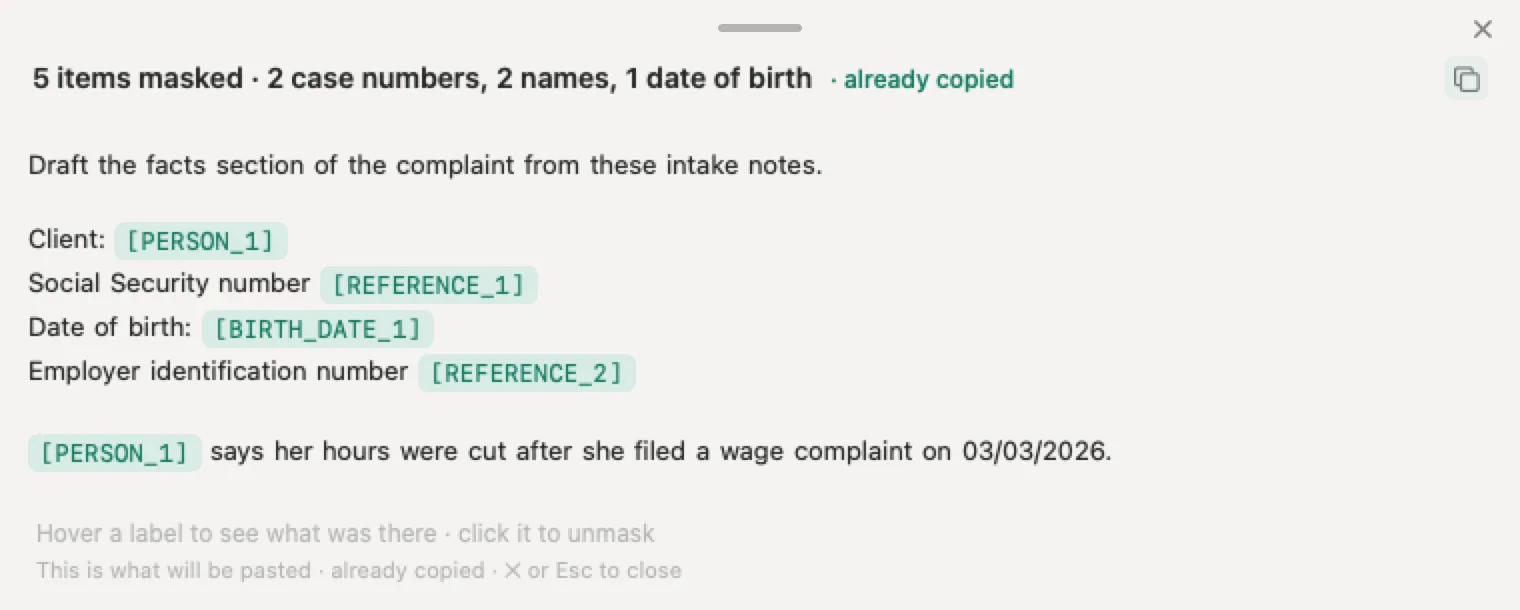
Nonimo for Mac on invented intake notes. Windows works the same way.
With identifiers handled, the review version B promises can go to context: an employer plus a date can identify a client too, as our checklist of identifying details shows. Because the firm can reverse the swap, “anonymous” is a word I would keep out of any letter that uses version B.

The engagement letter or the firm’s AI policy: what goes where
An engagement letter is a promise to one client, so it holds only what that client needs. How staff work belongs in the firm’s policy, which can change without a new letter to everyone. I would rather send a short letter that is true than a long one the firm can’t keep.
In the engagement letter
- The notice, with the tasks listed
- One client information version: A, B or C
- The fee paragraph
- A consent box whenever version C applies
- For CPA firms, the notice before client information reaches a vendor
In the firm's AI policy
- Which tools and plans are approved
- Who may use them, on which matters
- How output is checked before use
- What is recorded about each prompt
- Which provider terms are checked, and how often
Bar guidance in this area keeps being revised, and California rewrote its guidance this year, so check your state’s current opinion before the letter goes out. If version B is the paragraph you would rather sign, Nonimo replaces client identifiers on each attorney’s computer before anything reaches the AI tool.
Sources
- ABA Standing Committee on Ethics and Professional Responsibility, Formal Opinion 512, July 29, 2024: consent, boilerplate and the Rule 1.4 situations (pages 6 to 9); fees, overhead and learning time (pages 11 to 14); read in a copy reproduced in a conference packet of the U.S. Court of Appeals for the Armed Forces.
- State Bar of California, Practical Guidance for the Use of Generative AI in the Practice of Law, 2026 revision: confidentiality, disclosure and client instructions, fees and AI costs (pages 5, 7 and 8).
- The Florida Bar, Ethics Opinion 24-1, January 19, 2024: consent before third-party AI sees confidential information; costs and overhead; read in the Bar’s ethics packet on technology.
- New York City Bar, Formal Opinion 2024-5, August 7, 2024: disclosure of tools not routinely used, consent, fees.
- Professional Ethics Committee for the State Bar of Texas, Opinion 705, February 2025: consent, informing clients of risks, time saved, expenses.
- State Bar of Texas, Sample AI Disclosures for Attorney-Client Contracts, 2025: three sample clauses.
- New York State Bar Association, Report of the Task Force on Artificial Intelligence, April 2024: engagement letter statement and Appendix C sample.
- Pennsylvania Bar Association and Philadelphia Bar Association, Joint Formal Opinion 2024-200 (read in a copy hosted by LawNext; the pabar.org address returns “page not found”): Rule 1.4 and client communication.
- Journal of Accountancy (AICPA & CIMA), Should I disclose my use of gen AI to clients?, April 1, 2025, and Working with third-party experts, November 1, 2022: no AICPA disclosure mandate; ET 1.150.040 and 1.700.040 on third-party service providers.
Checked on November 7, 2026.
Common questions
Do lawyers have to disclose the use of AI to clients?
Not always, but often. ABA Opinion 512 makes it a duty when the client asks, guidelines require it, client information goes into the tool, the fee depends on it, or the output shapes a significant decision.
Do lawyers need client consent to use AI under ABA Opinion 512?
Only when information about the representation goes into a tool that could disclose it. Using a self-learning tool for idea generation, with nothing from the client, needs no consent.
Is a general AI clause in an engagement letter enough for consent?
No. The ABA says boilerplate authorizing AI use is not informed consent. The client has to hear why the tool is used, what goes in, the risks and the benefit, and then agree separately.
Can lawyers bill clients for time saved by AI?
No. Hourly billing covers time actually spent, prompting and checking included. Texas Opinion 705 and the ABA both rule out charging for hours a tool saved, and a flat fee must stay reasonable.
How is AI usage billed to clients?
Usually it isn't billed separately. Firm-wide subscriptions are overhead. A per-use charge for one matter can pass through at actual cost, disclosed in advance; California bars any markup without informed written consent.
Is there a free AI disclosure clause template for engagement letters?
Yes, this page has sample paragraphs to copy. There is a notice, three versions of the client information paragraph, a fee paragraph and a CPA version, all samples to adapt rather than legal advice.
Do CPA firms have to tell clients they use AI?
No AICPA standard requires it specifically. The code does require telling clients, preferably in writing, before confidential information goes to an outside service provider. Treating an AI vendor as one is the safe reading.
What are the ABA Model Rules regarding artificial intelligence?
No Model Rule is written for AI. Opinion 512 applies existing ones: competence (1.1), communication (1.4), fees (1.5), confidentiality (1.6), candor (3.1, 3.3, 8.4(c)) and supervision (5.1, 5.3).