Is putting client data in ChatGPT a reportable data breach?
· Updated

Joaquín Trapero in Founder of Nonimo, writing on AI and privacy.
A colleague pastes a client’s letter into ChatGPT to tidy up the wording. Nothing was hacked and nobody outside the firm saw it. Data protection law sees a disclosure: the client’s details now sit with a company your firm may have no contract with.
This guide separates the two questions people merge: did a breach happen, and do you have to report it. The first mostly turns on which account was used. The second carries a deadline, so my advice is to answer it first. For OpenAI’s half of the story, see how ChatGPT handles what you type.
Often, yes: identifiable client details pasted into an account your organisation doesn't control are an unauthorised disclosure. Reporting is a separate test, set by the risk to the people named. A business account used as your rules allow changes the first answer; removing identifiers before sending lowers the risk behind the second.
Does pasting client details into ChatGPT count as a disclosure?
Yes, under EU and UK law. The GDPR and UK GDPR define a personal data breach as a breach of security leading to the “unauthorised disclosure of, or access to” personal data. No attacker is needed. The European Data Protection Board calls this a confidentiality breach, and its guidelines cover “unauthorised or accidental” disclosure alike.
Australia’s regulator says it more bluntly. In its guidance on commercial AI products, staff at an insurer enter a customer’s claim details into a public chatbot, and the OAIC concludes that the insurer “is disclosing the information” to the chatbot’s owners. The reasoning travels well beyond Australia.
What turns a paste into a breach is the word unauthorised. A business account your organisation chose, used as your rules allow, is processing you decided on. A personal account opened over lunch is not, and I’d treat that one as a breach until someone shows otherwise.
Breach or not: sorting your paste
Could anyone in the pasted text be identified, by name, number, email or context?
Did it go into an account your organisation set up, used in a way your rules allow?
Built on GDPR Article 4(12), EDPB Guidelines 9/2022 and the OAIC's guidance on commercially available AI products. A first sort for your own notes, not legal advice for your matter.
Is it safe to put personal data into ChatGPT? It depends on the account
The plan someone signs in with moves the answer more than anything else. OpenAI’s pricing page shows one line for Free, Go, Plus and Pro: content is used to train its models, with an opt-out available. Its ChatGPT Business page says the opposite: “Your data is never used for training our models.”
Training is only one part. A personal account also leaves the firm without a contract with OpenAI and without any admin view of what was sent. That gap is what makes the disclosure unauthorised. The opt-out doesn’t close that gap, so my line is simple: a personal plan never sees a client file.
The API is different again. OpenAI’s developer documentation says data sent to it is not used to train models, and that abuse-monitoring logs are kept for up to 30 days unless the law requires longer. A US practice holding patient records has one more gate first: whether a business associate agreement covers the product.
The same paste, three kinds of account
Find the row your colleague used.
| Account | Training on your content | Contract sits with | How we read a paste |
|---|---|---|---|
| Free, Go, Plus or Pro, signed in personally | Yes, opt-out available | The individual user | Unauthorised disclosure: assess it |
| ChatGPT Business, set up by the firm | "Never used for training" | The firm | Usually authorised, if your rules allowed that use |
| API, called from the firm's own software | Not used for training | The firm | Authorised; abuse logs kept up to 30 days |
Training column: ChatGPT pricing page, ChatGPT Business page and OpenAI's API data documentation, 10 November 2026. The last two columns are our reading, not OpenAI's.
Accidentally put sensitive data in ChatGPT? The first hour
In EU and UK law the 72 hours run from awareness, not from the paste. The EDPB places awareness at the point where you have “a reasonable degree of certainty” that personal data was compromised, and allows a short investigation before that. So write the time down as soon as you know.
Deleting the chat is sensible, but it doesn’t undo the disclosure: the text has already left. Removing a conversation from ChatGPT properly explains what deletion reaches and what it doesn’t. Do it after you’ve noted what was in the chat, not before.
If an outside IT provider manages your accounts, ask them today which account was used and who signed in. I’d insist on one named person owning the decision from here, because a group chat produces five versions of the same facts.
The first hour, ticked off
Tick what's already done.
0 of 7
Nothing ticked yet. Start with the contents, while memory is fresh.
Each unticked line is a question someone will ask you later.
The first hour is covered. Next comes the reporting test.
The breach log comes from GDPR Article 33(5), which requires documenting every personal data breach, reported or not.
Do you have to report it? The test changes with the regime
Whether a paste must be reported is a different question from whether it happened. Most regimes ask about the risk to the people in the text, not about how the data left. The thresholds differ, and so do the clocks.
Geography is less of an escape than people hope. Article 3(2) of the GDPR reaches firms outside the EU that offer services to people inside it, much as the EU AI Act follows the people it affects. A Toronto firm offering its services to clients in Lyon is in scope for their data.
I lean towards reporting the borderline case rather than arguing months later that it was too small to count. Pick the example closest to where you and the people in your text are.
Four regimes, side by side
Examples, not a full list. Which rules reach you depends on where your organisation is and where the people in the text are.
Test: notify the supervisory authority unless the breach is "unlikely to result in a risk" to people's rights and freedoms.
Clock: without undue delay and, where feasible, within 72 hours of awareness; later notices must give reasons.
Who else hears: the people themselves when the risk is high (Article 34). In Ireland the authority is the Data Protection Commission.
Test: the UK GDPR keeps the same exception for breaches unlikely to result in a risk.
Clock: the same 72 hours from awareness, where feasible.
Who hears: the Information Commission, and the people affected when the risk to them is high.
Test: an eligible data breach means unauthorised access or disclosure, likely serious harm to someone, and no remedial action that prevents it.
Clock: a suspected breach must be assessed quickly; then notify affected people and the OAIC.
Which products an Australian firm can use at all turns on how the Privacy Act treats each AI tool.
Public bodies face the same scheme; the guide for councils covers their side.
Test: no single federal law. The FTC notes that all states, the District of Columbia, Puerto Rico and the Virgin Islands have breach notification laws; each statute sets its own trigger.
Clock: set by each statute; check the law where each affected person lives.
Patient data: for a HIPAA covered entity or business associate, a disclosure the Privacy Rule doesn't permit is presumed a breach (45 CFR 164.402) unless a risk assessment shows a low probability of compromise. For unsecured health information, the covered entity tells patients within 60 calendar days of discovery (164.404) and HHS at the same time if 500 or more are affected, otherwise in a yearly log (164.408).
Breaches of electronic personal health records can bring in the FTC's Health Breach Notification Rule instead.
GDPR Articles 33 and 34 (EUR-Lex); UK GDPR Article 33 (legislation.gov.uk); OAIC, when to report a data breach; FTC, Data Breach Response: A Guide for Business; 45 CFR 164.402 to 164.408, 2024 edition (govinfo.gov).
Can an employee be personally responsible for a GDPR breach?
Under the EU and UK GDPR the organisation answers. Article 24 puts the duty to have “appropriate technical and organisational measures” on the controller. The EDPB adds that employees with access to personal data are generally not controllers, but persons acting under the controller’s authority, which is Article 29’s wording.
That cuts both ways. The firm can’t hide behind the employee who pasted the letter, because writing the rule and enforcing it was the firm’s job. A ready-made AI policy closes that gap in an afternoon, and I’m against letting any team near a chatbot until it’s signed.
Professional confidentiality is a separate duty, and it usually attaches to the professional personally. It also covers a client company’s trade secrets and figures, where data protection law has nothing to say because no individual is identified.
Four duties one paste can break
The same act can answer to several of them at once.
| Duty | Owed by | Owed to | Turns on |
|---|---|---|---|
| Data protection (GDPR and similar laws) | The organisation, as controller | The people in the text | Was the disclosure authorised, and how risky is it |
| Professional confidentiality | The lawyer, accountant or clinician | The client or patient | Consent and reasonable safeguards. ABA Opinion 512, for one, requires informed consent before client information goes into a self-learning AI tool |
| Contract or NDA | The firm | The client | What the engagement terms say about third parties |
| Employment rules | The employee | The employer | Whether the AI policy allowed it |
Rows 1 and 2: GDPR Articles 24 and 29; EDPB Guidelines 07/2020; ABA Formal Opinion 512, 29 July 2024, which also says general boilerplate in an engagement letter is not enough. Rows 3 and 4 describe ordinary contract and employment terms.
Taking the names out first: when text stops being personal data
Recital 26 of the GDPR draws the line. Pseudonymised data that can be linked back to a person “by the use of additional information” is still personal data, while anonymous information falls outside the regulation. A placeholder swap you can reverse sits on the first side, as de-identified versus anonymised sets out.
That doesn’t make redaction pointless. If ChatGPT only ever sees placeholders, a leak or a long retention exposes nothing that points to a person, and the risk to the people in the text falls sharply. Risk is the very test Article 33 applies.
Context can still give someone away. A dismissal at a small named employer identifies the claimant to anyone in that town, so I’d read every redacted text once before it goes. For choosing software, a survey of redaction tools by type is the place to compare.
One invented note, before and after
What the model sees once identifiers are swapped.
Ilse Varnholt (ilse.varnholt@example.com, +1 312 555 0186) wants to contest her dismissal from Brackenridge Joinery. She was signed off with anxiety in March.
[PERSON_1] ([EMAIL_1], [PHONE_1]) wants to contest her dismissal from [COMPANY_1]. She was signed off with anxiety in March.
Fictional data. The health detail stays, and it's still personal data for whoever holds the key. Where the context alone identifies the matter, a private model may suit better than a privacy proxy.

If it were my firm: three rules before anyone pastes again
I’d say no to a ban, because people use their own phones instead, where the firm sees nothing. Business accounts with a signed rule are the floor. Taking identifiers out before the text leaves is what keeps a slip from turning into a reportable event, and the rest of our guides cover each step.
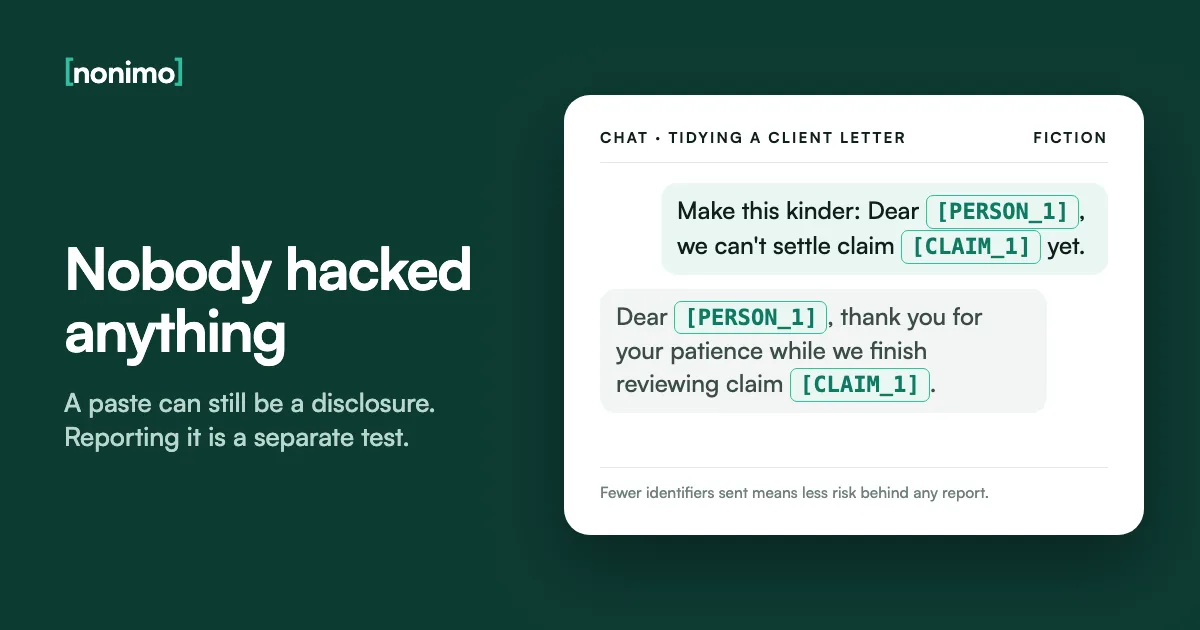
That last step is what Nonimo does before ChatGPT reads a word: it swaps client names, emails, numbers and other identifiers for placeholders, then puts the real values back into the answer. Where your own software calls the API, the same swap can run on your own server.
Three policies for the next paste
Our ranking for a small professional firm.
Ban or block
- Nothing to configure on day one
- Use moves to personal devices, out of view
- Prompt-blocking tools exist; how Nightfall flags prompts shows that model
Business accounts and a rule
- The firm holds the contract; OpenAI says business data isn't used for training
- A slip still sends real names
- Rolling it out firm-wide: Nonimo for organisations
Business accounts, a rule and redaction first
- The model sees placeholders, not clients
- Real values return in the answer
- For API traffic, the Gateway on your server; how text is handled is on our security page
The ranking is our judgement. The training statement is from OpenAI's ChatGPT Business page.
Sources
- GDPR, Regulation (EU) 2016/679, on EUR-Lex: Articles 3(2), 4(12), 24, 29, 33 and 34; Recitals 26 and 30.
- EDPB, Guidelines 9/2022 on personal data breach notification (PDF), version 2.0, 28 March 2023: awareness, confidentiality breaches, the internal register.
- EDPB, Guidelines 07/2020 on the concepts of controller and processor, version 2.1, on the EDPB website: employees act under the controller’s authority.
- UK GDPR Article 33, legislation.gov.uk: the UK’s 72-hour rule.
- OAIC, guidance on privacy and commercially available AI products, updated 17 January 2025: the insurer example.
- OAIC, when to report a data breach: the three criteria and the quick assessment.
- FTC, Data Breach Response: A Guide for Business: breach notification laws in all states, DC, Puerto Rico and the Virgin Islands; the HIPAA and FTC health breach rules.
- 45 CFR Part 164, Subpart D, 2024 edition (govinfo.gov): HIPAA breach definition and presumption, 60-day notice to individuals, notice to HHS.
- ChatGPT pricing: personal plans train on content, with an opt-out; Enterprise has no training on business data by default.
- ChatGPT Business: “Your data is never used for training our models.”
- OpenAI, Your data, API platform documentation on developers.openai.com: API data not used for training by default; abuse-monitoring logs kept up to 30 days.
- ABA Formal Opinion 512 (PDF), 29 July 2024, copy hosted by the National Conference of Bar Presidents: informed consent under Model Rule 1.6.
Accessed 10 November 2026.
Common questions
Is putting client data in ChatGPT a data breach?
Often, yes. Identifiable client details sent to an account your organisation doesn't control are an unauthorised disclosure. Whether you must report it is a second test, set by the risk to the people named.
Is it safe to put personal data into ChatGPT?
Not on a personal plan, and not with names left in. OpenAI's pricing page says content on Free, Go, Plus and Pro is used to train its models, with an opt-out.
Is it safe to upload financial data into ChatGPT?
Only once names and account numbers are gone. Bank and card details tied to a person raise the chance of fraud. Totals, trends and ratios with no one attached are far less sensitive.
Can I put confidential information in ChatGPT Enterprise?
Sometimes, if your contract and internal rules allow it. OpenAI's pricing page lists Enterprise with no training on business data by default and custom retention policies. What you owe a client under your engagement terms is a separate matter.
Can an individual employee be responsible for a GDPR breach?
Usually the organisation answers, not the employee. The EDPB treats staff as people acting under the controller's authority. Your own policy can still lead to disciplinary action internally.
Do I have to tell the client if their data went into ChatGPT?
Not always under data protection law. The GDPR requires telling people only when the risk to them is high. Your contract or professional rules may require it anyway.
Is an IP address personal data under GDPR?
Yes, it can be. Recital 30 names internet protocol addresses among the online identifiers that can single people out. A server log pasted into a chatbot can be personal data too.