ChatGPT in an accountancy practice: what the payroll query carries
Your Institute put its finger on it in August: confidentiality risk tends to come out of the ordinary run of the day rather than bad intent, and the first example in its guide is copying sensitive data into an AI system to get a draft. In a practice that’s the payroll query, the reply to a Revenue letter, or year-end notes that need tightening.
Every one of those carries numbers. The payroll query has the employee’s PPS number, the Revenue reply the client’s VAT number, the refund email an IBAN. They’re the lines nobody reads twice by the fourth draft, and the ones a CCAB-I alert had in mind. Who may use a PPSN at all is covered in our PPSN guide for Irish businesses.
So can accountants use ChatGPT for this kind of work? They can, if the personal data doesn’t travel with the question. Read literally, the prohibition leaves a practice two options: stop using the tool, or keep the identifiers out of it. Nonimo is the second option, carried out on the machine on the desk before anybody pastes a thing.
Chartered accountants and ChatGPT: what arrives once the key is pressed
It all happens on the PC or Mac in front of you. No server of ours sits in between, and the numbers Nonimo covers never leave that machine, as the security page sets out. Highlight the passage and hit the key. ChatGPT, Claude, Copilot or something else, the tab makes no odds, and the covered numbers are put back once the reply lands.
Each number is treated one of two ways. If a check digit settles what it is, a marker takes its place with no prompt. If it could be something else, it’s covered on screen with a reason, and one click brings it back. Either way, the real number goes back into the reply when it arrives, on the same machine.
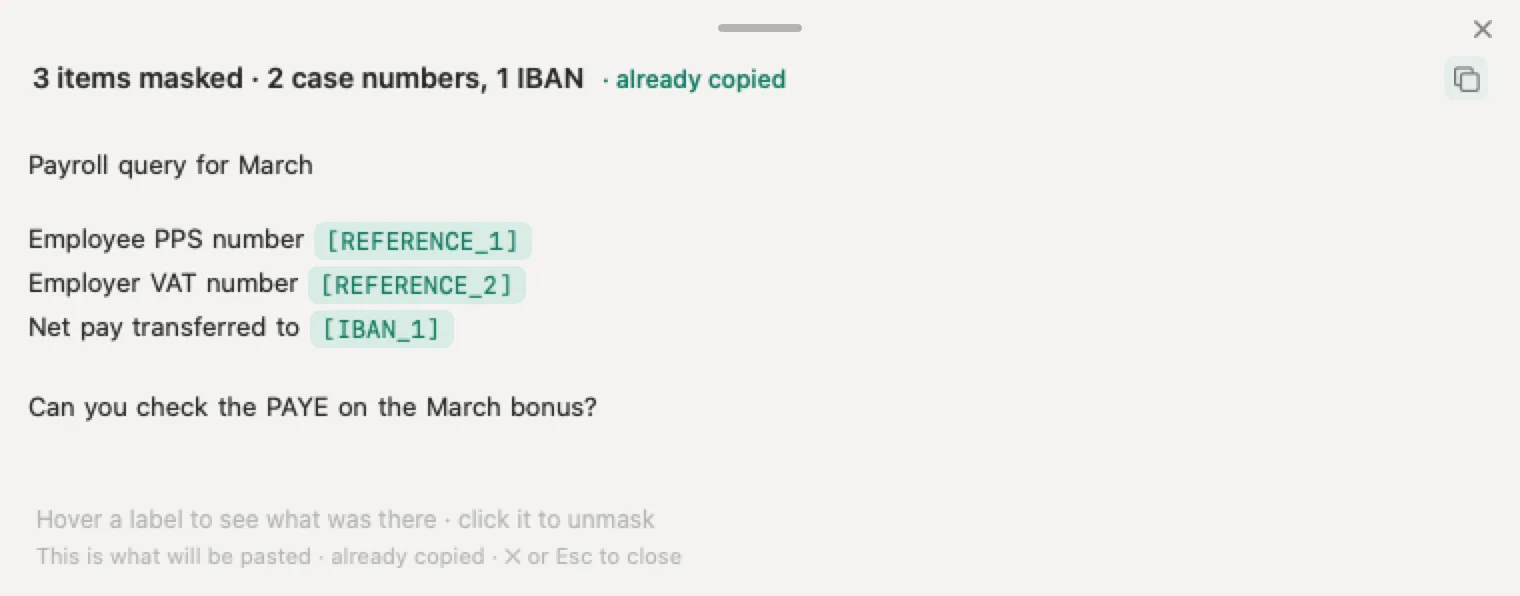
The payroll query alongside is invented from start to finish, and none of its three numbers reaches the tab. The IBAN’s check digits settle what it is, so a marker takes its place with no prompt. The PPS number and the VAT number are covered in view as references, each with its label right beside it, and one click brings either back.
Before: what gets pasted
Payroll query for March

Employee PPS number 0000000X
Employer VAT number IE1234567WH
Net pay transferred to IE29 AIBK 9311 5212 3456 78

Can you check the PAYE on the March bonus?
After: what the AI receives
Payroll query for March

Employee PPS number [REFERENCE_1]
Employer VAT number [REFERENCE_2]
Net pay transferred to [IBAN_1]

Can you check the PAYE on the March bonus?
Can accountants use ChatGPT under the CCAB-I prohibition?
The CCAB-I, which is your Institute and ACCA together, published its technical alert on a firm’s AI policy in February 2025, and the line quoted here is the one that bites. The same alert says whatever goes in must not breach any duty of confidentiality. It doesn’t mention enterprise licences, vendors or retention once: the prohibition is on the data.
That matters when a partner asks whether the Copilot licence covers it, and which Copilot the practice actually has is worth checking first. Your Institute’s August guide does describe working through a controlled enterprise environment, a sensible control. The same guide also counts client data used in an AI system outside the organisation’s control, shadow AI, as a threat of its own.
So can accountants use ChatGPT and still keep that line? The honest route is for the PPS number, the VAT number and the IBAN not to be in what reaches the AI system. The salary figure and the question still are, because that’s what you wanted help with. And the Code of Ethics duty stays yours: the guide applies it to any data shared with AI systems.
An accountants’ AI policy for ChatGPT: the Institute’s first question
Before anything is entered, your Institute’s guide asks four questions, and the first is whether any of the data is identifiable, sensitive or confidential. Nonimo shrinks the honest answer to that first part. It doesn’t turn it into a no: what the file says about a client’s affairs still goes, and a colleague still judges whether that points to them. Say so to the client in the letter of engagement.
That’s why a practice AI policy needs a rule people can see working at the desk. Those two cards alongside hold the entire rule: anything a check settles is replaced, and anything that could be read two ways is covered in view for the person to decide. Nothing is held back either; sending remains your colleague’s decision.
More guidance is on the way. The CCAB published an exposure draft of a statement to the profession on AI use in July 2026, and your Institute has asked members to help shape it. Until the final text is out, the alert and the guide are what a practice policy answers to, alongside the EU AI Act duties in Ireland.
ChatGPT for accountants: cost, and getting it onto the practice’s machines
Download Nonimo on Windows 10 or 11, or on a Mac with Apple Silicon running macOS 14 or newer. Nonimo’s free plan stops at a set number of words each month. Leave an email address on our licence page and a free licence file comes back that removes the cap until 31 January 2027, with no account to set up.
Across the whole practice, IT deploys the browser extension by policy, which covers text unasked and, where the practice decides, blocks; hello@nonimo.ai sets it up. The practical first step is the desks where ChatGPT is already open, rather than a project that waits for a quiet month. Whoever does the payroll and the Revenue correspondence is usually the right place to start, since that’s where the PPS numbers live.
One thing does go from each machine to us daily: a usage tally, meaning how much of the allowance went, which version and which platform. There’s no switch for it on either Windows or Mac, and none of your text is in it. Nothing is logged about what was covered.
- Free today, on Mac and Windows
- With a monthly word allowance
- The free licence lifts it until 31 January 2027, no account needed
Questions accountants ask us
Can accountants use ChatGPT with client data?
Not with personal data in it, going by the CCAB-I. Its February 2025 technical alert says there must be a prohibition on using personal or sensitive data in AI systems, and that nothing put in may breach a duty of confidentiality. Nonimo covers the PPS number, the VAT number and the IBAN on the practice's own computer, so the question can go without them.
We have Copilot through our Microsoft licence. Doesn't that cover it?
Not on its own. The CCAB-I prohibition is about the data, and the alert doesn't mention enterprise versions or vendors once. Your Institute's August 2026 guide describes controlled enterprise environments, yet still asks first whether any of the data is identifiable, whatever the tool. Nonimo works on the desk, whichever tool happens to be open, and shrinks the answer to that question.
Isn't a total ban on personal data in AI unworkable?
Read literally, it leaves a practice two options: stop using the tool, or stop the personal data going in. The alert offers no third route and carves out no licence. Nonimo is the second option, done on the machine with one key: the employee's PPS number and the client's VAT number are covered before the paste, and the question itself still arrives.
Is a PPS number more than ordinary personal data?
In one respect, yes: Irish law also limits who may use a PPSN at all, under section 262 of the 2005 Social Welfare Consolidation Act. No Irish decision has yet applied that to a PPS number put into a prompt, so treat it as a risk rather than a settled rule. Nonimo covers the PPS number in plain view, before the prompt goes anywhere.
Does Nonimo make client data anonymous?
No. Your Institute's own guide warns that anonymisation may not by itself remove confidentiality risk, and the Data Protection Commission said in 2019 that masking alone won't normally count as anonymisation. Removing the direct identifiers has to come first, and that's the part Nonimo does, on the practice's own machine.