AI for insurance brokers in Ireland: what a claim file carries
Ask any Irish brokerage what AI for insurance brokers looks like day to day, and the honest answer is a chatbot open on the claims desk.
A motor claim form is back from the client with a copy of their driving licence, there’s a garage estimate and three lines from a phone call, and somebody wants a covering letter the claims handler will actually read.
The claim form is full of the client. One insurer’s Irish motor form asks for the policyholder’s name, address, date of birth, policy number, mobile and email, the vehicle registration, the driver’s licence number and penalty points, and the extent of anyone’s injuries. A health insurance application wants the PPS number, for tax relief at source, and a life or income protection proposal adds a medical history.
An injury on a motor claim, or a disclosure on an income protection proposal, is health data, and the GDPR puts it in the special categories of Article 9, as our guide to special category data explains. The estimate, the damage and how the accident happened are another matter. None of that points to a person, and it’s exactly what the letter needs.
Drafting the motor claim letter with ChatGPT, minus the client
Highlight the claim note and press the key: Nonimo swaps every detail it recognises for a marker on that computer and keeps the originals there. ChatGPT drafts around the markers, and the client’s details come back on your screen.
It works the same on a Mac or a Windows PC, and with Claude or Copilot; what stays on the machine and what leaves it is listed on our security page.
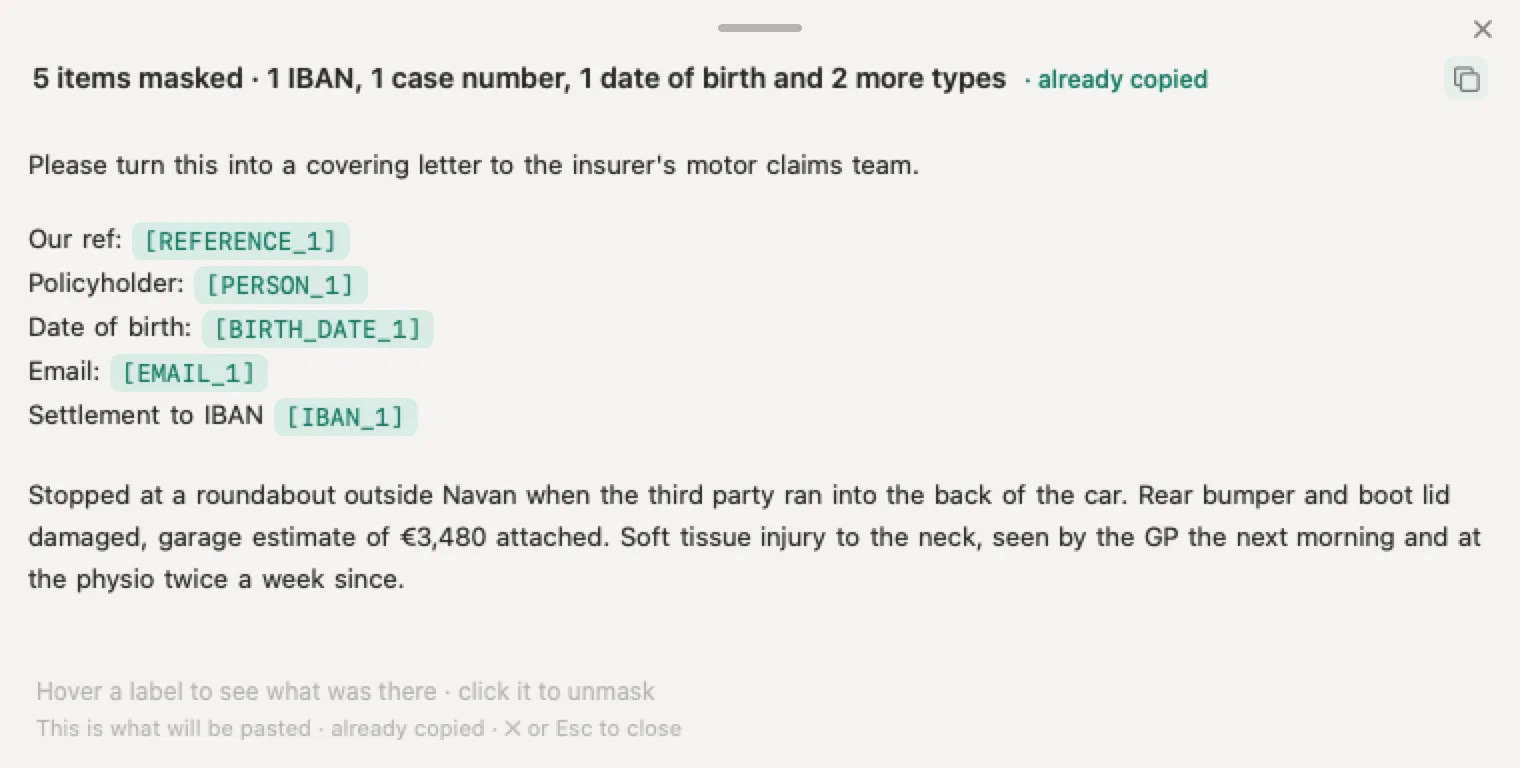
Look at the made-up note beside this: the brokerage’s own reference, the policyholder, the date of birth, the email and the IBAN have all gone to markers. The claims handler still gets a usable letter, since the roundabout, the damage, the estimate and the physio stay as typed. A policy number, a claim number or a PPS number is covered the same way when it follows its label.
If a value leaves no room for doubt, it’s replaced straight away. If it could be something else, it’s covered in plain view, with the reason beside it, and a click puts it back. The note is still personal data for your office, and the injury still health data, because you hold the originals; our guide to pseudonymised data explains why.
Before: what gets pasted
Please turn this into a covering letter to the insurer's motor claims team.

Our ref: 0000/00
Policyholder: A.B.
Date of birth: 30/02/1979
Email: policyholder@example.com
Settlement to IBAN IE29 AIBK 9311 5212 3456 78

Stopped at a roundabout outside Navan when the third party ran into the back of the car. Rear bumper and boot lid damaged, garage estimate of €3,480 attached. Soft tissue injury to the neck, seen by the GP the next morning and at the physio twice a week since.
After: what the AI receives
Please turn this into a covering letter to the insurer's motor claims team.

Our ref: [REFERENCE_1]
Policyholder: [PERSON_1]
Date of birth: [BIRTH_DATE_1]
Email: [EMAIL_1]
Settlement to IBAN [IBAN_1]

Stopped at a roundabout outside Navan when the third party ran into the back of the car. Rear bumper and boot lid damaged, garage estimate of €3,480 attached. Soft tissue injury to the neck, seen by the GP the next morning and at the physio twice a week since.
Regulation 49 of the Consumer Protection Code, on the claims desk
The Central Bank’s revised Consumer Protection Code came into operation on 24 March 2026, as S.I. No. 81 of 2025, and it applies to brokers, as to every regulated firm, in their dealings with consumers.
The word AI isn’t in it. Regulation 49, quoted here, is about something older: when you deal with clients by electronic means, what they send you has to be kept secure.
A claim form emailed in by a client is information received by electronic media, and so is the licence copy behind a motor claim or the medical report behind an income protection claim. Paste either into a chatbot and a copy leaves the arrangements your office put in place, under terms you never negotiated. Regulation 356 adds the clock: a broker helping with a claim sends the documents on within one working day.
That working day is exactly when someone reaches for ChatGPT to tidy the covering letter. Nonimo takes the client’s details out at that moment, at the desk where the note is written, and the rest of the letter goes as drafted. Where ChatGPT, Claude, Gemini and Copilot stand under the GDPR, personal account against business account, is in our guide to the GDPR and four assistants.
What it costs, and starting with the claims desk
One PC on the claims desk is enough to begin, Mac or Windows, and you’ll find the download at the top of this page.
Nonimo’s free plan stops at a set number of words each month. Leave an email address on our licence page and a free licence file comes back that removes the cap until 31 January 2027, with no account to set up. Start where the claims come in, then move to the account handlers on renewals, then life and pensions.
There’s no shortage of AI sold to brokers: quoting tools, renewal software, whole platforms. Nonimo isn’t one more of them. It goes between your staff and whichever chat assistant they already use. Each desk installs the app itself, and to reach every machine at once your IT provider can push a browser extension by policy, which covers text with no key at all; the setup is on organisations.
Pick a claim note from last month, press the key and read what ChatGPT would otherwise have been given. And when an SME client asks what its own cyber policy says about AI, our guide to cyber insurance in Ireland has read the Irish wordings.
- Free plan, on Mac and Windows
- With a monthly word allowance
- The free licence lifts it until 31 January 2027, no account needed
Questions principals and claims staff ask us
How does the Central Bank treat AI for insurance brokers in Ireland?
Nothing in its rules names it. The Consumer Protection Code 2025, in operation since 24 March 2026, doesn't use the word AI; it asks a broker to keep secure the information clients send in electronically, and the GDPR applies to each detail pasted. No rule stops an office using ChatGPT or Copilot. Nonimo covers the policyholder's name, date of birth, contact details, references and IBAN on the office PC first.
Is ChatGPT safe for insurance brokers?
For wording, yes, provided the client isn't in the prompt. A personal ChatGPT account runs on consumer terms with no processing contract with your brokerage, while a business subscription comes with a data processing agreement. Neither undoes what you've already sent. Nonimo sits between the desk and either plan, or Claude or Copilot, so what it recognises is already a marker when the provider receives the note.
Are the vehicle registration and licence number picked up?
Yes. The registration is covered after labels such as Vehicle registration, Reg no. or Car reg, and the driver number and the licence number after their own labels. You see each change before anything goes out.
What does Regulation 356 ask of a broker on a claim?
Speed. Where an intermediary helps a consumer make a claim, the completed claim documents go to the insurer within one working day of arriving. The regulation says nothing about how the covering letter gets written. If it's drafted with a chat assistant, Nonimo takes the client's name, date of birth, references and bank details out at the desk first, so the deadline isn't met at the expense of the file.
Who signs off on it in a brokerage?
Usually the principal, together with whoever holds the compliance role, since the Code binds the firm and they sign off its procedures, and the data protection officer where there is one. The decision itself is a small one: which desks install the app first, and whether your IT provider rolls out the browser extension by policy for the whole office. Nothing changes in how claims go to insurers.
Does anything about our clients reach Nonimo?
Nothing from your files. The work happens on the computer where the text is highlighted, so no word about any client, and none of the terms on your office's own list, ever reaches us. You won't need an account with us.