AI for local authorities: what a housing query carries
In a local authority, what ends up in ChatGPT is rarely a whole file. It’s the reply to a HAP query, a summary of a housing application for the senior executive officer, or the response to a submission on a planning file.
Nearly all of them carry the same details: the applicant’s name, PPS number and date of birth, the address and Eircode, an email and a mobile, and the council’s own file reference. A differential rent query adds an IBAN, and a housing file adds the household.
What council staff already use AI for, and what the DPC and the NCSC ask of the 31 authorities, is set out in our guide to AI in Irish local authorities.
A HAP query in the chat, with the applicant as placeholders
In the housing section, the staff member highlights the query, presses the key and pastes it into ChatGPT, Claude or Copilot. The chat receives the version with placeholders, and nothing about the applicant reaches us.
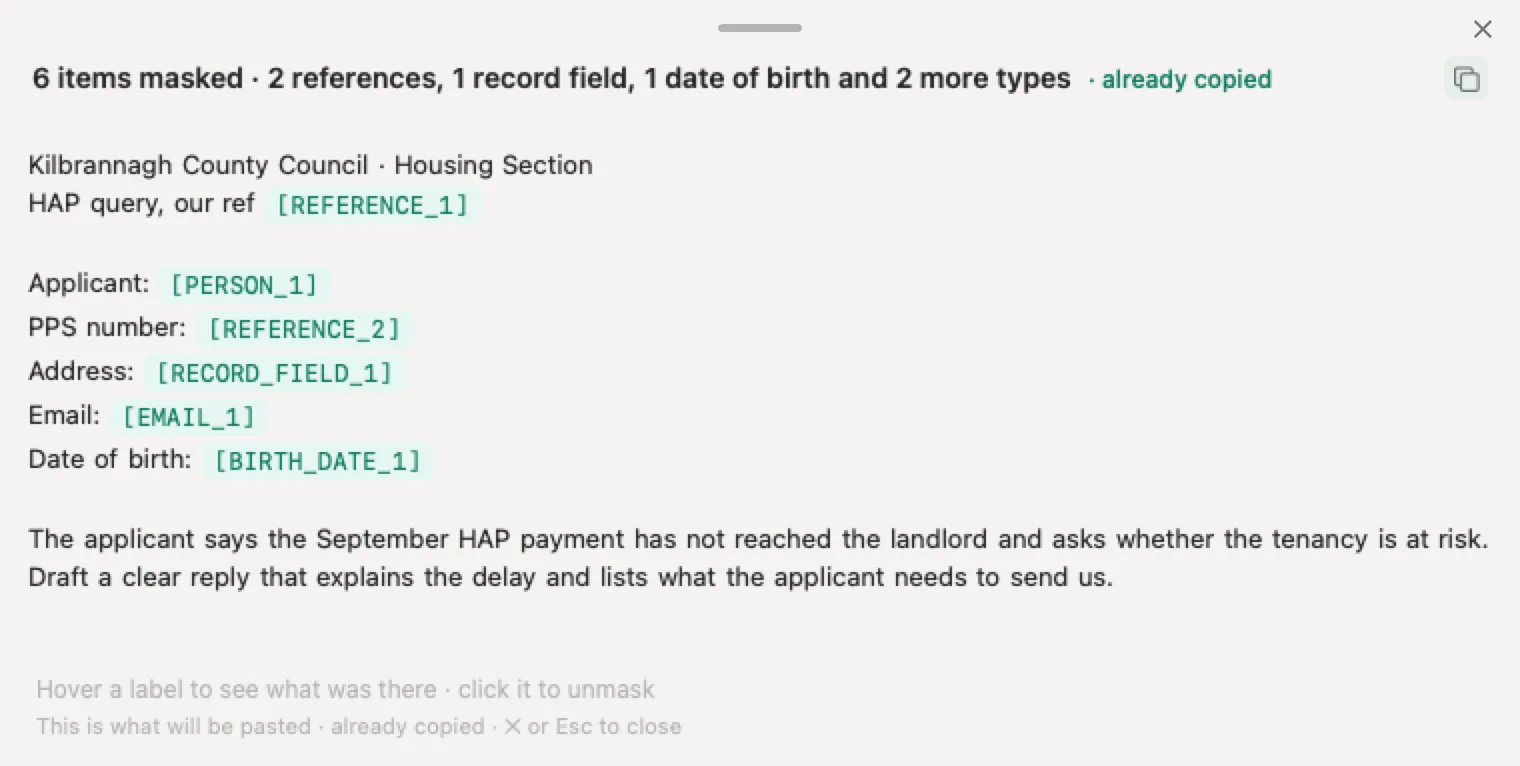
In the invented query below, Nonimo has masked six details: the file reference, the applicant’s name, the PPS number, the address, the email and the date of birth. The late payment, the landlord and the worry about the tenancy stay whole, which is all the AI needs to draft the reply.
The AI writes to [PERSON_1]. You copy the reply, press the key again and the applicant’s real name comes back on screen, ready to check and send.
Before: what gets pasted
Kilbrannagh County Council · Housing Section
HAP query, our ref HA/2026/004512

Applicant: A.B. Citizen
PPS number: 0000000X
Address: 0 Example Terrace, Kilbrannagh
Email: a.citizen@example.com
Date of birth: 30/02/1985

The applicant says the September HAP payment has not reached the landlord and asks whether the tenancy is at risk.
Draft a clear reply that explains the delay and lists what the applicant needs to send us.
After: what the AI receives
Kilbrannagh County Council · Housing Section
HAP query, our ref [REFERENCE_1]

Applicant: [PERSON_1]
PPS number: [REFERENCE_2]
Address: [RECORD_FIELD_1]
Email: [EMAIL_1]
Date of birth: [BIRTH_DATE_1]

The applicant says the September HAP payment has not reached the landlord and asks whether the tenancy is at risk.
Draft a clear reply that explains the delay and lists what the applicant needs to send us.
What the public service guidelines ask of staff using AI
The Government’s guidelines for AI in the public service tell staff to avoid putting personal data into generative AI systems, and they say it about the tools an organisation has made available, not only the publicly available ones. Replacing the applicant’s identifiers with placeholders before the text leaves the computer is how a busy desk follows that advice and still gets the draft.
For the data protection officer it is a measure explained in one sentence, with no server in the middle to assess: nothing is uploaded to be cleaned, and our security page lists what stays on the machine.
Why a PPS number still counts as personal data once it sits in a prompt is worked through in our guide to the PPSN.
The council’s name, readable on purpose
Nonimo masks who the file is about, not who is writing: the council, the section and the scheme stay readable, because they’re the context the AI needs to answer well.
What leaves no doubt, such as an email address or an IBAN, is replaced straight away. What Nonimo recognises from its label, like the applicant or the PPS number, is replaced too, and everything shows on screen before you paste.
It helps to write down what each member of staff may paste and into which chat, and our model AI policy gives the authority a starting point.
Nonimo for local authorities: price and where to start
ChatGPT for local authorities with Nonimo needs a PC with Windows 10 or 11, or a Mac with macOS 14 or later.
Nonimo’s free plan stops at a set number of words each month. Leave an email address on our licence page and a free licence file comes back that removes the cap until 31 January 2027, with no account to set up. The first desk is usually housing or customer services, the ones that write to the public all day.
To cover every desk without anyone pressing a key, IT deploys the browser extension by policy, and a dashboard receives counts by category only. Our page for organisations explains how, and what OpenAI keeps of what it does receive is in our ChatGPT guide.
- Free plan, on Mac and Windows
- With a monthly word allowance
- The free licence lifts it until 31 January 2027, no account needed
Questions local authorities ask
Can council staff in Ireland use ChatGPT with residents' data?
That is for your authority to decide as controller, and many have written it down: Dublin City Council, for one, requires enterprise approved tools. Whichever tool you use, Nonimo replaces the applicant's name, PPS number, address and contact details with placeholders on the staff member's own computer before anything is sent.
Is the text sent to a server to be cleaned?
No. The masking happens on each staff member's Mac or Windows PC, with no gateway or cloud service in between, and it keeps working with the Wi-Fi off. The only text that leaves the computer is the placeholder version pasted into the chat.
Does Nonimo see what our staff write?
Not a word. The masking happens on each staff member's own computer, and your staff don't open an account with us.
What happens to the name of the council or the section?
They stay readable, on purpose. The council, the section and the scheme are the context the AI needs to write a good reply. What Nonimo masks is who the file is about: their name, PPS number, address, date of birth, contact details and the references that lead back to them.
Can the reply go out with the applicant's real name?
Yes. The AI writes to [PERSON_1], you copy its reply, press the key again and the real name and details come back in place on your screen, ready to check and send from the council's own system.
Where does a local authority start?
With the desk that writes to the public most, usually housing or customer services. Install the app, press the key on a made-up query like the one on this page and see what gets masked. To cover every desk, IT deploys the browser extension by policy.