AI in Irish local authorities: what council staff can use
· Updated

Joaquín Trapero in AI and privacy expert, and founder of Nonimo.
Ireland’s 31 local authorities run housing lists, planning files, fire services and libraries, and most staff now have a chatbot a click away. The question at the desk is narrower than “AI, yes or no”: which tool, signed in how, and what from a resident’s file may never go into it.
I’m writing from Spain, not from a council office, so everything here rests on documents you can open yourself: the public service AI guidelines, the FOI and Data Protection Acts, DPC decisions on county councils and the AI Act. It’s a map of those, not legal advice on your authority’s files.
Use the AI tool your authority approved, on your work account, with residents' identifiers left out. Dublin City and South Dublin bar free public chatbots for council work; Dún Laoghaire-Rathdown bars confidential information in them. Whatever the council holds from the exchange may be released under the FOI Act 2014.
How Irish local authorities are using AI: the Gen AI Lab and the Galway conference
Most of what’s public is early work. In February 2025 Dublin City Council, the ADAPT Research Ireland Centre and Trinity Business School opened what they called Ireland’s first Generative AI Lab for local government, to find where AI could speed up administration and customer service requests, and to train staff.
In late November 2025, Galway City Council hosted the annual conference of the councils’ Heads of Information Systems, with the LGMA and the Department of Housing. Its chief executive talked up predicting housing maintenance, traffic analysis and translation, and Microsoft ran a workshop to build a sector “AI agent”.
Where AI shows up in Irish local government, on the record
| When | Who | What | Stage |
|---|---|---|---|
| February 2025 | Dublin City Council, ADAPT, Trinity Business School | Gen AI Lab: admin tasks, customer service requests, staff training | Research and prototypes |
| November 2025 | Heads of Information Systems from each authority, LGMA, the Department | Galway conference; workshop with Microsoft on an "AI agent" for the sector | A model, not a live service |
| Reported March 2026 | LGMA and nine authorities, Dún Laoghaire-Rathdown among them | 90-day Copilot pilot | Pilot |
| Named in Galway | Galway City Council's chief executive | Housing maintenance prediction, traffic flow, translation | Ideas, not deployments |
Smart Dublin, 19 February 2025; Galway City Council, 1 December 2025; Dublin Inquirer, 4 March 2026.
None of these puts a resident’s housing file into a model yet, and I’d want that line held until the council can name its legal basis. Scoring housing applications is the use most likely to land on the AI Act’s high-risk list in December 2027.
Copilot and ChatGPT in Irish councils: what the 31 authorities have decided
No national rule names the tools council staff may use. The public service guidelines advise against free GenAI tools, and each authority writes its own list, few of them public. The clearest account came in March 2026, when the Dublin Inquirer asked three Dublin authorities about staff use of generative AI.
Dún Laoghaire-Rathdown told the paper it was in a 90-day Copilot pilot led by the Local Government Management Agency, alongside eight other authorities. The LGMA’s Corporate Plan 2026 to 2030 lists harnessing AI among its 26 objectives. I couldn’t find the other eight pilot councils named anywhere.
What the public record says about staff AI rules
If your council isn't in the first three rows, its policy is on the intranet, not in the press.
| Authority | Free public chatbots for council work | What staff get instead | Binds councillors? |
|---|---|---|---|
| Dublin City Council | Barred by its staff guidelines | Paid Copilot licences; tools must be council approved | No |
| South Dublin County Council | Barred by its staff AI policy | A limited number of Copilot licences | No, "no role" in it |
| Dún Laoghaire-Rathdown | No sensitive or confidential information into public AI | A corporate AI policy from 2025 naming the tools; the LGMA pilot | Not stated |
| The other 28 | Not published | Ask your data protection officer; if the list names Claude or Gemini, check the account terms | Ask |
Dublin Inquirer, 4 March 2026, and the LGMA Corporate Plan 2026 to 2030.
In one of the other 28, the first thing I’d ask for is the approved list, in writing. A personal login doesn’t carry the terms of a paid licence; the terms on a free ChatGPT account won’t help on the day an FOI request asks why a resident’s letter went through it.
Councillors and AI tools: the gap in council policy
None of the published staff policies reaches elected members. South Dublin told the Inquirer it doesn’t dictate which AI councillors use, and a Dublin councillor said members’ ethical guidelines don’t really cover work practices.
On 17 February 2026, Dublin City Council circulated an Association of Irish Local Government webinar on the free version of ChatGPT, first given in March 2025. The AILG said members were told not to use such tools for personal data, confidential material or anything touching internal systems or decisions.
Council staff
- Bound by the authority's AI policy and approved tool list
- Work through the council's own accounts and contracts
- Their emails and drafts are council records
Elected members
- The staff policy usually doesn't reach them
- AILG training advises, it doesn't bind
- A representation they forward carries a named resident
The AILG advice rests on each councillor alone. A representation about rent arrears names a tenant and an address, and pasted into a public chatbot, the paste itself can be the breach. My fix is the hand-off: staff answer councillors with the substance, minus the identifiers.
Resident data in council files: what stays out of a public AI tool
A council holds records nobody hands over by choice: housing applications with medical priority, homeless services files, Traveller accommodation, disability adaptations. Health and ethnic origin are on the GDPR’s list of special category data, which needs a condition on top of a lawful basis.
What sits in each section's files
Some look routine and aren't. Pick your section.
| File | What it usually holds | Why it needs care |
|---|---|---|
| Housing application or HAP file | PPS number, income, household members, medical or disability evidence | Special category data next to a national identifier |
| Proof of identity for a housing application | Passport or Passport Card copy, ideally sent safely | Reusable for fraud if it leaks, so watermark the council's copy |
| Rent account | Tenancy reference, arrears, repayment plan | Financial hardship tied to a home address |
| Planning submission or objection | Name and address of the person objecting | Open to inspection for planning, not for anything else |
| Derelict sites, litter or dog control case | The person accused, witness statements | Can end in a prosecution |
| Complaint or councillor representation | The resident, the councillor, the grievance | Two people identifiable, one with a political role |
| Recruitment or sick leave file | Candidates, medical certificates | Health data, and AI screening is high-risk |
General categories, not any one council's record schedule.
Before anything goes into a chat window, check for the numbers with a fixed format. I wouldn’t trust my eye to spot a PPS number in the third email of a long chain. The example is invented; paste over it.
Which numbers are still in this text?
The check looks for patterns. It can't read meaning.
It runs in your browser and nothing you paste leaves it. It finds PPS numbers with a valid check letter, IBANs, Eircodes, Irish phone numbers and emails. It doesn't catch names, addresses or file references, so keep the full list of what to redact beside the screen.
The Guidelines for the Responsible Use of AI in the Public Service, read from a council desk
The Department of Public Expenditure, Infrastructure, Public Service Reform and Digitalisation published them on 7 May 2025 and updated them on 31 October 2025. They’re addressed to all public service workers, but the examples talk about Departments, so a council applies them by analogy.
Three passages do most of the work. Where AI is a tool in a high-risk decision, a human makes the final decision. Free GenAI tools are advised against, since what goes in could train the model. And GenAI access is restricted by default, allowed on an approved business case.
That last line is quoted from 2023 NCSC guidance, marked deprecated on 30 July 2026. Its replacements are an AI cyber security risk assessment and Securing AI Adoption in the Public Sector, written for smaller bodies without AI security specialists, which describes most councils.
Can this AI use go ahead under the guidelines?
One tool and one task at a time.
Is there an approved business case for this tool?
Will it process personal data?
Does that include health, ethnic origin or another special category?
Will the output help decide someone's eligibility, rent or priority?
Simplified from sections 4.1, 4.3.1.2 and 5.3 of the Guidelines for the Responsible Use of AI in the Public Service.
To my mind the business case protects the officer as much as the council: a tool approved in writing beats one somebody found alone. With nothing on paper yet, an AI use policy template gets a draft moving faster than the guidelines’ 84 pages.
GDPR lawful basis for councils: section 38 and the DPC’s county council inquiries
A council rarely relies on consent. Section 38(1) of the Data Protection Act 2018 makes processing lawful where it’s necessary and proportionate for a function conferred by an enactment. My test for any AI use: name the statutory function it serves, then say why the tool is proportionate to it.
The DPC has tested councils on exactly this, with cameras, in decisions on Kerry, Waterford, Limerick, Kildare, Galway and Sligo. In Sligo, on 5 December 2024, it found no valid legal basis for CCTV and number plate cameras, and imposed a temporary ban at some sites, a reprimand and a €29,500 fine.
The Sligo findings, asked again about an AI tool
| What the DPC found about the cameras | The same question about AI |
|---|---|
| No valid legal basis | Which statutory function does this use serve, and is it proportionate? |
| Impact assessment obligations not met | Was the DPIA done before staff started, or after? |
| No logs of specific access to recordings | Can you show who sent which resident's details to the tool, and when? |
| Signage not adequate | Does the privacy notice tell residents AI is used in this service? |
| Temporary ban until a basis is found | Could the service run tomorrow if the tool were switched off? |
Left column: DPC announcement on Sligo County Council, 5 December 2024. Right column: my reading, not the DPC's. Fines on a public body are capped at €1,000,000 by section 141(4) of the 2018 Act; which AI tools meet the GDPR runs each assistant against the DPC's positions.
FOI Act 2014: is a prompt a record a resident can request?
Very likely, yes. Section 2 of the Act counts written material in any form, including on an electronic device or in machine-readable form, as a record, and a council is an FOI body under section 6(1)(b). Prompts and outputs it holds are within reach.
Mason Hayes & Curran pointed out in May 2025 that no Irish guidance deals with officials’ ChatGPT records as such, and that existing FOI guidance already reaches personal accounts and devices used for official business. A free login opened on a whim doesn’t sit outside the Act.
What comes out is another matter. Section 37 generally requires refusal where release would disclose personal information about someone other than the requester, so a resident’s details pasted into a prompt would normally be blacked out before release.
Who's asking, and what they can reach
Anyone, under the FOI Act 2014. A decision is due within 4 weeks of receipt. It reaches records the council holds: prompts saved to a case file, outputs pasted into letters, emails about whether to trust them.
The resident, under Article 15 GDPR, answered within one month, extendable in some cases. It reaches their personal data wherever the council processes it, including inside an AI tool if it was put there.
The resident, after the council's own complaints process, normally within 12 months. The Ombudsman asks whether the action was fair and reasonable. Reserved functions of councillors, and decisions with a right of appeal elsewhere, are outside its remit.
FOI Act 2014, section 13; GDPR, Articles 12 and 15; Office of the Ombudsman, Your questions.
Section 11(9) deems records a service provider holds, insofar as they relate to the service, to be held by the council. Whether that reaches a chat log an AI vendor keeps under contract hasn’t been tested, as far as I can find; it’s one for your solicitor.
Deleting chat history doesn’t make the decision it fed go away. Section 15(1)(a) covers records that can’t be found after reasonable steps, but section 80(2) of the Local Government Act 2001 makes managing records, machine-readable ones included, a council function.
The Ombudsman’s Six Rules ask public bodies to give reasons for decisions and keep proper records. Records released under FOI usually go out as PDFs, where a box drawn over a name isn’t a redaction that removes it. One line on the file, whenever AI helped, makes the record explain itself:
A note to keep on the file
AI assisted with this document. Tool and account: [tool, council work account]. Date: [date]. What it was given: [description, with no resident identifiers]. Checked and approved by: [officer name and grade].
Fill in the brackets. Keeping it with the record helps answer an FOI or access request later.
AI Act obligations for public bodies: what applies to a council and from when
For drafting, summarising and translating, the AI Act asks two things today: Article 4 measures for staff AI literacy, softened by Regulation (EU) 2026/1744, and, for a website chatbot, Article 50 transparency since 2 August 2026.
Article 50(1) puts that duty on the chatbot’s provider, yet the Government guidelines’ example has the public body telling users, so the notice belongs on screen either way. The heavier Annex III duties start on 2 December 2027.
Where common council uses sit under the AI Act
| Council use | Where it sits | What the council owes | From |
|---|---|---|---|
| Drafting, summaries, translation, no decisions | Not high-risk | AI literacy measures, Article 4 | Now |
| Chatbot on the council website | Transparency, Article 50 | People told it's AI | 2 August 2026 |
| Scoring housing or grant applications | Annex III point 5(a), arguably | Article 26 duties, registration, an Article 27 assessment (it can cross-refer to the DPIA), telling applicants | 2 December 2027 |
| Screening job applicants | Annex III point 4 | The same, plus informing staff representatives | 2 December 2027 |
| Fire service call triage or dispatch | Annex III point 5(d) | The same as housing | 2 December 2027 |
Regulation (EU) 2024/1689, Articles 4, 26, 27, 49 and 50 and Annex III, as amended by Regulation (EU) 2026/1744. Whether a given tool falls in point 5(a) depends on what it actually does.
Two duties fall on public bodies alone. Article 26(8) bars them from using a high-risk system missing from the EU database, and Article 27 requires a fundamental rights impact assessment before first use. A tool bought in 2026 to rank housing applicants will still be running in December 2027, so I’d draft that assessment now.
The Regulation of Artificial Intelligence Act 2026 caps a fine on a public body at €1,000,000 (section 105(5)(a)); who supervises what in Ireland is in our AI Act guide.
Buying AI for a council: contract questions before you sign
Public procurement is slow, and for once that helps: the questions get asked before the contract. These are the ones a local authority has that a company doesn’t. Get each answer in writing.
Before the council signs
0 of 7
Not ready to sign. The gaps are the ones a resident's FOI request or the DPC would find first.
Close. Get the missing answers into the contract, not a sales email.
The council's side is covered. What's left is how staff use it.
Drawn from the FOI Act 2014 and Articles 26, 27 and 49 of the AI Act. Not a full procurement checklist; on the last item, see what Irish cyber policies cover.
A product sold as “AI Act compliant” out of the box is oversold: half the duties belong to the deployer, which is the council. If the insurer’s renewal form asks about AI, the AI questions on a cyber questionnaire shows how to answer them truthfully.
Some bids bundle a prompt filter. Ask where it runs, who maintains it and which processor it adds to the chain; we’ve compared a few:
| If the bid includes | Ask | Our notes |
|---|---|---|
| A hosted privacy API | Is it another processor, and where? | Protecto |
| An open-source scanner | Who maintains it, and is it still maintained? | LLM Guard |
| A prompt security service | What does it do with the text it screens? | Lakera Guard |
| The council's own software calling an AI API | Can personal data be stripped on our own server first? | Nonimo Gateway |

Keeping residents’ names out of the prompt, desk by desk
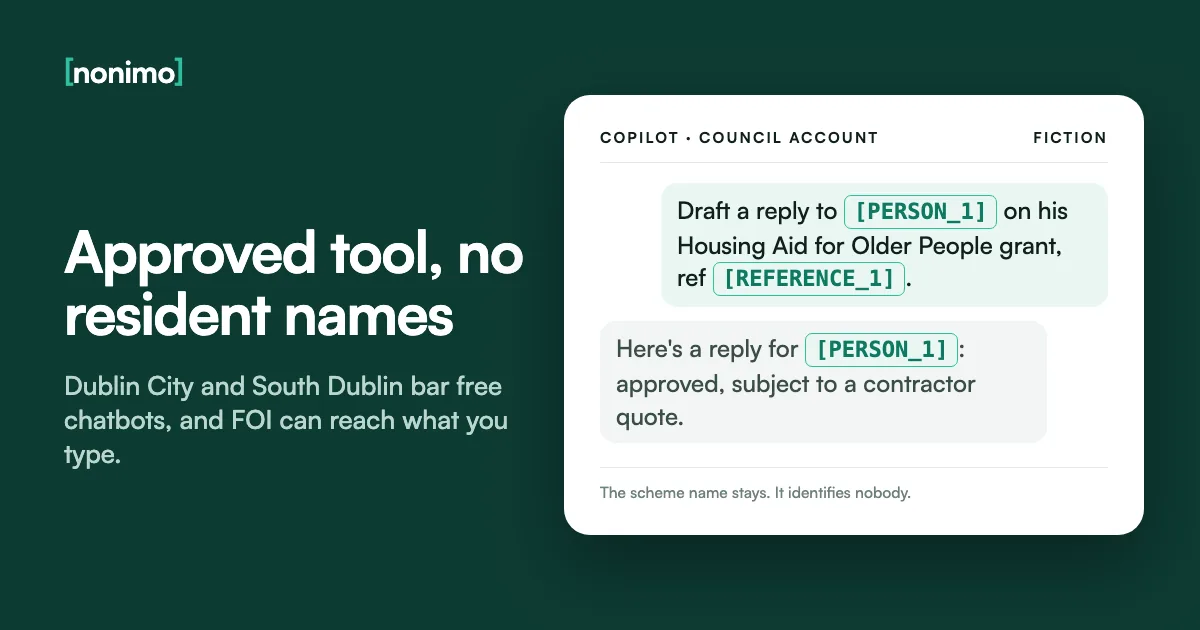
Staff will keep using these tools whatever the policy says, so my aim is that the resident’s name never makes the trip. Nonimo is a Mac and Windows app that takes names, addresses, contact details, PPS numbers and Eircodes out of the text before it leaves the PC, leaving markers like [PERSON_1].
When the answer comes back, the original details go back in on the officer’s screen. Here’s a Housing Aid for Older People query with invented details:
The same query, before and after
Draft a reply to Mr Colm Brennock about his Housing Aid for Older People application, ref HOP-2026-0193, explaining the grant is approved subject to a contractor quote.
Draft a reply to [PERSON_1] about his Housing Aid for Older People application, ref [REFERENCE_1], explaining the grant is approved subject to a contractor quote.
Invented example. The scheme name stays: the AI needs it to write the letter, and it identifies nobody.
The list that matches each marker to a resident never leaves that computer, which is also why the text is still the council’s personal data, with every duty above attached. More on how we handle security.
An authority rolling this out across departments, rather than one desk at a time, will want the organisations version.
Every prompt a council officer writes may end up as a record someone reads. To try it on one housing reply before anyone writes it into policy, Nonimo for Irish desks installs on a single PC.
Sources
- Guidelines for the Responsible Use of AI in the Public Service, gov.ie. Dates, audience, human decision, free GenAI tools, NCSC quote, legal basis and DPC consultation.
- Securing AI Adoption in the Public Sector, NCSC-IE, 2026. Written for smaller public bodies.
- Cyber Security Guidance on Generative AI for Public Sector Bodies, NCSC-IE. Marked deprecated on 30 July 2026.
- Freedom of Information Act 2014, section 11. Service provider records; sections 2, 6, 13, 15 and 37 of the same Act for the rest.
- Data Protection Act 2018, section 38. Lawful basis for public functions; section 141(4) for the €1,000,000 cap. Also relied on: Local Government Act 2001, section 80; Regulation of Artificial Intelligence Act 2026, section 105; S.I. No. 405 of 2026.
- DPC, conclusion of inquiry into Sligo County Council, 5 December 2024. Findings, ban and fine.
- DPC, published decisions. The other county council decisions.
- Regulation (EU) 2024/1689, the AI Act. Articles 4, 26, 27, 49, 50 and Annex III.
- Regulation (EU) 2026/1744. New Annex III date, Article 4 and Article 27(4).
- Office of the Ombudsman, Your questions. Complain first to the council, 12 months, reserved functions.
- Office of the Ombudsman, Guidance. Six Rules for Getting it Right.
- Dublin Inquirer, 4 March 2026. Dublin council policies, the LGMA pilot and the AILG webinar.
- LGMA Corporate Plan 2026 to 2030. The 31 authorities and the AI objective.
- Smart Dublin, Ireland’s first Gen AI Lab for local government, 19 February 2025. Partners and aims of the lab.
- Galway City Council, Local Authorities Lead Conversation on Future of AI in Public Services, 1 December 2025. The Heads of Information Systems conference.
- Mason Hayes & Curran, ChatGPT and Freedom of Information, 21 May 2025. No specific Irish guidance on officials’ AI records.
Checked on 8 November 2026.
Common questions
How are Irish local authorities using AI?
Mostly through pilots and licensed Copilot so far. Dublin City Council runs a Gen AI Lab with ADAPT and Trinity Business School, and nine authorities joined a 90-day LGMA Copilot pilot.
Are council staff allowed to use ChatGPT for work?
Only if their authority approves it, and rarely the free version. The public service AI guidelines advise against free GenAI tools, and Dublin City and South Dublin bar them for council work.
Can you get a council's ChatGPT prompts under FOI?
Very likely, if the council holds them. The FOI Act 2014 counts machine-readable material as a record, and every local authority is an FOI body.
What would a council hold back from AI records released under FOI?
Other people's personal information, mainly. Section 37 of the FOI Act generally requires refusal, unless the data is the requester's own or the person consented.
What do the Guidelines for the Responsible Use of AI in the Public Service say?
A person makes the final call in high-risk decisions. Published on 7 May 2025, they also advise against free GenAI tools and want an approved business case before GenAI enters a process.
Is there NCSC guidance on AI for public sector bodies?
Yes, two 2026 documents. An AI risk assessment and Securing AI Adoption in the Public Sector replaced the generative AI guidance the NCSC deprecated on 30 July 2026.