Does Gemini share your data? What Google does with it
· Updated

Joaquín Trapero in Founder of Nonimo, writing on AI and privacy.
Google’s short answer is that it doesn’t sell what you type into Gemini. That’s accurate, and it leaves most of the question untouched: who else gets to read a chat, and what is still sitting on Google’s side after you press delete.
The answer also moves with the login: a personal Google Account, a Workspace work account and a Gemini API key each run under different terms. Which one you’re in matters more to me than any toggle. Anthropic splits Claude along similar lines, with the borders elsewhere.
Google doesn't sell your Gemini data, but it does pass some of it on. On a personal account, human reviewers, some at Google's service providers, read a subset of chats, and those copies survive your deletion for up to three years. Workspace accounts and the paid Gemini API keep prompts out of model training.
Who Google passes your chats to
Google’s privacy policy, effective 16 October 2026, names four situations in which personal information leaves the company: your consent, your organisation’s domain administrator, service providers working on Google’s instructions, and legal reasons such as a court order or a government request.
Gemini adds routes of its own. Google’s Gemini notice mentions human reviewers, the apps you connect, public links to shared chats and Canvas apps built by other users, whose creators can see whatever you share and store it wherever they like.
Among them, the Canvas route is the one I’d steer staff away from at work: a stranger’s app, inside Google’s interface, with the data leaving on the creator’s terms. Four of these exits are yours to shut, and human review only partly. Rules for staff belong in a written AI policy for your team.
Where a Gemini chat can travel, and which exits you can shut
Personal Google Account. The shaded row is the one no switch closes completely.
| Route | Who ends up with it | Can you close it? |
|---|---|---|
| Your consent | The outside business you asked Google to deal with | Yes, by not giving it |
| Connected third-party apps and MCP servers | That company, under its own privacy policy | Yes, disconnect the app |
| Public link to a shared chat | Anyone holding the link | Yes, under Your public links |
| A Canvas app built by another user | The app's creator, and anyone with its public link | Yes, by not entering data in it |
| Human review | Trained reviewers, some at service providers, once the chat is detached from your account | Partly: Keep Activity off stops review for improving Google AI, not for safety |
| External processing | Service providers working on Google's instructions | No |
| Work or school account | Your domain administrator and any reseller managing the account | No, it's the organisation's call |
| Legal process | Courts and government bodies with an enforceable request | No |
Google Privacy Policy, effective 16 October 2026; Gemini Apps Privacy Hub, notice updated 13 October 2026. No row for selling: Google says it doesn't sell personal information to anyone. OpenAI's list looks different: see who receives what you type into ChatGPT.
Do humans read Gemini conversations?
Some, yes. Google says a subset of chats is reviewed by people, including trained reviewers at its service providers, who rate the answers and suggest better ones. Chats are also reviewed for safety and for breaches of Google’s terms. Before a chat goes to a service provider, Google detaches it from your account.
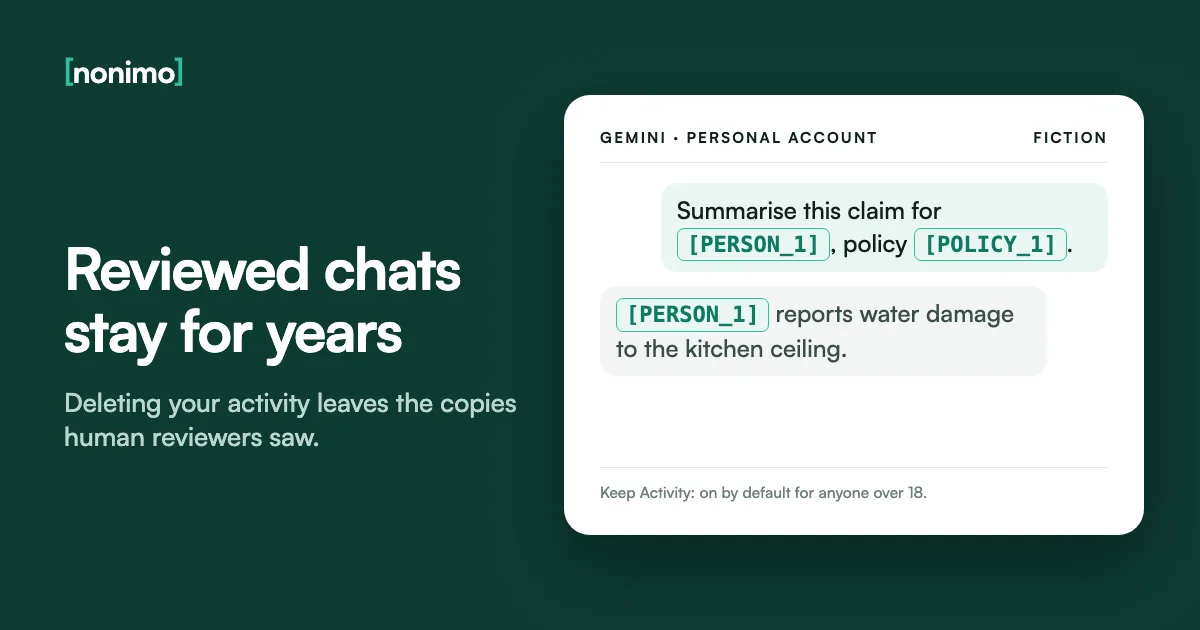
Detached is not deleted. Reviewed chats, with related data such as your language, device type, location information and feedback, are kept for up to three years, and deleting your activity doesn’t reach them. Google also asks users not to enter confidential information they wouldn’t want a reviewer to see.
The feedback button is where I’m most careful. With Keep Activity off, one piece of feedback sends Google the last 24 hours of your chats as context, uploads included, kept up to three years once reviewed. A file also carries names and dates in its hidden properties, and those go with it.
One chat, two copies
Your delete button only ever sees the left column.
The copy in your account
Saved in Gemini Apps Activity while Keep Activity is onAuto-deleted after 18 months unless you change itRemoval starts as soon as you delete itThe copy picked for review
Selected from a subset of chatsDetached from your Google Account, then read and annotatedKept for up to three yearsUntouched when you delete your activityGemini Apps Privacy Hub, questions updated 26 October 2026. Microsoft takes another line on reviewing prompts in its business assistant: Copilot's training and review rules.
Keep Activity, temporary chats and the 72-hour copy
Keep Activity is the setting behind most of this on a personal account, and Google’s help page says it’s on by default for anyone 18 or over. While it’s on, chats are saved to Gemini Apps Activity and can be used to improve Google’s AI, with human reviewers involved.
Switching it off, or opening a temporary chat, stops future chats being used for training unless you send feedback. Storage doesn’t stop: Google keeps each chat with your account for 72 hours to answer you and to protect Google, its users and the public, with human reviewers where needed.
For a one-off question about a client, my choice is a temporary chat, because it skips training without switching off everything else. Turning Keep Activity off also cuts Gemini off from Google Workspace apps, which people notice quickly. Clearing what’s already saved is covered in our walkthrough for wiping chat history.
Your setting, and what Google keeps
Choose the one that matches your Gemini account today.
Saved: in Gemini Apps Activity, auto-deleted after 18 months. Training: yes, including generative AI models. Reviewers: a subset of chats, held up to three years once reviewed.
Saved: 3 months, then auto-deleted. Training and reviewers: as with the default. A shorter clock does nothing to a chat already reviewed, which keeps its three years.
Saved: not in Activity, but held with your account for 72 hours. Training: no, for future chats. Reviewers: still possible for safety and abuse checks. Workspace connected apps stop working.
Saved: 72 hours with your account. Training: no. Reviewers: not for improving Google AI, though safety checks can still involve them. Your other chats keep their setting.
Sent: the feedback, the last 24 hours of chats as context and any uploads or connected-app data inside them. Kept: up to three years once reviewed, detached from your account.
Gemini Apps Privacy Hub, questions updated 26 October 2026, and Gemini Apps Help, "Manage & delete your activity in Gemini Apps". Personal accounts only: on a work account the administrator sets these.
Connected apps and extensions: what the assistant can reach
Connected Apps, which many people still call Gemini extensions, let the assistant read your Gmail, Drive, calendar or Google Photos and work with outside services, including Model Context Protocol servers you add yourself. Gemini saves and uses what comes back under its own notice, which includes improving Gemini Apps.
Two lines in that notice get less attention than they deserve. Third-party services handle your data under their own privacy policies. For custom third-party connections, Google says it does not monitor or secure the data, and warns they may expose your data, passwords, devices and accounts.
Disconnecting an app doesn’t delete what’s already in Gemini Apps Activity. If it were my firm, no work mailbox would ever be connected to a personal Gemini account, and an IT provider that manages your computers can enforce that more reliably than a memo.
Connections to check in Gemini's Connected Apps settings
Tick each one that is switched on for your account.
0 of 6 switched on
Nothing connected: Gemini only sees what you type or upload.
A short list. Make sure each one was chosen on purpose.
Gemini can reach a lot from one prompt. Disconnect what nobody uses.
Gemini Apps Privacy Hub: Connected Apps, Canvas and "Other things to know". Our list of the common connections, not Google's full catalogue.
Gemini in Google Workspace: what a work account changes
On a work or school account the rules are different, and the personal notice says so itself. Google’s Workspace privacy hub, updated 6 October 2026, says your content isn’t used for other customers, and isn’t human reviewed or used to train models outside your domain without permission.
Workspace data counts as customer data under Google’s Cloud Data Processing Addendum, so Google acts on your organisation’s instructions: what Article 28 of the GDPR, in Europe and in Britain, calls a processor. The administrator sets retention: 90 days to indefinite for Gemini in Docs or Gmail, up to 36 months for the Gemini app.
Data regions are narrower than they sound: the United States or Europe, minus Gemini Notebook, logs and cached content. For a small office already paying for Workspace, moving staff off personal accounts is the cheapest upgrade, and the first on my list. Nonimo for whole organisations adds the step before either account sees a name.
The same assistant on two kinds of account
Human review, highlighted, is the line to read before any client work.
| Personal Google Account | Work account on Google Workspace | |
|---|---|---|
| Human reviewers | A subset of chats | Not outside your domain without permission |
| Model training | Yes while Keep Activity is on | Not outside your domain without permission |
| Retention | 18 months by default; 3, 36 or no auto-delete | Set by the admin; Gemini app up to 36 months |
| Governing document | Gemini Apps Privacy Notice | Workspace agreement and Cloud Data Processing Addendum |
| Third-party apps | Their own privacy policies | Different terms, outside the Workspace commitments |
| Where data is held | Servers around the world, possibly outside your country | United States or Europe, on editions with data regions |
Gemini Apps Privacy Hub; Generative AI in Google Workspace Privacy Hub, updated 6 October 2026; Google Workspace, "Data covered by data regions". If an insurer asks which column your staff work in, see the AI part of a cyber questionnaire.
Gemini API and AI Studio: paid versus free tier
Developers meet a third set of rules, the Gemini API Additional Terms of Service, effective 23 March 2026. On unpaid services, which include Google AI Studio and the free API quota, Google uses prompts and responses to improve its products, and human reviewers may read and annotate them.
The same terms tell you not to send sensitive, confidential or personal information to the unpaid tier. On paid services, Google doesn’t use prompts or responses to improve its products, but logs them for a limited period to catch policy violations. The terms give no number of days.
In the EEA, Switzerland or the UK, the paid-tier data terms cover free quota too, and AI Studio counts as paid once the account reaches an active Cloud Billing project. Real customer records stay out of any prototype, in my book, until billing is on. Nonimo Gateway masks those records before either tier sees them.
Which Gemini API terms cover your prompts?
Are you, or the users of your app, in the EEA, Switzerland or the UK?
Does the key or AI Studio account sit on a Cloud project with active billing, or a Workspace enterprise account?
Gemini API Additional Terms of Service, effective 23 March 2026. Apps offered to users in the EEA, Switzerland or the UK may only use paid services. Where a proxy sits in that path is explained in our primer on AI gateways.
Deleting Gemini history: what goes and what stays
On a personal account, deletion happens in Gemini Apps Activity, where you can remove one chat, the last hour or day, a custom range or everything. Google says removal begins at once, first from view and then from its storage systems. Several copies sit outside that button.
Reviewed chats are the main one. A shared chat is another: deleting it leaves the public link alive until you remove it under Your public links. Gems survive the deletion of a conversation held with them, and data that other Google services saved while you used Gemini has to be cleared in those services.
Public links are where I’d spend the first five minutes, since anyone holding one can still open the chat. The same exercise for pictures is in how long each assistant holds an uploaded image.
You delete this, and this is what's left
Personal Google Account, Gemini on the web.
| You delete | What goes | What stays |
|---|---|---|
| One chat, or all your activity | The chats in Gemini Apps Activity, with any Live audio and transcripts | Chats already reviewed, for up to three years; some usage data until the account closes |
| A chat you shared | The chat | Its public link |
| A conversation with a Gem | The conversation | The Gem itself |
| A connected app, or data inside it | The connection | Anything already saved in Activity |
| Keep Activity, switched off | Future saving to Activity | A 72-hour copy of each new chat |
Gemini Apps Help, "Manage & delete your activity in Gemini Apps"; Gemini Apps Privacy Hub, notice updated 13 October 2026.
Is pasting a client’s file a disclosure? What regulators say
No regulator has banned Gemini, but several have described what pasting client details into a public chatbot amounts to. Australia’s OAIC, in guidance updated 17 January 2025, uses an insurer entering a customer’s claim into a chatbot as its example, and treats it as a disclosure to the chatbot’s owners.
In Europe, Ireland’s Data Protection Commission opened a cross-border inquiry into Google Ireland in September 2024, asking whether a data protection impact assessment was required before EU personal data went into developing its PaLM 2 model. In the US, the FTC has warned model providers that broken privacy commitments can be enforced.
None of that makes Gemini a forbidden tool. It makes the account choice a legal choice, and I’d never sign off on leaving it to whoever happened to open the tab. If a file has already gone in, deciding if the paste was a reportable breach comes next, and it has its own guide.
Three regulators and one law, on the same paste
Examples from different places, not a list of your obligations.
| Authority | What it published | What it means for a Gemini user |
|---|---|---|
| OAIC (Australia) | Entering personal information into a public chatbot discloses it to the chatbot's owners | A personal Gemini account is a disclosure to Google |
| DPC (Ireland) | Inquiry into whether Google had to carry out an Article 35 impact assessment before using EU/EEA personal data to develop PaLM 2 | An EU regulator is examining how Google built a model on EU data |
| FTC (US) | Model providers that break privacy commitments can face enforcement | Google's written promises carry legal weight, so date them |
| GDPR (EU and UK), Article 28 | A processor acts only on the controller's documented instructions | The Workspace contract is what makes Google a processor |
OAIC, guidance on commercially available AI products; DPC press release, 12 September 2024; FTC Office of Technology, 9 January 2024; Regulation (EU) 2016/679 on EUR-Lex. More on each assistant in our library of AI privacy guides.

Before the next client file goes into the chat box
The copy you can’t delete is the one a reviewer picked, held for up to three years apart from your account. Whether it carries a client’s name is decided before you send, on your side of the screen, which is where Nonimo’s desktop software for Mac and Windows works.
It replaces names, account numbers and other identifiers with placeholders before Gemini reads the prompt, and puts them back when you copy the answer. A reviewer who opens that chat later finds a placeholder. In the app, your text never passes through our servers; what it does send us is listed openly.
For a small practice I’d put work accounts first and labels before every paste second. Run the app on the next document headed for Gemini: it behaves the same whichever account sits behind the tab, and the plans for a whole office are a click away.
Three ways to ask Gemini about Rosamund Treleaven's tax return
A fictional client. The right-hand column is the one we built Nonimo for.
Personal account, as typed
- Her name and figures reach Google
- Can be picked for human review
- A reviewed copy outlives your deletion
Workspace account, as typed
- Her name reaches Google as customer data
- No review or training outside your domain without permission
- Retention set by your administrator
Labels first, either account
- Gemini sees [PERSON_1] and the figures
- Whatever is kept or reviewed has no name in it
- Her name returns when you copy the reply
Account rules from the Gemini Apps and Workspace privacy hubs. Rosamund Treleaven is invented for this example.
Sources
- Google, Gemini Apps Privacy Hub: human reviewers and service providers, the three-year hold on reviewed chats, 72 hours with Keep Activity off, feedback context, Connected Apps, Canvas, no selling and no ads.
- Google, Gemini Apps Help, “Manage & delete your activity in Gemini Apps”: Keep Activity on by default from 18, auto-delete options, public links surviving a deleted chat.
- Google, Generative AI in Google Workspace Privacy Hub: no review or training outside your domain without permission, the processing addendum, retention ranges.
- Google Workspace, “Data covered by data regions”: United States or Europe; Gemini Notebook, logs and cached content not covered.
- Google, Gemini API Additional Terms of Service, effective 23 March 2026: unpaid and paid tiers, reviewers, abuse logging, EEA, Switzerland and UK.
- Google Privacy Policy, effective 16 October 2026: the four sharing situations and servers around the world.
- OAIC, Guidance on privacy and the use of commercially available AI products: the insurer example of a disclosure to a chatbot’s owners.
- Data Protection Commission, inquiry into Google’s AI model: cross-border inquiry into Google Ireland over PaLM 2, 12 September 2024.
- FTC, AI companies: uphold your privacy and confidentiality commitments: broken commitments by model providers can be enforced.
- EUR-Lex, General Data Protection Regulation: Article 28(3)(a), processing only on documented instructions.
Accessed 10 November 2026.
Related guides
Common questions
Does Google sell my Gemini chats?
No, Google says it does not sell your personal information to anyone. Its Gemini privacy hub adds that chats aren't used to show you ads, and that Google will say so clearly if that changes.
Can a Google employee read my Gemini conversations?
Yes, a subset of chats goes to human reviewers. Some work for Google's providers. The chat is disconnected from your account first, and Google asks you not to type anything confidential you wouldn't want a reviewer to see.
Is Gemini private with Keep Activity turned off?
More private, not sealed. Future chats stop feeding training unless you send feedback, but Google still holds each chat with your account for 72 hours and may use human reviewers for safety checks.
Does Gemini share my data with third-party apps?
Only with the ones you connect. Those services handle what Gemini passes them under their own privacy policies, and Google says it doesn't monitor or secure data from custom third-party connections.
Are my company's Gemini chats used to train Google's models?
Not on a Workspace account without your organisation's permission. Google says Workspace content isn't human reviewed or used for model training outside your domain, and treats it as customer data under its processing addendum.
Does Google AI Studio keep my prompts private?
Not on the free tier outside Europe. Unpaid use can improve Google's products and reach human reviewers. With active Cloud Billing, or from the EEA, Switzerland or the UK, paid-tier data terms apply.
How long does Google keep a deleted Gemini chat?
It depends on whether a reviewer saw it. Ordinary activity starts its deletion process straight away. A chat already reviewed is held apart from your account for up to three years.