AI for NDIS progress notes: what the paperwork carries
Progress notes are where a shift ends: the note written at nine at night, the referral that has to go out before the plan review, the incident summary for Monday’s meeting. When one of them is pasted into a chatbot to be shortened, tidied or turned into plain language, everything in it travels, including the numbers that point straight at one participant.
Those numbers have names in this sector. The NDIS number, the Medicare card and the Individual Healthcare Identifier that arrives in allied health letters. Each of them points to one participant on its own, even with the name taken out, which is why they are the first thing a progress note should lose before it is pasted into a chatbot.
What comes out of a note first, and the judgement that has to stay with a colleague, is worked through in our guide to cleaning up a case note before AI. This page is about the other half of that job: the mechanical pass, done once on the computer, before the note goes anywhere near a chatbot.
AI for progress notes: what leaves the desk after one key
AI for NDIS progress notes starts with a support coordinator selecting the text and pressing one key. What Nonimo recognises becomes a placeholder on that computer, Mac or Windows, and the note travels on to ChatGPT, Claude or Copilot only after that. The model works with the placeholders, and the real values return in the reply.
A healthcare identifier is covered without asking, even when nothing announces it. Where Nonimo is less certain, the value is covered in the open, with the reason shown and a click to undo it. Nothing needs configuring first: the same key works on a progress note, a referral or an incident summary.
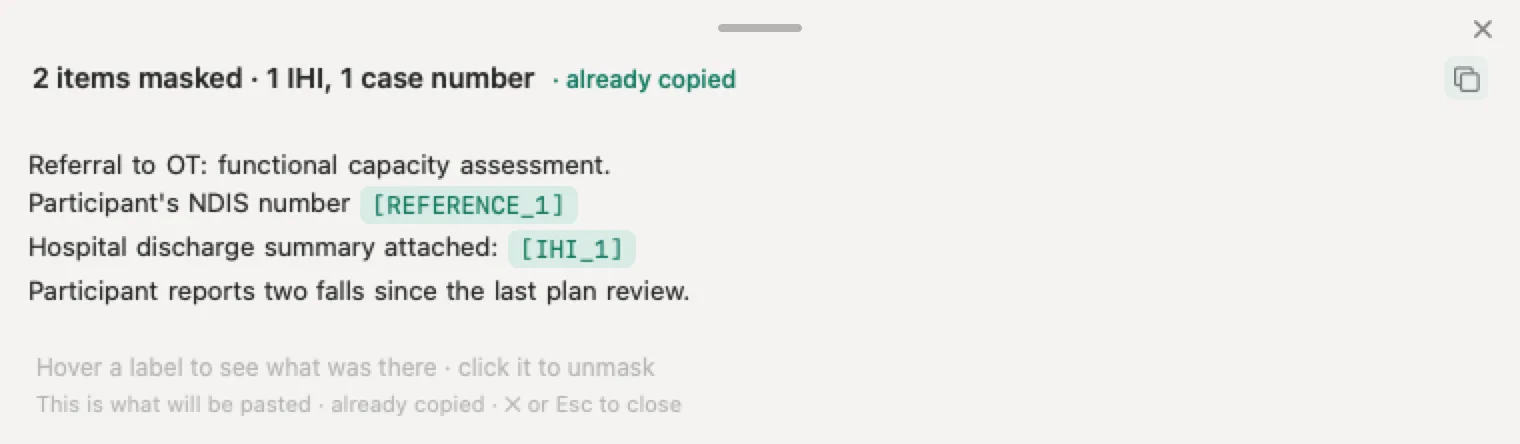
In the invented referral below, the IHI sits after a line about the discharge summary, with no label in front of it, and still comes out as [IHI_1]. The NDIS number follows its label and reaches the chat as a reference. What OpenAI holds on to afterwards is set out in what a pasted note leaves behind.
Before: what gets pasted
Referral to OT: functional capacity assessment.
Participant's NDIS number 000000001
Hospital discharge summary attached: 8003 6080 0031 1670
Participant reports two falls since the last plan review.
After: what the AI receives
Referral to OT: functional capacity assessment.
Participant's NDIS number [REFERENCE_1]
Hospital discharge summary attached: [IHI_1]
Participant reports two falls since the last plan review.
What the NDIS Commission expects of AI for NDIS progress notes
The NDIS Commission published its position statement on artificial intelligence in February 2026. Its subject is behaviour support plans, but the expectation beside it is written for any provider that decides to use AI, and it closes with a sentence that stops a manager mid-page: “they may be breaking the law, including their legal obligations under the NDIS Act”.
Read the verbs carefully, because they matter in an audit. The Commission “expects” and says “should”, and the consequence it names arrives through the NDIS Act rather than through any rule about AI. It backs no product either, ours included, while making clear that this “does not prevent NDIS providers using AI” within their legal obligations.
Where your practitioners are AHPRA-registered, their own regulator says much the same clinically. Its guidance, reviewed 22 August 2024, warns that “if public generative AI software is used personal information becomes public domain”. Which chatbot a provider may reach for in the first place is taken apart in our Privacy Act guide.
AI for NDIS progress notes: the IHI, and what an auditor sees
The Individual Healthcare Identifier is where a provider is most exposed and least covered. Microsoft Purview, Google Cloud and Google Workspace all detect the Medicare number, and on 21 September 2026 none of their published lists included the IHI. Nonimo covers it on its own form, with nothing in front of it, which is how it usually turns up in a letter.
The NDIS number is covered in the open, with the reason beside it, and you can put it back with a click if a letter truly needs it. The IHI, whose form leaves no doubt, is swapped straight away. You see exactly what changed before anything is pasted, and both placeholders read as identifiers, so the AI can still write the letter around them.
The audit trail stays yours. Nonimo shows each change as the paste happens and keeps no log of it; where the provider runs the compliance dashboard, it holds counts by category, never text. So a registration audit reads the provider’s own procedure and training, the way the other tools in the office are logged. What the application does report daily is on our security page.
AI for NDIS progress notes: price and how to start
The app installs the same way on Mac and on Windows, one computer at a time, and the downloads sit above. Nonimo’s free plan stops at a set number of words each month. Leave an email address on our licence page and a free licence file comes back that removes the cap until 31 January 2027, with no account to set up.
Each computer installs the application on its own, so AI for NDIS progress notes can be made safer at the desks where ChatGPT or Copilot is already open. Across a whole provider, IT pushes out the browser extension by policy, and it covers notes without being called. Support workers keep using ChatGPT, Claude or Copilot as they already do, with no new tool to learn before the next shift.
What Nonimo adds is one mechanical step on each computer: select the note, press the key, and check the placeholders before anything is sent. Covering identifiers is not the same as de-identifying a note, so your procedure, your consent practice and your audit evidence stay where they always were, under the provider’s own policies and the Commission’s expectations.
- Free today, on Mac and Windows
- With a monthly word allowance
- The free licence lifts it until 31 January 2027, no account needed
Questions providers ask
Can we use AI for NDIS progress notes at all?
The Commission doesn't forbid it. Its February 2026 position statement backs no AI tool for behaviour support plans, and says in the same breath that this “does not prevent NDIS providers using AI” where such use complies with their legal obligations. Nonimo does the mechanical part of staying inside them: the participant identifiers it recognises are replaced before the text leaves the computer.
Does the position statement cover progress notes, or only behaviour support plans?
Its subject is behaviour support plans. The risks it lists, among them “disclosure of personal participant information to third parties” and “processing or storage of personal information overseas”, are the ones a progress note carries the moment it is pasted into a chatbot. Nonimo covers the identifiers it recognises whatever the document is. Select the text and press its key, or drop the whole progress note on the Nonimo window: you get the masked text ready to paste, and a masked copy next to the original, with a Word file coming back as a Word file and a PDF as a new PDF with just the text.
Doesn't Microsoft or Google already pick these numbers up?
For the Medicare number, yes. Microsoft Purview, Google Cloud and Google Workspace each detect it, and on 21 September 2026 none of their published lists included the Individual Healthcare Identifier. Nonimo covers an IHI on its own form alone, with no label in front of it, which is the number most likely to arrive in an allied health letter and be pasted without a second thought.
What will the registration auditor see from Nonimo?
Each change, shown at the moment someone pastes, on the computer where it happens. The app logs none of those changes, and a provider-wide dashboard only counts them by category, so your AI procedure, your training and your notes are what an auditor reads. The step Nonimo adds is the one a support worker can show at the desk, with a made-up note, in under a minute.
What does Nonimo learn about our participants?
Nothing at all. Detection runs on the provider's computer, and the only thing the application sends us is a usage count once a day: how much of the month's allowance has gone, the version and the platform. None of your text and none of the terms you add yourself ever come to us, which is the line to put in your own procedure.