What a claim file carries before it reaches ChatGPT
AI for insurance brokers usually starts at the claims desk: a client rings after a prang, the claim form comes back half filled in, and someone wants a clean summary for the insurer by lunch.
By then the repairer’s quote and the assessor’s report are on file too. On a motor claim that means the policy number and claim number, the insured’s date of birth and driver’s licence, with its card number, the rego of both cars, a mobile and an email, and the BSB and account the settlement goes to. A business pack claim adds the ABN and the GST status, because the insurer settles net of input tax credits.
Personal accident, sickness and travel claims carry more: a GP certificate, a hospital discharge summary, a diagnosis typed into the claim form. Under the Privacy Act, health details are sensitive information, a class with stricter rules, and our guide to sensitive information in the files staff give AI sets out what changes once it reaches a chatbot.
From the claim file to the chat, with one key in between
Is ChatGPT safe with a live claim in it? Safer after one key: highlight the text, press it, and Nonimo swaps what it recognises for placeholders on that Mac or Windows PC before anything goes to ChatGPT, Claude or Copilot.
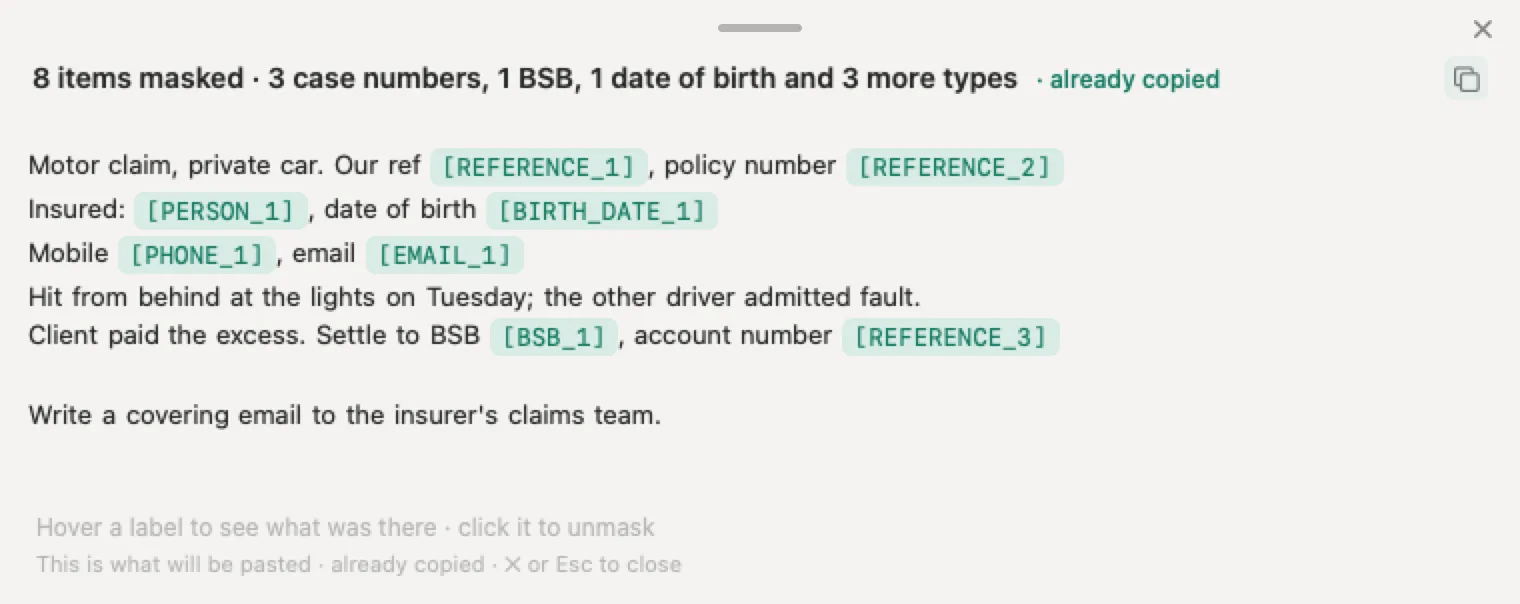
In the invented motor claim below, the file reference, policy number, insured’s name, date of birth, mobile, email and the BSB and account for the settlement all reach the chat as placeholders. The facts of the loss stay readable: who hit whom, who admitted fault, who paid the excess. The model drafts the covering email to the insurer around those placeholders, and the real details return in its reply, on your screen and nowhere else.
The rego of both vehicles, the insured’s ABN, a Medicare number and a risk address come out as placeholders too. How long OpenAI keeps whatever does reach it is a separate question, answered in what ChatGPT keeps of a paste.
Before: what gets pasted
Motor claim, private car. Our ref 000000, policy number MV00000000
Insured: John Citizen, date of birth 31/02/1979
Mobile 0491 571 266, email j.citizen@example.org
Hit from behind at the lights on Tuesday; the other driver admitted fault.
Client paid the excess. Settle to BSB 000-002, account number 00000003

Write a covering email to the insurer's claims team.
After: what the AI receives
Motor claim, private car. Our ref [REFERENCE_1], policy number [REFERENCE_2]
Insured: [PERSON_1], date of birth [BIRTH_DATE_1]
Mobile [PHONE_1], email [EMAIL_1]
Hit from behind at the lights on Tuesday; the other driver admitted fault.
Client paid the excess. Settle to BSB [BSB_1], account number [REFERENCE_3]

Write a covering email to the insurer's claims team.
What ASIC expects of a licensee that uses AI
For insurance brokers, AI sits under rules ASIC already has. Report 798, Beware the gap (October 2024), calls them technology neutral: a licensee’s existing obligations apply to a chatbot as they do to anything else.
ASIC got there by looking at how 23 licensees in banking, credit, insurance and financial advice were using AI. Page 34 spells those obligations out. A licensee needs adequate technological resources, including enough to protect confidential information, and it remains responsible for outsourced functions, which ASIC extends to third party AI providers. The report also asks each licensee whether its AI strategy has become policies that its staff actually follow, day to day.
For a brokerage working as an authorised representative, that policy is usually written by the licensee and applies across the network. How far the Privacy Act reaches into a smaller brokerage on its own account is a separate test, worked through in our Privacy Act guide to choosing a chatbot, along with what APP 8 expects when the chatbot sits offshore.
The OAIC, the client file and what you see on screen
The OAIC’s answer on whether ChatGPT is safe for confidential information came on 21 October 2024: as best practice, hold personal information, sensitive information above all, back from AI tools the public can sign up to.
A claim file is little else, so the covering comes before the paste. Nonimo applies the judgement a careful claims officer would. When a number’s shape can only mean one thing, it is replaced straight away. When it is less certain, it is replaced too, but flagged on screen with the reason, and a click restores it. Our security page lists what stays on the computer and what the app reports.
Clients will ask about the other side of this too. The four Australian cyber wordings our guide to cyber cover went through line by line say nothing about AI, so whether a leak through a chatbot is covered turns on the wording and the insurer’s reading of it. Keeping client identifiers out of the chat in the first place is the simpler answer.
Nonimo for insurance brokers: price and how to start
AI for insurance brokers can start tomorrow, one desk at a time: install Nonimo on Mac or Windows from the buttons above and press the key on the next claim before it goes into ChatGPT.
Nonimo’s free plan stops at a set number of words each month. Leave an email address on our licence page and a free licence file comes back that removes the cap until 31 January 2027, with no account to set up. Every desk sets itself up separately, with no project to wait for.
Across a whole brokerage or a network of authorised representatives, IT can deploy the browser extension centrally, which covers text with no key to press, as our page for organisations explains. Staff keep the chatbot they already use.
After the claims desk, where most pasting happens, come new business and renewals. When a client asks how to answer the AI question in a renewal pack, point them to our model answers for the AI questions on insurer forms. Your file notes, your privacy policy and your records for the licensee stay in your own systems, and not a word of your clients’ text reaches us.
- Free plan, on Mac and Windows
- With a monthly word allowance
- The free licence lifts it until 31 January 2027, no account needed
Questions brokers ask
Is ChatGPT safe for insurance brokers to use with client information?
It can be, if the client's identifiers stay out of the text. ASIC's Report 798 treats AI as something a licensee's existing obligations already reach, protecting confidential information included, and the OAIC's AI guidance calls it best practice to leave personal information out of chatbots open to the public. Nonimo does the heavy lifting at the desk: the policy number, date of birth, rego and bank details it recognises become placeholders on the brokerage's computer before anything is sent.
Has ASIC made new rules about AI for brokers?
Not in Report 798, published on 29 October 2024. ASIC reviewed 23 licensees across banking, credit, insurance and financial advice, and said the framework is technology neutral: acting efficiently, honestly and fairly, adequate resources, risk management and responsibility for outsourced functions all apply to AI. Among its questions for licensees is whether their AI strategy has become policy for staff. Nonimo gives that policy one step anyone can follow at the desk.
We're an authorised representative. Can we start on our own?
Read your licensee's AI policy first, because it usually binds the whole network. Nonimo needs no project to get going: each computer installs the app and uses one key, and the licensee can later install the browser extension across its representatives by policy. Either way, the way you lodge claims and keep file notes stays the same, and the licensee's records stay in its own systems.
What about health details in a personal accident claim?
Health information is sensitive information under the Privacy Act, and a personal accident, sickness or travel claim is full of it. Nonimo replaces the identifiers it recognises, such as the client's name, date of birth and Medicare number, so the chat no longer learns who the claim is about. The diagnosis stays in the text for the AI to work with, and the file stays sensitive on your side.
Is any of the claim text sent to Nonimo?
No. Everything happens on the brokerage's computer, and no part of the text about your clients comes to us, including any terms you add to your own list. You don't open an account with us.