Is ChatGPT safe for insurance brokers? Look at what gets pasted
Whether ChatGPT is safe for a broker depends on what goes in: a first notification of loss turned into an email to the claims team, a chaser to a slow insurer, a fleet renewal cut down to two pages.
Ask an account handler and it is rarely anything cleverer than that. Each of those opens with the same block. The insured’s name and home address, a date of birth, the policy number and the claim number, the vehicle registration and often the driving licence number from a copy of the licence, then a mobile and an email. A commercial combined or an income protection claim adds an employer, a National Insurance number or a note from a GP.
The provider’s side, how long a chat is stored and who at OpenAI may look at it, is covered by our guide to what ChatGPT keeps. The broker’s side is simpler: what the chat never receives, it cannot keep. That opening block of details is exactly where Nonimo starts.
A motor claim, before and after the key
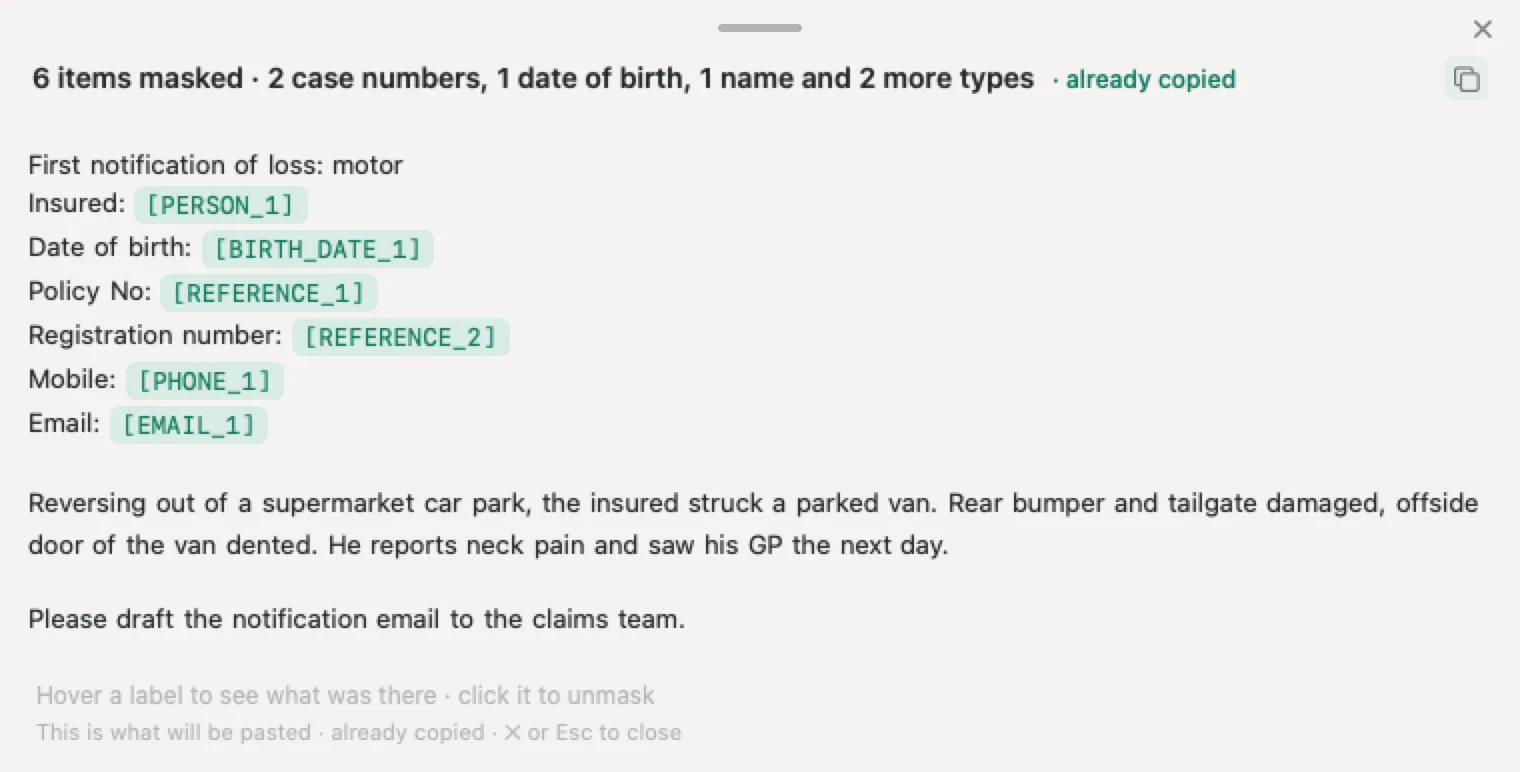
Here is what AI for insurance brokers looks like on a motor claim. Highlight the notification and press the key: on the handler’s own computer, each detail Nonimo recognises becomes a stand-in such as PERSON_1 before anything travels.
It works the same on Mac or Windows, and a policy number becomes REFERENCE_1. When the draft comes back, the real name, policy number and registration return to your screen, because only your computer knows who each placeholder stands for.
In the made-up notification below, the insured, the date of birth, the policy number, the registration, the mobile and the email are all placeholders. What the claims team needs is still there: a car reversing out of a supermarket car park, a parked van, a damaged tailgate and a dented door. The assistant can write the email without knowing whose car it was.
The same routine works on a letter chasing a slow insurer, a statement of fact before renewal or a reply to a complaint. Nothing has to be set up first, and the assistant stays the one the office already uses, whether that is ChatGPT, Claude or Copilot. What leaves the computer, and what stays on it, is set out on our security page.
Before: what gets pasted
First notification of loss: motor
Insured: Mr Joe Bloggs
Date of birth: 30/02/1978
Policy No: MC/0000000
Registration number: ZZ00 ABC
Mobile: 07700 900787
Email: j.bloggs@example.net

Reversing out of a supermarket car park, the insured struck a parked van. Rear bumper and tailgate damaged, offside door of the van dented. He reports neck pain and saw his GP the next day.

Please draft the notification email to the claims team.
After: what the AI receives
First notification of loss: motor
Insured: [PERSON_1]
Date of birth: [BIRTH_DATE_1]
Policy No: [REFERENCE_1]
Registration number: [REFERENCE_2]
Mobile: [PHONE_1]
Email: [EMAIL_1]

Reversing out of a supermarket car park, the insured struck a parked van. Rear bumper and tailgate damaged, offside door of the van dented. He reports neck pain and saw his GP the next day.

Please draft the notification email to the claims team.
What the FCA expects of a broker using AI
The FCA has said plainly that it does not plan to write extra rules for AI and will rely on the frameworks firms already answer to.
For a broker that means the Principles for Businesses, the systems and controls in SYSC and the Consumer Duty, with senior managers accountable under the Senior Managers and Certification Regime for how the firm uses it.
The FCA’s AI Update, quoted here, adds the part that matters most for a claims file: once personal data goes into an AI system, data protection law applies on top, the UK GDPR with the 2018 Act beside it, and the ICO oversees both. A pasted notification is personal data from its first line, and the handler who pastes it is acting for the firm.
None of that stops a brokerage using AI. It asks the firm to know what goes where, and to have a control it can describe. Swapping the client’s details for placeholders before the text leaves is a control you can explain in one sentence to your compliance officer. What the UK GDPR asks of the firm is in our guide to choosing an AI tool as a UK business.
Injury notes and convictions: the details that need more care
Two parts of a broker’s file weigh more than the rest. Injury and health details are special category data under Article 9 of the UK GDPR, and convictions have rules of their own.
That covers an injury in a motor claim, a sickness absence in an income protection claim and a condition declared on a health questionnaire.
For health data, the Data Protection Act 2018 has an insurance condition, in paragraph 20 of Schedule 1, which covers processing that is necessary for an insurance purpose. Whether pasting a GP’s note into a chat is necessary for anything is worth asking first. Convictions sit next door: the ICO treats even a clean record on a proposal form as data relating to criminal convictions.
Nonimo takes out who the claim is about and leaves what happened, so the assistant can still work with the neck pain in the example while the insured’s details stay out of the text. Anything unmistakable is replaced without asking, and anything less certain is replaced in view, with a short reason and one click to undo.
Cost, and rolling it out across the broking floor
AI for insurance brokers with Nonimo starts on one desk that handles client files, on a Mac or a Windows PC.
Nonimo’s free plan stops at a set number of words each month. Leave an email address on our licence page and a free licence file comes back that removes the cap until 31 January 2027, with no account to set up. A brokerage can start with the claims team and bring in new business and renewals later, one computer at a time.
For the whole office, your IT support can roll out a browser extension instead, which covers text without the key and blocks where the firm decides, as the organisations page explains. Write to hello@nonimo.ai to set it up.
Your breach log, your DPIA and your FCA returns stay yours, in your own systems. What Nonimo adds is one step on each desk, taken before a notification, a letter or a presentation goes to the AI provider, and none of that text ever comes to us.
- Free plan, on Mac and Windows
- With a monthly word allowance
- The free licence lifts it until 31 January 2027, no account needed
Questions from the broking floor
Is ChatGPT safe for insurance brokers?
Safe enough for wording, less so for client details. The FCA relies on its existing rules for AI, and its AI Update reminds firms that data protection law comes in as soon as personal data does. A claim pasted as it stands hands the provider the insured's name, policy number and registration. Nonimo swaps those for placeholders on your computer first.
Does Nonimo cover the vehicle registration and the policy number?
Yes, written after the label you would expect on a claim form. Each becomes a placeholder before the text is sent and comes back when the draft returns. The make, the model and the damage stay readable, so the assistant can still describe the loss properly.
Are licence numbers and NI numbers picked up too?
Yes. Written after their usual label, the driving licence number and the NI number both become placeholders before the text is sent, and come back when the draft returns.
Can Nonimo or the AI provider read the real claim?
The assistant sees the version with placeholders, and your screen shows the real one. Nothing from the notification reaches Nonimo, not even the terms on your own list, because the swapping happens on the handler's computer.
Our office is in Glasgow. Is a Scottish claim handled differently?
In one respect that matters for motor. The whiplash tariff in the Civil Liability Act 2018 applies in England and Wales only, so a neck injury in Glasgow, like one in Belfast, is valued outside it. The FCA's rules and the UK GDPR run across the whole United Kingdom, and what Nonimo does with the notification on the desk is the same in Inverness as it is in Ipswich.