AI for accountants: what the junior pastes, and what it carries
It is rarely the partner who pastes the client’s file into an assistant. It is the trainee tidying up a client’s email before replying, the payroll clerk asking why a starter’s tax code looks wrong, the senior drafting a letter to HMRC from the notes on file. Each piece is short, and each carries enough at the top to say exactly whose affairs these are.
What it carries is the Unique Taxpayer Reference, the National Insurance number, the date of birth, the company number and the VAT registration number, often with a bank detail or two alongside. Since 1 July 2026 the ICAEW Code of Ethics has placed the responsibility for that on you, through R114.1(d): reasonable steps so that personnel under your control keep your duty of confidentiality.
So AI for accountants is less a question of which assistant the firm licenses than of what the junior’s text still says when it arrives. A step taken on the machine where the pasting happens is one you can point to. Before choosing the assistant itself, our guide to choosing an AI tool as a UK firm sets out what to check.
Can accountants use ChatGPT? What the assistant receives
Highlight the passage and press one key. Before anything is sent, the details Nonimo spots become placeholders such as PERSON_1, and the assistant works with those. When its reply comes back, Nonimo swaps the real details in again on your own screen, since only your desktop holds the link between each placeholder and the client. Mac or Windows, all of it runs locally.
When there is no doubt about a value, Nonimo swaps it without asking. Anything else it spots is swapped too, but on screen, with a short note saying why, and each swap can be reversed. The UTR and the NI number always fall in that visible group, so the junior sees exactly what the assistant will receive before pressing send.
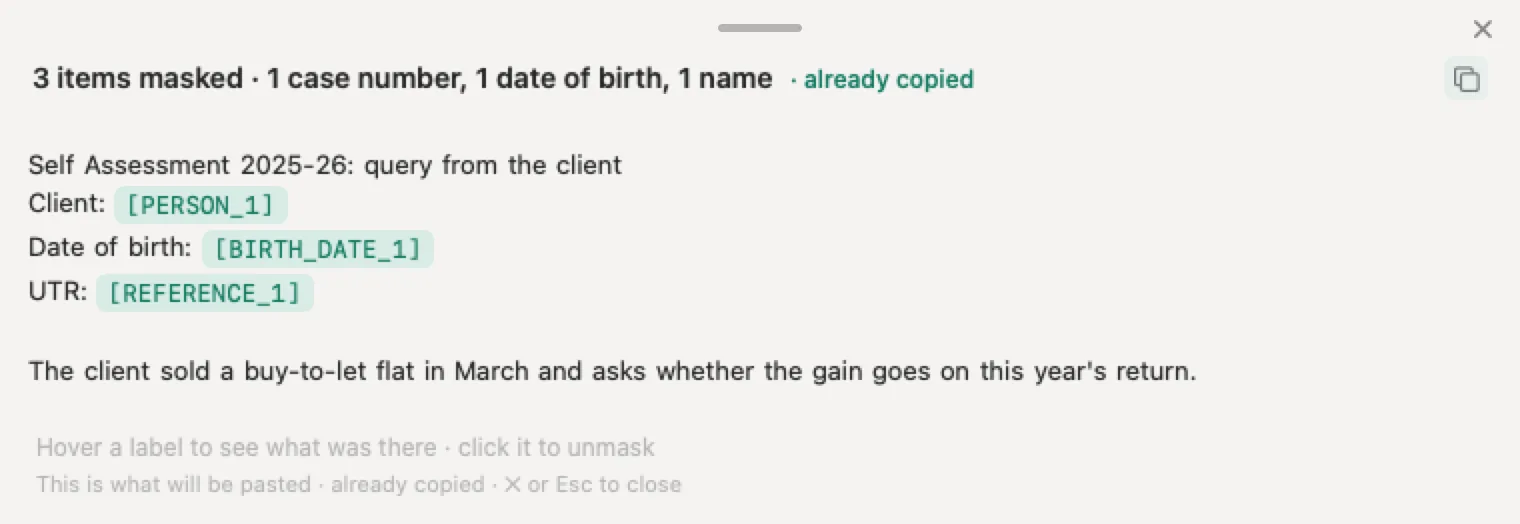
In the made-up query below, which we ran through Nonimo on 25 September 2026, the UTR is swapped because the letters UTR come straight before it; HMRC publishes no check for a UTR, so the label is all Nonimo has. The client’s name and date of birth become placeholders as well, and the question about the flat reaches the assistant as written. The security page lists what leaves your machine.
Before: what gets pasted
Self Assessment 2025-26: query from the client
Client: Mr Joe Bloggs
Date of birth: 30/02/1970
UTR: 12345 67890

The client sold a buy-to-let flat in March and asks whether the gain goes on this year's return.
After: what the AI receives
Self Assessment 2025-26: query from the client
Client: [PERSON_1]
Date of birth: [BIRTH_DATE_1]
UTR: [REFERENCE_1]

The client sold a buy-to-let flat in March and asks whether the gain goes on this year's return.
AI for accountants: what ICAEW expects of the firm
R114.1(d) is quoted in full here because the word that matters is personnel. The chartered accountant is not only answerable for their own keyboard but for the people working under them, which in most firms means the trainees and clerks who are quickest to try a new tool. A step that works on each of their machines is one you can name when asked what the firm actually did.
On 28 July 2026 ICAEW’s regulatory policy director applied that duty to AI in a note to firms. It asks for due diligence, contractual protections and internal approval before confidential client information goes into a system. A paid plan with the AI provider is the contractual part; it is not the due diligence, and it is certainly not the approval, which remains your firm’s own policy.
The same note asks firms to understand where data is stored, who can access it and whether it may be used to train models. Whatever Nonimo swapped out was never sent, so the provider holds nothing of it. For what OpenAI keeps of the rest, and for how long, read our guide on what ChatGPT does with a UK user’s data.
AI for accountants: price and how the firm starts
Nonimo’s desktop program runs on Mac and on Windows. Nonimo’s free plan stops at a set number of words each month. Leave an email address on our licence page and a free licence file comes back that removes the cap until 31 January 2027, with no account to set up. The installer is linked at the head of this page.
Each desk can get its own install. Firm-wide, IT installs the browser extension through policy, and it covers text without being asked and, where the partners decide, blocks; hello@nonimo.ai sets that up. Staff carry on with ChatGPT, Claude or Copilot as before, in the same browser they already have open every day.
The sensible place to start is with the people already pasting client queries into an assistant: the payroll team, the tax trainees, whoever answers the client inbox, and the partner who signs off the work. Each of them selects the passage, presses the key and reads the placeholders before sending; nothing needs configuring first.
- Free today, on Mac and Windows
- With a monthly word allowance
- The free licence lifts it until 31 January 2027, no account needed
Questions from the firm
Can accountants use ChatGPT?
Yes, provided client information is properly protected before it goes in. ICAEW's regulatory note of 28 July 2026 asks firms not to enter confidential client information into systems without appropriate due diligence, contractual protections and internal approval. Nonimo helps with what actually reaches the provider: the client details it spots on the desktop become placeholders first, so the assistant can work on the query without the client's identity attached.
Is ChatGPT safe for accountants on a paid plan?
Paying for the plan gives you a contract, which is one of the three things ICAEW lists, next to due diligence and internal approval. The same note reminds firms that AI and other digital tools do not reduce a firm's ethical responsibilities. Whatever plan you are on, Nonimo changes the words that arrive: the client details it recognised are placeholders by the time the text is sent.
What should an accountants' AI policy cover?
ICAEW's note is a fair checklist. It asks firms to understand where data is stored, who can access it, whether it may be used to train models and how outputs are monitored, and to have internal approval before client information goes in. Nonimo answers one line of that list: what it swapped out never reaches the provider, so there is nothing of it to store or train on.
Does Nonimo recognise a UTR on its own?
Nonimo recognises a UTR by its label, the way HMRC letters and returns print it, and swaps it for a placeholder on screen, so you see the change before anything is sent. The placeholder tells the assistant that a reference stood there, so it can still draft the reply, and the real UTR comes back in the answer on your own desktop.
Does Nonimo read our clients' figures?
No. The checking is done on the desktop and your text never comes to us; R114.1(d) is about keeping the client's affairs confidential, and nothing of a client's return passes through our hands. The one thing we receive is a daily usage count, which gives this month's share of the word allowance, plus version and platform, and holds no text.
We are an ICAS firm in Edinburgh. Does this page apply?
The app does, but the quotes on this page are ICAEW's. North of the border your institute is ICAS, and ICAS and ACCA members should read their own body's guidance on AI. What Nonimo does on your desks is identical in Edinburgh and in Bristol, including how the UTR and the NI number are swapped.