AI for solicitors: what goes from the file into the chat
Nobody in a practice uploads the whole file to ChatGPT. What goes in is a piece of it: the first draft of a witness statement, two paragraphs of an attendance note, a Home Office letter a trainee has been asked to summarise, the chronology going to counsel. Where the whole document is needed, drop it on the Nonimo window and a masked copy comes back beside the original, a Word file still a Word file. Each of those pieces opens with the lines that lead straight back to the client, usually before the first full sentence.
Those lines are the National Insurance number, the NHS number, the date of birth, your own matter reference and the tribunal’s appeal number, with the passport as well in an immigration matter. Immigration is where the warning came from: in [2026] UKUT 00081 (IAC), promulgated on 17 November 2025, the Upper Tribunal said in its headnote that uploading confidential documents to ChatGPT places them “in the public domain”.
So the question AI for solicitors raises is less which assistant the practice picks than what the passage still says when it lands. Taking the names out is only the first step, and what remains is still personal data for the firm. Our guide on cleaning a client file under the UK GDPR explains what is left and how to test it.
Can solicitors use ChatGPT? What arrives after the key press
Select the passage and press the key. Nonimo swaps what it recognises for placeholders on the fee earner’s own machine, Mac or Windows, and only then does the text go to ChatGPT or Claude. The assistant drafts with the placeholders, and when its answer comes back Nonimo puts the client’s real details in again, because only your machine knows which placeholder stands for what.
Where there is no doubt about a value, Nonimo replaces it without a prompt. British identifiers are replaced in plain view, with a one-line reason and an undo for each change. The fee earner sees the passage exactly as the assistant will receive it, and can put back anything the draft genuinely needs before pressing send.
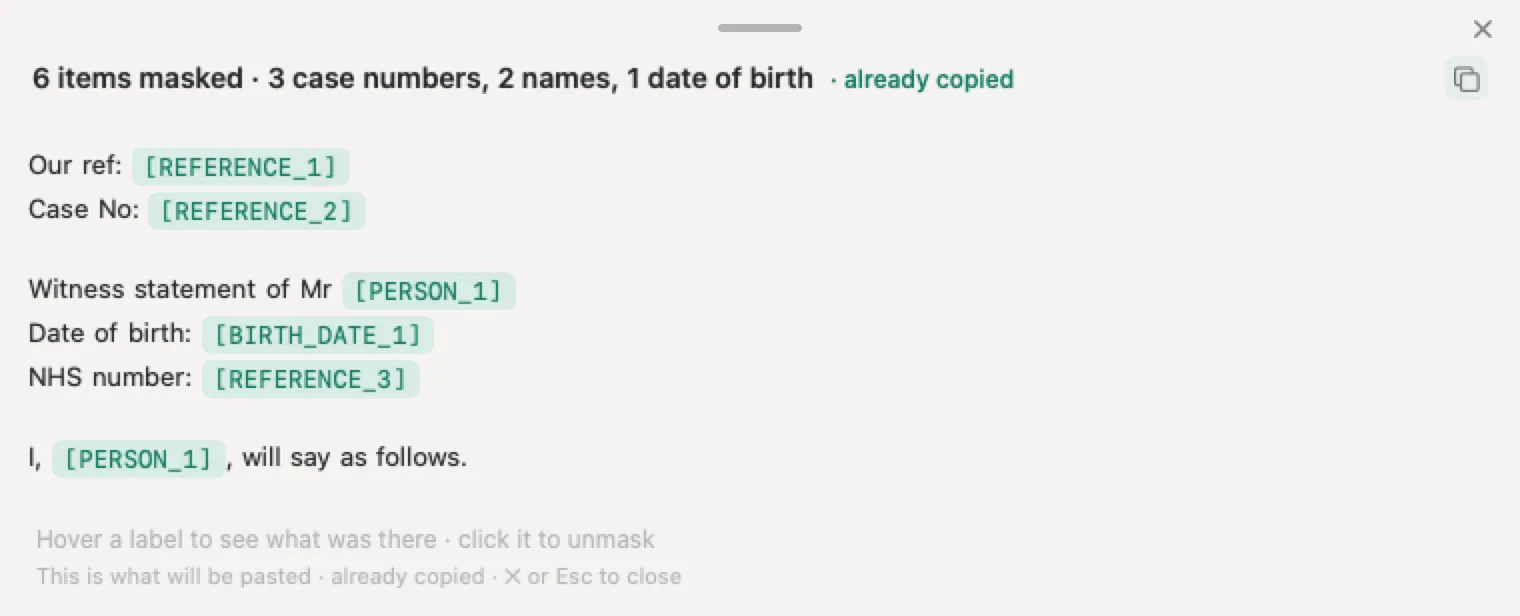
In the invented witness statement below, measured on 25 September 2026, the NHS number comes from the range kept for testing and is covered because the words “NHS number” sit before it; a real one keyed in wrongly would be covered too. The two references at the top, ours and the tribunal’s, become placeholders as well. What reaches us is set out on the security page.
Before: what gets pasted
Our ref: JB/0000/00
Case No: UI-0000-000000

Witness statement of Mr Joe Bloggs
Date of birth: 30/02/1970
NHS number: 999 234 5675

I, Joe Bloggs, will say as follows.
After: what the AI receives
Our ref: [REFERENCE_1]
Case No: [REFERENCE_2]

Witness statement of Mr [PERSON_1]
Date of birth: [BIRTH_DATE_1]
NHS number: [REFERENCE_3]

I, [PERSON_1], will say as follows.
What the SRA says about AI for solicitors on a paid plan
The SRA published its warning notice on the misuse of AI on 17 August 2026, and the sentence quoted here is the one a practice on a paid plan should read twice. The notice then asks firms to understand the safeguards that apply and make sure they fit the nature and sensitivity of the information. A subscription answers only part of that. The notice also shapes your client care terms.
The contractual safeguard comes from your agreement with OpenAI or Anthropic, and nothing we make changes it. The technical safeguard is what happens to the passage before it leaves the fee earner’s desk, and that is where Nonimo works. Client identifiers are replaced on the machine itself, and not a word of the passage comes to us at any point.
If the whole practice already works inside Microsoft Copilot, paragraph 21 of the same decision speaks to that choice, and our guide to Copilot and confidential information goes through it. This page is for the practice where people reach for ChatGPT or Claude. Either way, paragraph 7.2 of the Code of Conduct still expects you to justify the decision.
AI for solicitors: price and how the practice starts
Nonimo’s desktop app runs on Mac and Windows. Nonimo’s free plan stops at a set number of words each month. Leave an email address on our licence page and a free licence file comes back that removes the cap until 31 January 2027, with no account to set up. The app downloads from the top of this page.
Each fee earner’s machine gets its own install. For every machine at once, IT sets the browser extension through group policy, and it covers text without being called; the practice manager arranges that through hello@nonimo.ai. Fee earners keep using ChatGPT or Claude as they already do, in the browser they already have open.
Either way, start where ChatGPT or Claude is already open on someone’s screen, a team or a desk at a time. The next witness statement or attendance note is enough to see it work: select the passage, press the key and read the placeholders before anything is sent. Nothing needs configuring first.
- Free today, on Mac and Windows
- With a monthly word allowance
- The free licence lifts it until 31 January 2027, no account needed
Questions from the practice
Can solicitors use ChatGPT?
Yes, but not with identifiable client information unless the safeguards are in place. The SRA's AI warning notice, published on 17 August 2026, wants contractual, technical and organisational safeguards protecting confidentiality before client information goes into any AI system. Nonimo supplies one technical part: it replaces the client identifiers it recognises on the fee earner's machine before the passage is sent, and shows each change as it makes it.
Is ChatGPT safe for solicitors on a paid plan?
A paid plan changes your contract with the provider, not what the passage says when it arrives. The SRA's notice is explicit that paid and free-to-use tools alike may not provide the contractual and technical safeguards client confidentiality needs. Nonimo works on the second of those: the identifiers it recognises become placeholders before anything is sent, whichever plan the practice happens to be on.
Do we still need to check the AI provider's terms?
Yes. The SRA names three kinds of safeguard, contractual, technical and organisational, and Nonimo is only the technical kind. Your agreement with OpenAI or Anthropic remains the contractual safeguard, and your AI policy and supervision remain the organisational one. What Nonimo adds is that the passage reaching the provider carries placeholders wherever it found a client identifier, and the fee earner has seen them.
Can we show the SRA what Nonimo covered?
Your justification is what the SRA reads. Paragraph 7.2 of the Code of Conduct, which the warning notice cites, asks you to be able to justify your decisions and actions to demonstrate compliance, and that sits in your AI policy and file notes. Nonimo keeps no log of what it covered: it shows the fee earner every change at the moment of pasting, and a firm-wide dashboard counts by category. That is the step your policy can describe.
What does Nonimo learn about our clients?
Nothing from the text. Detection runs on the fee earner's machine, and the only thing that reaches us is a daily usage count: how much of the month's allowance has gone, the app version and the platform. The tribunal's concern was information placed in the public domain, and the details Nonimo replaced are simply never sent anywhere.
We practise in Scotland. Does any of this apply?
In part. The tribunal decision and the SRA warning notice are England and Wales; Scottish solicitors answer to the Law Society of Scotland and should read its own guidance on AI. What Nonimo does on the machine is the same in Glasgow as in Leeds, including how National Insurance and NHS numbers are covered.