Use of AI in court documents: the rules in England and Wales
· Updated

Joaquín Trapero in AI and privacy specialist, and founder of Nonimo.
The Civil Justice Council published its final report on using AI to prepare court documents on 29 October 2026. It makes fifteen recommendations, and for solicitors and barristers the main one is a refusal: no new AI declaration on pleadings, skeletons or advocacy.
The declarations land instead on witnesses of fact and on experts. None of it is in force until the rules are changed. Meanwhile the TCC Guide, three judgments and the SRA already set expectations, and our page for solicitors covers the client-file side.
There's no general duty to declare AI use in court documents in England and Wales yet. The CJC's final report recommends declarations only from witnesses of fact and experts, through CPR changes still to come. The TCC Guide already says disclose when in doubt, and every court expects you to check citations yourself.
What the Civil Justice Council’s final report on AI recommends
The working group was chaired by Sir Colin Birss. Its approach is functional and risk-based: the question isn’t which tool you used, but whether AI generated or influenced the substantive content, meaning the facts, evidence, opinion, reasoning or argument.
Regulation by the SRA, BSB and LSB stays the starting point. The Civil Procedure Rule Committee is asked for a plain-language Practice Direction codifying what the courts have said on AI use and sanctions. Knowing which details identify someone is part of the regulators’ confidentiality guidance.
Of the fifteen, Recommendation Six is the one I’d flag to anyone who isn’t a lawyer: it changes what happens when a client sits down to write their own statement.
The fifteen recommendations, by document
The highlighted row is the one new duty that reaches beyond lawyers and experts.
| Document or topic | Recommendation | No. |
|---|---|---|
| Statements of case, skeletons, advocacy | No new declaration; the responsible professional is identified | 4 |
| Disclosure | No reform for now, subject to the Disclosure Review Working Group | 5 |
| Witness of fact's statement | A declaration that AI hasn't generated or influenced its substantive content | 6 |
| Statement signed by a lawyer, not as a witness | No declaration; the lawyer stays responsible | 7 |
| Translations | Every translation certified by a professional human translator; an AI translation comes with the original | 8 |
| Expert reports | A new AI declaration where AI shaped the substance | 9, 10 |
| Litigants in person | The CJC and the rule committee to consider their AI use as a matter of urgency | 2 |
| The rules generally | Regulators keep the lead on guidance; new Practice Direction; tools defined by function; no tool-naming duty for lawyers; no permission regime | 1, 3, 11 to 15 |
Civil Justice Council, Use of AI for Preparing Court Documents: Final Report, 29 October 2026, section 3. Recommendations only: nothing changes until the rule committee acts.
Do you have to disclose AI use? It depends on your role
The interim report of 17 February 2026 had floated a declaration from legal representatives on trial witness statements. The final report moves that duty onto the witness, whether or not the party has a lawyer, and likens AI that reshapes a witness’s evidence to witness coaching.
For lawyers, it went the other way. Consultation responses strongly backed professional responsibility for statements of case, and warned that a declaration would breed satellite litigation over whether AI was used. Until the Practice Direction lands, my preference is to act as if the witness and expert declarations already existed.
What do I have to declare?
Pick who you are. Each panel separates today's position from what the CJC recommends.
Today: no CPR declaration. You're personally responsible for what you file. In the TCC, doubt about mentioning AI is resolved in favour of disclosure. In the Upper Tribunal, the judicial review claim form makes you confirm each authority exists.
Recommended: still no declaration on pleadings, skeletons or advocacy, and no duty to name the tool. The Practice Direction would make clear that a specific professional takes responsibility for the document.
Today: a statement of truth, and the duty to give evidence in your own words. In the Business and Property Courts, trial statements also follow PD 57AC.
Recommended: a declaration that any AI used in preparing the statement hasn't generated or influenced its substance. It wouldn't ban a spelling checker; it covers the result, not the tool.
Today: the statement of truth in paragraph 3.3 of PD 35, which says nothing about AI.
Recommended: a separate AI declaration whenever AI generated or influenced the substance of the report, naming the tool where scrutiny needs it, plus good-practice guidance in the revised expert instruction guidance.
Today: you answer for what you put before the court, and a judge who suspects a chatbot may ask what you checked. Nothing from the CJC is written for you yet.
Recommended: the CJC and the rule committee to look at litigants in person as a matter of urgency. If you give a witness statement, the witness declaration would apply to you too.
Today: for a witness statement in a foreign language, the translator signs the original and certifies the translation as accurate.
Recommended: AI translation stays allowed, but a professional human translator certifies every translation and an AI translation comes with the original. Part 32 and its Practice Direction would say so expressly.
Final report, recommendations 2, 4, 6, 7, 8, 9, 10 and 14; TCC Guide 1.6.2; UK and Munir [2026] UKUT 81; PD 35 paragraph 3.3; PD 32 paragraph 23.2. Not legal advice for your case. For the firm's own handling of client files, see Nonimo for solicitors.
From interim report to Practice Direction: what’s in force now
There’s a timeline problem with this subject. Articles written between February and October 2026 quote the interim report’s proposals as if they were the plan, and several were dropped. Quoting the interim report as current law is the mistake I’d most expect this winter.
What binds you today is narrower than the commentary suggests: court guides, the Upper Tribunal’s amended form, the existing CPR and your regulator.
The SRA’s warning notice of 17 August 2026 is the piece most firms will be measured against, and our checklist for choosing an AI tool works through its conditions on contracts and training.
AI and court documents in England and Wales, date by date
Filter by type. The highlighted rows are the two that set today's picture.
| Date | What |
|---|---|
| 6 June 2025 | Ayinde v Haringey: freely available chatbots can't do reliable legal research |
| 31 October 2025 | Updated AI guidance for judicial office holders |
| 17 November 2025 | UK and Munir promulgated: statement of truth on authorities |
| 17 February 2026 | CJC interim report and consultation |
| 22 April 2026 | Godwin v Godwin: ChatGPT and the witnesses' own words |
| June 2026 | CJC update on consultation responses |
| 1 July 2026 | TCC Guide 2026 published, with section 1.6 on AI |
| 17 August 2026 | SRA warning notice, Misuse of AI |
| 29 October 2026 | CJC final report: fifteen recommendations |
| No date | Practice Direction and CPR amendments from the rule committee |
| No date | The CJC's approach to litigants in person using AI |
Dates from each document, listed under Sources. The judicial guidance and the CJC's June update are named without links. The CJC will review progress in its next Annual Review.
The TCC Guide on AI: if in doubt, disclose
Section 1.6 of the TCC Guide, published on 1 July 2026, runs to five short paragraphs. Paragraph 1.6.2 says “any doubt as to whether the fact that AI has been used should be mentioned must be resolved in favour of disclosing such use”.
Paragraph 1.6.3 gets less attention. Legal representatives must uphold the confidentiality, and protect the privacy, of “any underlying data” used with AI. Much of it sits in scanned PDFs, where a black box drawn over a name can leave the text underneath for any tool to read.
This one irritates me slightly: two judicial texts eight months apart start from opposite defaults. Embedded AI in practice software makes the TCC default harder to apply, and the leaks that happen through those built-in model calls rarely reach the fee earner’s screen.
Three texts, three starting points on mentioning AI
Which one governs depends on the court you're in and the document.
Judges' guidance, Oct 2025
No reason to mention responsible use, depending on contextJudges may ask you to confirm you verified AI researchTCC Guide 1.6, Jul 2026
Doubt is resolved in favour of disclosingVerify research and citations, and be able to say soProtect the underlying dataCJC final report, Oct 2026
No declaration for lawyers' documentsDeclarations for witnesses of fact and expertsA named professional responsibleAI Guidance for Judicial Office Holders, 31 October 2025; TCC Guide 2026, paragraphs 1.6.1 to 1.6.5; CJC final report, recommendations 4, 6 and 9. Counsel and solicitors in the TCC are expected to follow its Guide in letter and spirit; other courts have their own guides.
AI fake citations in UK courts: Ayinde and Munir
The case every litigator now knows is Ayinde v Haringey, heard with Al-Haroun by a Divisional Court led by Dame Victoria Sharp. At paragraph 6 it said freely available generative AI tools “are not capable of conducting reliable legal research”. They may cite sources that don’t exist.
The Upper Tribunal went further in UK and Munir, promulgated on 17 November 2025. Its judicial review claim form now has a statement of truth that every authority cited exists, can be found from its citation and supports the point. Sign it over a false case and expect, ordinarily, a regulator referral.
Munir is principally about supervision: a supervisor who misses a junior’s false citation is likely to be more culpable. The Law Society lists court sanctions from public censure to contempt or referral to the police. Put the checking rule in your firm’s AI policy, not in each fee earner’s memory.
For each authority in the skeleton
Tick only what someone did by opening the source, not by asking a chatbot.
0 of 5
Not ready to cite. In Ayinde and in Munir, citations nobody had checked ended in Hamid hearings.
Ready. Note who checked it and when, in case the court asks.
Drawn from Ayinde [2025] EWHC 1383 (Admin), paragraph 6; UK and Munir [2026] UKUT 81, headnote 3; TCC Guide 1.6.4. Skip the chatbot when checking a citation: open the judgment itself.
AI in witness statements: Godwin v Godwin
Godwin v Godwin, [2026] EWHC 923 (Ch), was decided in Leeds on 22 April 2026 by HHJ Klein: two brothers, both in person, disputing how their father’s body should be disposed of. The defendant and his former wife said a “digital assistant” had helped with grammar, spelling and presentation.
It was ChatGPT, and they said it changed no words. The judge saw no good reason to use it and couldn’t rule out that ChatGPT supplied the phrase “digital assistant” itself. Without the first drafts, he couldn’t be sure the statements were in the witnesses’ own words.
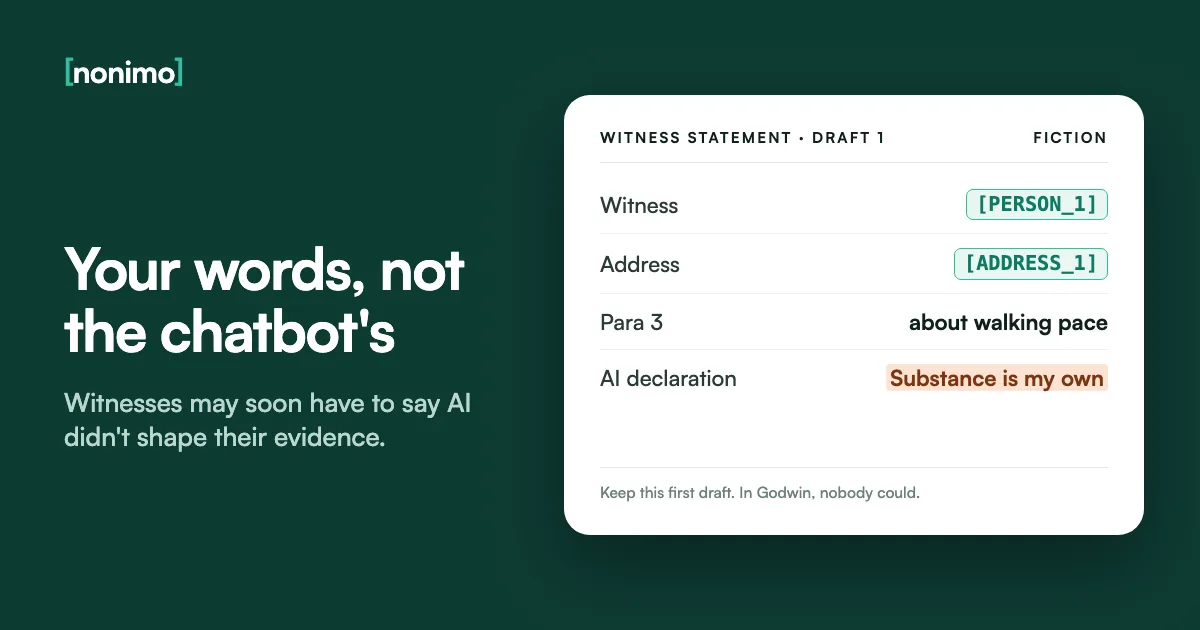
Godwin is the case I’d hand to any client drafting their own statement, with one instruction: keep the first draft, bearing in mind that a Word draft carries its tracked changes to whoever receives it. Recommendation Six would turn the lesson into a declaration.
A witness's words, before and after a chatbot "tidies" them
Nothing was added in bulk. Three small changes alter the evidence.
I saw the van back into the gatepost. It was going slowly, about walking pace. I shouted but I don't think the driver heard me.
I clearly observed the van reverse at speed into the gatepost. I shouted a warning, which the driver ignored.
Made-up example. The highlights show what the CJC's final report warns about: evidence "embellished, strengthened or otherwise altered". Before any draft goes near a chatbot, clear the Word file properly.
AI use in expert reports under Practice Direction 35
An expert’s report must already carry the statement of truth in paragraph 3.3 of PD 35: the expert has made clear which facts are within their own knowledge, and the opinions are true and complete. It says nothing about AI, a gap the CJC thinks matters more for experts than lawyers.
AI can properly be part of an expert’s method, and the other side has to see the method to test it. The interim report cited the Bond Solon Expert Witness Survey 2025: 20% of the 525 experts who took part had used AI in that role.
My bet is that experts meet this first through Recommendation Ten, in the CJC’s revised 2014 Guidance for the Instruction of Experts, well before any CPR amendment. Medical records they work from are special category data under UK GDPR, whichever tool reads them.
The expert declaration: interim proposal against final recommendation
| Interim, February 2026 | Final, October 2026 | |
|---|---|---|
| When it bites | Any AI use beyond transcription or admin | AI that generated or influenced the substance |
| Naming the tool | Always | Where needed for effective scrutiny |
| Where it sits | In the PD 35 statement of truth | A separate, AI-specific declaration |
| Guidance | Not specified | In the revised 2014 Guidance for the Instruction of Experts |
CJC final report, paragraphs 8.3 and 8.10 to 8.12, and recommendations 9 and 10. Neither version is in force. If records went into Claude, Anthropic's training and retention terms become part of your file.
Litigants in person using AI in court
The CJC’s terms of reference excluded litigants in person, but consultation responses pushed hard. Recommendation Two asks the CJC and the rule committee to consider their use of AI “as a matter of urgency”, with no date attached.
Until then, the judges’ guidance of October 2025 is the nearest thing. It accepts that chatbots may be the only advice some litigants receive, and tells judges to ask what checks were made and to remind the litigant they’re responsible for what they put before the court.
I find it odd that the people most likely to lean on a chatbot are the ones the CJC has left for later. What OpenAI keeps from those conversations is set out in our ChatGPT guide.
A chatbot helped with my court document. What now?
What kind of document is it?
AI Guidance for Judicial Office Holders, October 2025; Godwin [2026] EWHC 923 (Ch); PD 32 paragraph 23.2; CJC final report, recommendations 2 and 8. General information, not advice on your claim.
Can what you say to AI be used in court? Privilege and disclosure
The sharper risk is what leaves the firm. In Munir, the Upper Tribunal said uploading confidential documents into an open-source tool such as ChatGPT puts them in the public domain. It named closed tools such as Copilot as an alternative, so check what Copilot does with confidential work.
The SRA’s notice speaks of “the permanent waiver of privilege that can occur”. Paid tools aren’t exempt: client data must stay secure, not train models without explicit authority, and not be kept longer than necessary. Firms building their own face a choice between a private LLM and a privacy proxy.
Treat every prompt as something you might one day have to show the other side. A saved chat is information recorded, which is how CPR 31.4 defines a document. If your systems call a model, what went in may also sit in the logs of an AI gateway.
Where a pasted passage can end up
| Where | What the source says |
|---|---|
| A public chatbot | Judges are told to treat anything typed there as published to all the world |
| Your privilege | Munir: waived. SRA: the waiver can be permanent |
| Your chat history | On CPR 31.4's words, a recorded document like any other |
| Your regulator | Munir: may warrant SRA referral, and should be referred to the data protection regulator |
UK and Munir [2026] UKUT 81, headnote 4 and paragraph 21; SRA warning notice, 17 August 2026; CPR 31.4; judicial AI guidance, October 2025. The interim report also raised whether prompts used in AI-assisted disclosure might themselves have to be disclosed. Munir names the ICO; its functions passed to the Information Commission on 30 September 2026, which still uses the ICO name on its site.
If the model calls come from your own software, redacting client data at your own gateway keeps names out of those logs and out of the provider’s hands.

Preparing court documents with AI, without the client in the prompt
Recommendation Six asks whether AI shaped a witness’s words. It says nothing about the bundle someone wants summarised, the chronology built from emails or the first draft of a letter to the other side, and those are what carry the client’s identifiers.
Under UK GDPR, swapping names for labels is pseudonymisation, not anonymisation: the facts can still point to someone. The step nobody signs for is the one I’d make routine. Paste a passage into the box below to see which fixed-format identifiers it carries.
What a chronology entry gives away
14 March 2026: Bronwen Askey (07700 900355, 3 Wyvern Close, ZZ4 6PW) emails Harcastle Plant Hire Ltd about the damaged gatepost and attaches the only CCTV clip from Wyvern Close.
14 March 2026: [PERSON_1] ([PHONE_1], [ADDRESS_1], [POSTCODE_1]) emails [COMPANY_1] about the damaged gatepost and attaches the only CCTV clip from [ADDRESS_2].
Made-up people and company; 07700 900355 is in Ofcom's drama range. The checker runs in your browser and sends nothing; it doesn't detect names or street addresses. How the labels stay on your machine is on our security page.
Before a chronology or a bundle extract goes into an AI tool, Nonimo replaces the names, phone numbers and postcodes in the passage you select with labels on the fee earner’s own computer, and restores them in the reply. See how it works for UK litigation teams.
Sources
- Civil Justice Council, Use of AI for Preparing Court Documents: Final Report, 29 October 2026: the fifteen recommendations, the witness and expert declarations, litigants in person, translations.
- Technology and Construction Court Guide 2026, edition 4.1, published 1 July 2026 and updated September 2026: section 1.6, paragraphs 1.6.1 to 1.6.5.
- Godwin v Godwin, [2026] EWHC 923 (Ch), 22 April 2026: paragraphs 44 to 48.
- R (Ayinde) v London Borough of Haringey, [2025] EWHC 1383 (Admin), 6 June 2025: paragraph 6.
- UK and R (Munir) v Secretary of State for the Home Department, [2026] UKUT 81 (IAC): headnotes 2 to 4, paragraphs 21 and 37.
- SRA, Misuse of AI: warning notice, 17 August 2026: safeguards for client data and the permanent waiver of privilege.
- The Law Society, Generative AI: the essentials, updated June 2026: verifying citations and the range of court sanctions.
- Civil Procedure Rules, Practice Direction 35: paragraph 3.3, the expert’s statement of truth.
- Civil Procedure Rules, Part 31: rule 31.4, the meaning of document.
- DCMS, Information Commission succeeds the ICO (GOV.UK): the transfer of functions on 30 September 2026.
Accessed 8 November 2026.
Common questions
Do you have to disclose if you use AI in a court document?
Not under any general rule in England and Wales yet. The TCC Guide says to disclose when in doubt. The CJC's final report wants declarations only from witnesses of fact and experts, once the CPR are amended.
Can what you say to AI be used in court?
Potentially, yes, like any other record. CPR 31.4 defines a document as anything in which information is recorded, which covers a saved chat. Whether yours must be disclosed turns on relevance, privilege and the usual disclosure tests.
Is AI accepted in court in England and Wales?
Yes, as long as a named person answers for the result. The TCC Guide says AI can be used, and the CJC rejected any permission regime. Invented citations can still end in a regulator referral.
Can AI be used for legal documents?
Yes, but whoever signs is answerable for every line. The Law Society tells solicitors to check each citation against a genuine source. Witness statements are stricter: the words must stay the witness's own.
How is AI used in the judiciary?
As a possible secondary tool, under guidance updated in October 2025. It tells judges never to enter private or confidential information into a public chatbot, and to treat anything they type there as published.
What did Godwin v Godwin decide about ChatGPT?
The judge couldn't be sure two statements were the witnesses' own words. Both had been run through ChatGPT for presentation, the first drafts weren't produced, and he approached their evidence cautiously.
Does the CJC's final report apply in Scotland or Northern Ireland?
No, it deals with civil proceedings in England and Wales. Scotland and Northern Ireland have their own courts and procedure rules, so look at what the court hearing your case has published.