Special category data under UK GDPR: how to keep it out of AI
· Updated

Joaquín Trapero in AI and privacy specialist, and founder of Nonimo.
A data protection training quiz asks you to pick the one wrong item from a list: race, sexual orientation, date of birth. The answer is date of birth, and that small question hides a bigger one for any office using AI on staff paperwork.
The nine special categories in Article 9 of the UK GDPR turn up in payslips, fit notes and tribunal bundles without anyone labelling them. Which AI tool your firm may use is a separate decision about the tool itself. This page is about the text you put into it.
Date of birth is personal data, but it is not special category data. The special categories are racial or ethnic origin, political opinions, religious or philosophical beliefs, trade union membership, genetic data, biometric data used to identify someone, health, sex life and sexual orientation. Criminal records sit apart, under Article 10.
Is date of birth special category data? Sorting the usual quiz items
Quiz writers like date of birth as a decoy because it feels private. It is personal data: it helps identify a living person. It reveals no health condition, belief or membership, so Article 9 doesn’t touch it.
The same goes for a home address, a salary or a National Insurance number. These are the details that make a document about someone, which is a different job from revealing something sensitive about them.
Two items catch people out in the other direction. A union line on a payslip and a halal meal request look routine, yet both can reveal a category. The meal request is the one HR teams overlook most easily, in my view. Tick anything below to see where it lands.
Is it special category data?
Tick the items from your quiz or your files.
Nothing ticked yet.
Our reading of Articles 4, 9 and 10 of the UK GDPR and section 11 of the Data Protection Act 2018. The everyday details are the ones to strip first; which personal details to redact lists them by document.
The nine categories, and why “revealing” catches more than you’d think
Article 9(1) splits the list in two. Origin, political opinions, beliefs and union membership are caught by data “revealing” them. The other five are caught as such, and biometric data only when it is used to identify someone, which rules out most photos uploaded to a chatbot.
The verb is where offices go wrong. Nobody writes “trade unionist” on a payslip, but the deduction says it. Health is the broadest: a broken wrist on a sick day record counts as much as a psychiatric history, and a GP practice using AI handles little else.
Inference has a test of its own. The ICO’s guidance says an inferred religion or ethnicity may count, depending on whether you intend to draw that inference or to treat someone differently because of it. A prompt to “flag anything about this employee’s background” asks the model for exactly that.
Where each category turns up in a UK office
The highlighted row is the one payroll forgets.
| Category | Caught by | British paper that carries it |
|---|---|---|
| Health | Being about health | Fit notes, sickness absence logs, occupational health referrals |
| Trade union membership | What it reveals | The subscription deduction on a payslip |
| Religious or philosophical belief | What it reveals | Leave requests for festivals, meal choices for staff events |
| Racial or ethnic origin | What it reveals | Equality monitoring forms kept with the HR record |
| Political opinions | What it reveals | Disciplinary notes about social media posts |
| Sex life or sexual orientation | Being about it | Next of kin entries, harassment complaints |
| Genetic and biometric data | Being about it, if used to identify | Fingerprint clocking, facial recognition door entry |
Categories from Article 9(1) UK GDPR; definitions in Article 4(13) to (15). The paperwork examples are ours. Health codes on a driving licence are another place health hides.
Criminal offence data: Article 10, not Article 9
Article 9 does not mention criminal records, and quiz writers know it. Convictions and offences sit in Article 10, which allows processing only under official authority or where domestic law authorises it. A private employer has no official authority, so it needs a condition from Schedule 1 to the Data Protection Act 2018.
Section 11(2) of the 2018 Act stretches the scope to allegations and to proceedings, including sentencing. A tenant reference mentioning an arrest is in, as is a grievance note recording a caution. I find that wider net more useful to remember than the label itself.
Letting files are a common route out: estate and letting agents see references like that weekly, and an agent asking AI to draft a reply would paste the arrest along with the name.
Two neighbouring regimes
Same weight, different articles. Know which one your text is in.
Article 9: special category
Nine categories, listed in 9(1)Ten conditions in 9(2), on top of an Article 6 basisFive of them also need a condition in Schedule 1 or A1 to the 2018 ActExample: a fit note diagnosisArticle 10: criminal offence data
Convictions, offences, allegations, proceedings (s.11(2))Official authority, or authorisation in UK lawWithout authority: a condition in Part 1, 2 or 3 of Schedule 1 (s.10(5))Example: a DBS certificate resultUK GDPR Articles 9 and 10; Data Protection Act 2018, sections 10 and 11. A basic DBS check shows unspent convictions and conditional cautions, according to GOV.UK. Councils hold far more through licensing and enforcement: see AI for councils.
Schedule 1 conditions and the appropriate policy document
Since 20 August 2025, Article 9(2) opens by requiring that the processing is based on Article 6(1). So the Data (Use and Access) Act 2025 wrote into the article what was already the practice: one lawful basis from Article 6 and one condition from Article 9, never one standing in for the other.
Which condition you use depends on who you are. Employers lean on 9(2)(b), and section 10 of the 2018 Act sends them to paragraph 1 of Schedule 1. A solicitor running a claim relies on 9(2)(f), whose wording since 2025 names tribunals beside courts, and which needs no Schedule 1 condition.
Paragraph 1 brings an appropriate policy document: how the employer meets the Article 5 principles and how long it keeps the data. The Information Commission, which replaced the ICO on 30 September 2026 and still publishes as the ICO, can ask to see it. Many small firms have never written one.
Which route covers your file?
Who is handling the special category data?
UK GDPR Article 9(2) as amended from 20 August 2025; Data Protection Act 2018, section 10 and Schedule 1, paragraphs 1, 5 and 39. A simplification: other conditions exist.
What UK government guidance says about personal data in AI tools
The page many people still quote is the Cabinet Office’s guidance to civil servants: never put sensitive information or personal data into these tools. GOV.UK now marks it as superseded. The current text is the AI Playbook for the UK Government, published by GDS on 10 February 2025.
The Playbook is less blunt and more useful. It asks for a DPIA that identifies all personal data, special category data included, and for the smallest amount of personal data the purpose needs. It also warns that public tools may reuse prompts, so users must be taught what they can enter.
The NCSC said in 2023 that queries to a public LLM are visible to its provider and stored. Nothing here creates an AI exemption, and the EU AI Act doesn’t either. I’d pin the Playbook’s minimisation line above every HR desk.
Official UK guidance on sensitive data and AI tools
The highlighted row is the current government text.
| Source | Date | On personal or sensitive data |
|---|---|---|
| Cabinet Office, guidance to civil servants on generative AI | June 2023, updated January 2024 | Never put sensitive information or personal data in. Now marked as superseded |
| GDS, AI Playbook for the UK Government | 10 February 2025 | DPIA naming special category data; minimum personal data; teach users what not to enter |
| NCSC blog on large language models | 14 March 2023 | Queries are visible to the provider and stored; keep sensitive information out of public LLMs |
| Judicial guidance on AI | October 2025 | Judicial office holders reminded not to enter private information into public AI tools |
From each publication on GOV.UK, ncsc.gov.uk and judiciary.uk. What a business account changes is in how ChatGPT treats business data.
Business accounts don’t change the Article 9 analysis either. Copilot’s handling of prompts differs from a consumer chatbot’s, but a processor holding health data still holds health data.
A hosted AI gateway that logs prompts is one more processor holding the same health data, with its own retention period to check.
If you’re weighing a private model against a privacy proxy, the condition question travels with you: running the model yourself doesn’t remove the need for an Article 9 condition.
Payslips, fit notes and sickness records: what to cut before AI
Each HR document carries its category in a predictable place. A worker must authorise union deductions in writing under section 68 of the Trade Union and Labour Relations (Consolidation) Act 1992, so the payslip line reflects real membership. Accountants running payroll see thousands of them.
Acas says a fit note is needed after more than seven calendar days off sick. DWP’s guide to the form puts the health condition in field 2. That’s the field an AI summary usually needs, and the name above it the one it doesn’t. Sickness records for NHS staff raise further duties of their own.
Pick a document to see what we’d take out and what can stay. Payroll exports need the column headers checked first, because every identifier tends to have its own column.
One document at a time
What reveals a category, what identifies the person, and what to do with each.
Category: union membership, from the subscription line. Cut: name, payroll number, NI number, tax code, home address, bank details. Keep if needed: the deduction itself, when the task is reconciling pay.
Category: health, in field 2 and in the advice on adjustments. Cut: patient name, date of birth, practice details if they place the person. Keep if needed: the condition and the suggested adjustments for a return to work plan.
Category: health, in each absence reason. Cut: names, staff numbers, exact dates that single out one person. Keep if needed: reasons grouped by type for trend analysis. An exported Word or PDF log also carries author names in its metadata.
Category: anything, from union rep to orientation, often in tracked changes. Cut: every name in the thread, including witnesses. Check hidden comments with a proper Word redaction.
Category: the protected characteristic in the claim, plus medical evidence. Cut: names, case numbers, addresses, NHS numbers. Before filing anything AI touched, read what you certify to the court. PDFs need real redaction, not black boxes.
Our routine, based on DWP's fit note guidance, Acas and section 68 of the 1992 Act. A starting point, not a legal test.
Taking out the person: pseudonymised is not anonymous
A label the firm can reverse is pseudonymisation: under Article 4(5) of the UK GDPR, the data can’t be tied to a person without extra information kept separately. Your firm holds that information, so for you the note is still health data. Our UK pseudonymisation guide works through the test.
What changes is what the provider receives. A diagnosis attached to PERSON_1 says much less than one attached to a named warehouse supervisor. Calling the result “anonymised” in a DPIA would be wrong, and the difference between deidentified, pseudonymised and anonymised is worth getting straight before anyone writes that word.
Context gives people away too: “the only union rep at the Quillmere Joinery Ltd site in Hull” needs no name. We made that firm up, as everything in the example below. Some tools that restore names keep the originals in a store of their own, as LLM Guard does with its vault.
An invented sickness note, before and after
The category stays; the person goes.
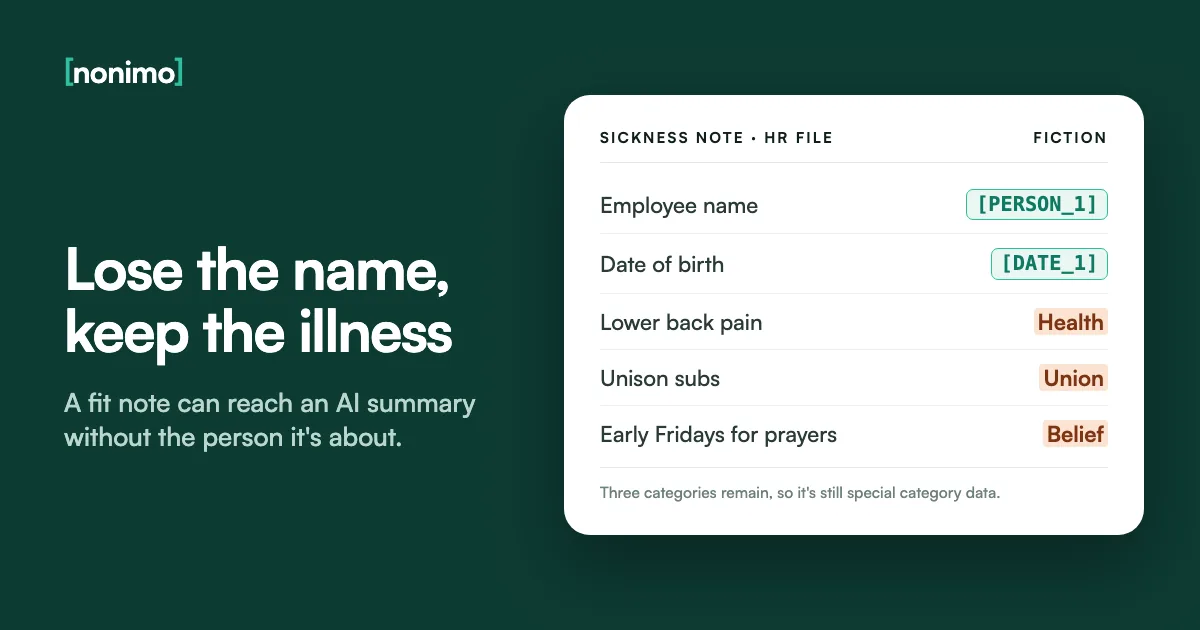
Callum Ostry, joiner, date of birth 31/09/1984, mobile 07700 900812. Off since 3 November with a fit note for lower back pain. Unison subs deducted monthly. Asks to finish early on Fridays for prayers.
[PERSON_1], [ROLE_1], date of birth [DATE_1], mobile [PHONE_1]. Off since early November with a fit note for lower back pain. Unison subs deducted monthly. Asks to finish early on Fridays for prayers.
Made-up person and details: 31 September doesn't exist and 07700 900812 is in Ofcom's drama range. The back pain, the union and the prayers still reveal three categories.
Before a note goes anywhere, paste it into the box below. It flags the numbers people miss, such as NI numbers, NHS numbers, postcodes and UK phones, the same way you would check a passport copy for its number.
Runs in your browser and sends nothing. It finds patterns with a fixed format; it doesn't detect names or street addresses. If a named note has already gone out, see whether that was a breach.
Developers calling a model from their own code can strip identifiers at a gateway on their own server before any request leaves the building.

Special category data in an HR file: before anyone pastes it
The checklist below is the whole routine in eight ticks. If two or more stay empty, the note isn’t ready, and I’d rather the summary waited a day. Your AI acceptable use policy is where the routine belongs once it works.
A health note that leaks with a name attached can also raise an insurance question; cyber cover for UK small firms differs widely on data incidents. This page explains the law in general and isn’t legal advice for your file.
For HR teams who need the diagnosis kept but the employee left out, Nonimo for UK offices replaces names, dates of birth and contact details with labels on your own computer before the note reaches the AI.
Before the HR note goes to an AI tool
Tick what's true for this note.
0 of 8 done
Not ready. Fix the empty boxes before the note leaves.
One gap left. Close it, then send.
Ready to send, with the person taken out.
A working routine drawn from Articles 9 and 10, Schedule 1 and the ICO's guidance, not a legal sign-off. If the AI output decides something significant about the employee with no human involved, Articles 22B and 22C add stricter limits. How the labelling stays on your machine is on our security page.
Sources
- ICO, Special category data: the nine categories, the inference test, criminal data outside the definition, five conditions needing Schedule 1 or A1.
- UK GDPR, Article 9 (legislation.gov.uk): the nine categories; “based on Article 6(1)” and “or tribunals” inserted from 20 August 2025.
- Data Protection Act 2018, Schedule 1 (legislation.gov.uk): paragraph 1 employment condition; paragraph 5 and Part 4 on the appropriate policy document; Part 3 for criminal convictions; “Commission” substituted from 30 September 2026.
- DCMS, Information Commission succeeds the ICO (GOV.UK): the Information Commission took over from the ICO on 30 September 2026.
- GDS, AI Playbook for the UK Government (GOV.UK): DPIAs naming special category data, data minimisation, what users may enter in public tools.
- NCSC, ChatGPT and large language models: what’s the risk?: queries visible to the provider and stored; keep sensitive information out.
- Courts and Tribunals Judiciary, AI judicial guidance, October 2025: no private information in public AI tools.
- Acas, Fit notes and proof of sickness: fit note after more than seven calendar days; who can issue one.
Accessed 8 November 2026.
Related guides
Common questions
Is date of birth special category data?
No, date of birth is ordinary personal data. It helps pick a person out but reveals none of the nine Article 9 categories. In a quiz listing race, sexual orientation and date of birth, it's the odd one out.
Is name and address special category data?
No, they're personal data only. They matter here because of what sits beside them: next to a diagnosis or a union deduction, the name and address tell a reader whose health or membership it is.
Is job title special category data?
No, Article 9 doesn't list it. A job title linked to a person is ordinary personal data. It moves closer to the line when the title itself states a belief, such as a chaplain's post.
Is a criminal record special category data under UK GDPR?
No, it has separate rules. Article 10 of the UK GDPR and sections 10 and 11 of the Data Protection Act 2018 cover convictions, allegations and proceedings, with the conditions set out in Schedule 1.
Is a medical condition special category data?
Yes, any data about physical or mental health is. That takes in the diagnosis on a fit note, the reason logged for a sick day and a referral to occupational health.
Can I put sensitive personal data into ChatGPT under UK GDPR?
Only if an Article 9 condition covers sending it there. You also need an Article 6 basis. The NCSC advises keeping sensitive information out of public chatbot queries, so take out who it's about first.
Who can process special category data?
Any organisation that meets an Article 9 condition. Employers usually rely on the employment condition in Schedule 1 to the Data Protection Act 2018, which also requires an appropriate policy document.