Can NHS staff use ChatGPT? The patient details to take out first
· Updated · Written and maintained by Joaquín Trapero, Nonimo
Can NHS staff use ChatGPT? Yes, in the narrow sense that no statute names the tool and bans it. No, in the sense most people mean when they ask, which is whether a clinic letter can go into a chat window as it stands. It cannot, and not because of the software. The problem is the header: the name, the birth date and the NHS number that tell the provider exactly whose diabetes this is.
The practical answer comes in two parts. Your organisation decides which tools may be used and for what, and that decision belongs to named people. Then, whatever the tool, what goes into it should be the clinical content without the patient attached. This guide is mostly about the second part, taken in the order a GP surgery, a hospital clinic or a private practice meets it.
Can NHS staff use ChatGPT? The short answer
The law does not ask which product you open. It asks what you do with confidential patient information, who agreed to it, and whether you used more of it than the task required. A chat window is simply the newest place where those old questions get answered badly.
That shifts the question from the tool to the text. A plain English version of a diagnosis, a shorter discharge summary or a first draft of a reply to a complaint can all be produced from a letter that no longer identifies anyone. The work is in getting the letter to that state before it leaves the computer, and in knowing where the identifiers hide.
Four nations, one data protection law
The core answer is the same in Cardiff, Glasgow and Belfast, because UK GDPR covers all four nations, and so does the Data Protection Act 2018. What changes is the paperwork around it. The Caldicott Principles on GOV.UK are marked as applying to England, the Data Security and Protection Toolkit is run by NHS England, and the patient number on the letter depends on where it was written.
A Scottish letter carries a CHI number and a Northern Irish one an H&C number, and both behave differently from the NHS number in ways that matter later in this guide. If you work across a border, check which number your letters actually carry before assuming a search for NHS number has found everything.
What the surgery already pastes
Nobody needs convincing that this is happening. In a survey run with the Royal College of General Practitioners and published by the Nuffield Trust on 3 December 2025, 598 of 2,108 GPs, or 28%, said they already used AI tools in clinical practice, and 11% of all respondents used tools they had obtained themselves rather than ones their practice provided.
Among the GPs who said what they used it for, 57% named clinical documentation and taking notes. That is the referral, the discharge summary somebody wants in plain English, the reply to a complaint. Patient privacy and data security worried 82% of the GPs who did not use AI, and 69% of those who did, so the concern is shared on both sides of the line.
For the practice view of the same problem, the letters and who signs off the tool, our page for GP practices walks through a referral on the practice computer.
Patient data in ChatGPT: why a clinic letter falls into the special categories
Article 9 of UK GDPR opens with a prohibition: processing data concerning health is not allowed unless one of the conditions in Article 9(2) applies. Article 4(15) defines that data broadly, as personal data about someone’s physical or mental health, including the provision of health care, that reveals something about their health status. A clinic letter is little else.
Article 9(1), as legislation.gov.uk prints it on 23 September 2026, still starts with that prohibition. The ICO flags at the top of its guidance that the text has been under review since Parliament passed its Data (Use and Access) Act in 2025. Worth watching, but the starting point for a clinical letter has not moved.
An NHS number is health data once it sits in a letter
The ICO’s guidance on special category data is explicit about the part people tend to skip. A number assigned to identify someone for health purposes counts as health data when combined with information about the state of their health, and the ICO gives the NHS number and the Scottish CHI number as its examples. In a referral or a discharge summary, that combination is what the document exists to carry.
So removing the name and leaving the number achieves very little. The number was issued so that every part of the health service could find the same person, and it does that job just as well inside a prompt. A payroll or staff number does the same on a fit note in an HR file, where health data outside the clinic usually sits unlabelled.
The condition written for care, and who it covers
The condition clinicians rely on is Article 9(2)(h): processing necessary for medical diagnosis, the provision of health care or treatment, and the management of health services. Paragraph 2 of Schedule 1 to the Data Protection Act 2018 sets out the same condition in UK law. Article 9(3) then ties it to secrecy: the data must be handled by or under the responsibility of a professional bound by professional secrecy, or by another person under a duty of secrecy.
Section 11(1) of the 2018 Act spells out who that is: a health or social work professional, or someone who owes a duty of confidentiality under an enactment or rule of law. Set that beside a personal chat account and the gap is plain. Whether a particular supplier can be brought inside that circle, through a contract and an impact assessment, is a question for the organisation and not for whoever has the letter on screen.
Does the letter reveal something about the patient's health? (Article 4(15))
YesIt is data concerning health, and Article 9(1) prohibits processing it unless a condition in Article 9(2) applies.
Is it for diagnosis, health care or treatment, or managing health services? (Article 9(2)(h))
YesThe condition written for care is available, set out in UK law in Schedule 1, paragraph 2 of the Data Protection Act 2018.
Is it handled by a professional bound by secrecy, or someone with a duty of confidentiality? (Article 9(3) and section 11(1))
YesThe condition can cover it.
NoThe condition written for care does not reach it.
Does a personal chat account sit inside that circle?
NoNot on its own. Whether a supplier can be brought inside, through a contract and an impact assessment, is for the organisation to decide.
What a personal ChatGPT account keeps, and who acts as controller for a UK user, is set out in what OpenAI does with a British user’s chats. If the choice is between assistants, our questions for a UK business weighing AI tools go supplier by supplier.
The eight Caldicott Principles, applied to a paste into AI
In England the Caldicott Principles are the rules clinicians already know by name. The National Data Guardian published the current eight on 8 December 2020, and none of them mentions artificial intelligence. They do not need to. Each is written about any use of confidential information, and pasting a letter into a chat window is a use.
| Principle | In short | Before you paste |
|---|---|---|
| 1. Justify the purpose | Every use defined and reviewed | Has the practice agreed to this use? |
| 2. Use it only when necessary | Identify people only where needed | Does the chat need to know who this is? |
| 3. Use the minimum necessary | Justify each item | Keep the history, drop the header |
| 4. Need-to-know access | Only those who need it | The provider is not on the care team |
The first four are about the information itself. The last four are about the people who handle it, the law around them and the patient at the other end.
| Principle | In short | Before you paste |
|---|---|---|
| 5. Everyone aware of their duty | Staff understand the rules | Has reception been told what not to paste? |
| 6. Comply with the law | Statute and common law | Article 9 and confidentiality both apply |
| 7. The duty to share | Share for care with confidence | Covers the consultant, not the chatbot |
| 8. Inform patients | No surprises | Would the patient expect this? |
Source: National Data Guardian, The Eight Caldicott Principles, 8 December 2020. Paraphrased; the full wording is on GOV.UK.
Principle 2 is the one that settles it
The second principle asks that the need to identify individuals be considered at each stage, with alternatives used where possible. Rewriting a letter for a patient, shortening a summary or drafting a reply does not require the model to know who the patient is. The alternative the principle asks for is the same letter with its identifiers replaced, and that is what the rest of this guide shows how to produce.
The third principle then does the arithmetic on what remains. Each item left in the text should be justified for the task. A blood result may be; a postcode almost never is.
The fourth principle is the one people forget applies outside the building. Need-to-know access covers whoever can read the text once it has left, and some providers say that human reviewers may read a sample of conversations. For one assistant, who at Google can read a Gemini chat, and when is set out from its own documentation.
Principle 8 and the patient in the waiting room
The eighth principle, added in 2020, asks for no surprises: patients should have clear expectations about how their confidential information is used. If a practice does adopt an AI tool for letters, that belongs in its privacy information for patients. A letter that reaches a chat with the patient still in it is the kind of surprise the principle was written to avoid.
Who in the practice owns the decision
On 27 August 2021 the National Data Guardian issued guidance on Caldicott Guardians under the Health and Social Care (National Data Guardian) Act 2018. It applies to public bodies in the health service, adult social care and adult carer support in England, and to organisations contracted by them to deliver health or adult social care. Those organisations must have regard to it, and were encouraged to comply by 30 June 2023.
For a practice working under an NHS contract, the person to ask is therefore usually named already: the Caldicott Guardian, alongside whoever leads on information governance and the data protection officer. The first principle asks for scrutiny and documentation precisely so that no clinician decides alone, in the middle of a clinic, that a tool is fine.
Your organisation’s policy on AI tools, and what it will ask of you
There is no single national NHS policy on ChatGPT that answers yes or no for every setting. What exists is a set of obligations that make a local answer necessary, and a few official signals about what an acceptable route looks like. Knowing them makes the conversation with your IG lead shorter.
| Who or what | Who it applies to | What it means before a paste |
|---|---|---|
| Data Security and Protection Toolkit | Every organisation with access to NHS patient data and systems | Unapproved tools are hard to square with it |
| NHS England’s IG guidance on AI | Patients, professionals and IG teams | Read the page for professionals yourself |
| GMC confidentiality guidance, paragraph 127 | Doctors, whether or not they are controllers | Follow the local policy on AI tools |
| Caldicott Guardian, IG lead and DPO | Health and care bodies in England, and those they contract | They decide on this tool and this use |
The Data Security and Protection Toolkit
Any organisation with access to NHS patient data and systems must complete the Data Security and Protection Toolkit, an online assessment against the National Data Guardian’s ten data security standards. The 2026 to 2027 version was published on 8 September 2026. An organisation that lets staff paste letters into tools nobody approved will struggle to square that with the assurances it gives there.
NHS England’s guidance on AI
NHS England has written information governance guidance on artificial intelligence for three audiences: patients and service users, health and care professionals, and IG professionals. The index page was last edited on 11 May 2026. We could not access the page for professionals in full when we checked on 23 September 2026, so we do not summarise it here; it is worth reading it yourself.
For doctors, the GMC’s confidentiality guidance already covers the gap. Paragraph 127 says that, whether or not you are a data controller, you must be familiar with and follow the confidentiality, data protection and records policies where you work, and know where to get advice. A local policy on AI tools is one of those.
What an approved route looks like
The contrast is instructive. NHS England’s AI Assisted Discharge Summary uses language models hosted on the NHS Federated Data Platform to draft the summary from the record, and leaves review and approval to the responsible clinician. The government’s AI Knowledge Hub described it as a pilot at Chelsea and Westminster when its entry was written on 15 September 2025. The model sits inside a governed platform, not a personal account.
If your organisation has no written position yet, our template for an AI use policy is a place to start and adapt. If the tool on offer is Microsoft 365 Copilot, its own questions are set out in what Copilot does with confidential material.
Patient identifiers in a clinic letter, one by one
A UK clinic letter carries its identity in a predictable place: a header block of five to eight lines, then a salutation, then a first paragraph that uses the patient’s title and surname again. The table is what to look for and why each item matters.
| Identifier | Where it sits | Why it matters |
|---|---|---|
| Name and title | Re: line, salutation, narrative | The plainest identifier, and it repeats |
| Date of birth | DOB line | With a postcode, points to very few people |
| NHS or H&C number | Header, England and Wales or Northern Ireland | The patient’s primary identifier there |
| CHI number | Header, Scotland | Its first six digits are the birth date |
| Hospital or unit number | Header of trust letters | Leads straight back to the record |
| Address, phone, email | Header | Locate and contact the person |
| Relatives, employer, places | The narrative | Identify without any number at all |
Sources: NHS Data Model and Dictionary, entries for the three patient numbers; ICO guidance on special category data.
The NHS number format is ten digits, printed on NHS letters in groups of three, three and four. The tenth is a check digit, worked out from the first nine with the modulus 11 method; a number for which that calculation gives 10 is never issued. It is the same number wherever the patient is seen in England and Wales, which is exactly why it identifies so well.
The CHI number carries the date of birth inside it
Scotland’s Community Health Index number is ten digits long, like the NHS number, but its first six digits are the patient’s date of birth, written day, month, year. The ninth digit is even for women and odd for men, and the tenth is a check digit. Delete the DOB line but leave the CHI number, and the letter still gives away when the patient was born.
Northern Ireland’s Health and Care number looks exactly like an NHS number, grouped three, three and four with a modulus 11 check digit, but it comes from its own range: the first nine digits run from 320 000 001 to 399 999 999. A letter from a Belfast clinic has no NHS number in it to find, and a search for one will come back empty.
The details that identify without a number
The hardest identifiers are not in the header. A daughter who is a pharmacist at the local branch, a husband who drove her in, an unusual diagnosis in a village, a job mentioned in the history: any of them can point to one person after every number has gone. No pattern finds them reliably, and they are the part somebody has to read for.
We explain why a letter stripped of its numbers can still be personal data, and a way to check one before sending it, in a separate guide on what survives once the numbers go.
A routine for the letter, the summary and the complaint reply
Most of the risk sits in three habits: shortening, rewriting for the patient and drafting replies. One routine covers all three, and it takes about as long as reading the letter once.
- Check the tool is on the list. Ask whoever leads on information governance, or the Caldicott Guardian, whether this tool and this use are approved. A personal account on a practice computer is rarely the answer.
- Copy only what the task needs. A plain English version of a diagnosis does not need the header, the salutation or the signature block, so leave all three behind.
- Remove the header identifiers. Name, date of birth, NHS, CHI or H&C number, hospital number, address, postcode, phone and email, in the order they appear.
- Read the narrative for people and places. Relatives, carers, employers, schools, a named ward or a small village either go or become a neutral description.
- Replace rather than delete. Writing “the patient” or “her daughter” keeps the sense of the sentence; a gap leaves the model guessing and the output needing repair.
- Put the details back on your side. Restore names and numbers in the clinical system, not in the chat, and check the clinical content before anyone signs it.
Keep the clinical content, lose the header
The routine is easier to hold in your head as a split between two piles. One pile never leaves the practice: everything that says who the letter is about. The other pile is what the task needs, and that is usually most of the clinical content.
If the letter goes with tags or placeholders in it, say so in the request. A line asking the model to keep every tag exactly as written means the reply keeps them in the right places, ready for the details to go back in on your side.
A rare diagnosis sits awkwardly across the two piles. If the condition plus the town is enough to name somebody, generalise one of them: a coastal town rather than its name, or a rare metabolic disorder rather than its eponym, if the task still works without it.
When a colleague has already pasted a letter
Treat it as an incident to report, not a secret to keep. Tell whoever leads on information governance, or the data protection officer: which service, which account, what text, and whether the conversation can be deleted. Article 33 of UK GDPR then sets the clock: a breach that puts people at risk has to be notified to the ICO within 72 hours of the organisation learning of it, where that is feasible, and with no undue delay in any case.
Whether a paste into a chat is a breach at all turns on which account was used and what contract stands behind it. The answer, account by account, is worked through in whether a paste into a chat window is itself a breach with the ICO’s position alongside other regulators’.
What Nonimo does to a clinic letter: a test on version 0.2.8
Nonimo runs as an app on Mac and Windows computers. You select the text, press one key, and the names, dates and numbers it recognises turn into labels like PERSON_1 on that computer; the tagged text is what you paste. Once the reply arrives, the tags are filled in again so you read it with the real details, and the record of which tag stands for which detail stays encrypted on that computer.
For this guide we wrote a clinic letter to a GP from scratch and ran it through version 0.2.8, the version available to download today. Here it is, with every suggestion accepted:
BEFORE
Dear Dr Pemberton,

Re: Mrs Adaeze Hartley
Born: 31/04/1968
NHS number: 123 456 7890
Address: 12 Nowhere Lane, Leeds ZZ1 1ZZ
Mobile: 07700 900123
Email: a.hartley@example.com

I reviewed Mrs Hartley in the diabetes clinic today. Her HbA1c
is 71 mmol/mol and I have added gliclazide 40 mg once daily.

Please turn this into a short letter to the patient in plain English.

AFTER (Nonimo 0.2.8)
Dear [PERSON_1],

Re: Mrs [PERSON_2]
Born: [BIRTH_DATE_1]
NHS number: [REFERENCE_1]
Address: [ADDRESS_1]
Mobile: [PHONE_1]
Email: [EMAIL_1]

I reviewed Mrs [PERSON_3] in the diabetes clinic today. Her HbA1c
is 71 mmol/mol and I have added gliclazide 40 mg once daily.

Please turn this into a short letter to the patient in plain English.
Everything in the letter is invented. There is no 31 April; no valid NHS number can begin 123 456 789, because its check digit would have to be 10; the mobile number is in the block Ofcom keeps for drama; there is no ZZ postcode area; and example.com is reserved for examples.
Each change appears marked and explained in a line, and a click puts any of them back. Installing it on several desks at once is covered on the page for organisations.
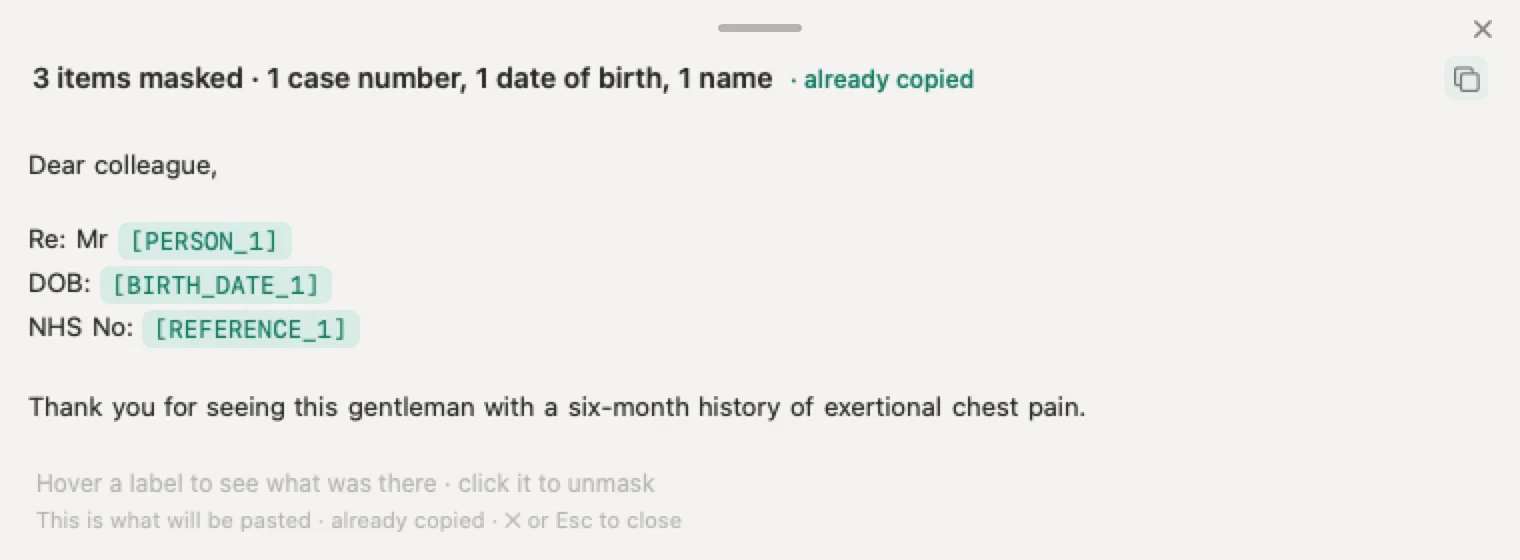
It knows no medicine: the people and places in the narrative are yours to check, in step 4 of the routine. What a practice pays is on the licence page.
What it keeps on the practice’s computer is set out on Nonimo’s security page.
What no tool decides for the practice
So can NHS staff use ChatGPT? The answer that survives a conversation with your Caldicott Guardian is narrower than yes and more useful than no: an approved tool, for an agreed task, with a letter that no longer says whose it is. The first two are decisions for named people in your organisation. The third is a habit, and habits slip late on a Friday.
A tool on the desk makes the habit cheaper; it does not replace the decision. The letters we built Nonimo around are laid out on our page for GP practices. If the question in your organisation is which assistant rather than whether, what Anthropic keeps from a UK user sets out another supplier’s terms, and what leaves your computer when Nonimo runs is in our privacy notice.
Nothing here is legal advice for a particular case. That belongs to your data protection officer, your IG lead or your own adviser.
Sources
Each with the fact it supports.
- UK GDPR, Article 9, legislation.gov.uk. 9(1) prohibits processing data concerning health; 9(2)(h) is the health and social care condition; 9(3) ties it to professional secrecy. Read as in force on 23 September 2026.
- UK GDPR, Article 4, legislation.gov.uk. 4(15) defines data concerning health.
- UK GDPR, Article 33, legislation.gov.uk. Notification of a personal data breach to the ICO without undue delay and, where feasible, within 72 hours.
- Data Protection Act 2018, section 11, legislation.gov.uk. 11(1): who counts as processing under an obligation of secrecy for Article 9(2)(h).
- Data Protection Act 2018, Schedule 1, paragraph 2, legislation.gov.uk. The health or social care purposes condition, which refers to Article 9(3) and section 11(1).
- ICO, What is special category data?, ico.org.uk. An NHS number or CHI number combined with information about health is health data; the guidance is under review after the Data (Use and Access) Act 2025.
- National Data Guardian, The Caldicott Principles, GOV.UK. The eight principles, published 8 December 2020, applying to England.
- National Data Guardian, new Caldicott Principle announcement, GOV.UK. 8 December 2020: the seven principles revised and the eighth, on no surprises for patients, added.
- National Data Guardian, guidance on the appointment of Caldicott Guardians, GOV.UK. Published 27 August 2021; who it applies to, including contracted organisations; compliance encouraged by 30 June 2023.
- NHS Data Security and Protection Toolkit, dsptoolkit.nhs.uk. All organisations with access to NHS patient data and systems must use it; ten data security standards; 2026 to 2027 version 9 published 8 September 2026; the site is © NHS England.
- NHS Data Model and Dictionary, NHS Number, datadictionary.nhs.uk. Ten digits, modulus 11 check digit, a result of 10 is never used; primary identifier in England and Wales, the same whichever organisation sees the patient. Re-read 26 September 2026.
- NHS website, Find your NHS number, nhs.uk. A 10-digit number, shown in the example as three, three and four digits; it appears on letters, prescriptions and test results. Read 26 September 2026.
- NHS Data Model and Dictionary, Community Health Index Number, datadictionary.nhs.uk. Date of birth in the first six digits, sex in the ninth, check digit tenth.
- NHS Data Model and Dictionary, Health and Care Number, datadictionary.nhs.uk. Northern Ireland; 3 3 4 format with modulus 11 check digit; range 320 000 001 to 399 999 999.
- NHS England Digital, Artificial intelligence (information governance guidance), digital.nhs.uk. Guidance for three audiences; page last edited 11 May 2026. Read through the Internet Archive copy of 7 September 2026, as the site refused automated requests.
- GMC, Confidentiality: good practice in handling patient information, gmc-uk.org. Paragraph 127: follow the confidentiality and data protection policies where you work. Read through the Internet Archive, as the site refused automated requests.
- AI Knowledge Hub, AI Assisted Discharge Summary, ai.gov.uk. Language models hosted on the NHS Federated Data Platform; clinician review and approval; pilot at Chelsea and Westminster; entry created 15 September 2025.
- Nuffield Trust and RCGP, How are GPs using AI? Insights from the front line, nuffieldtrust.org.uk. Published 3 December 2025: 598 of 2,108 GPs (28%) use AI tools; 11% using tools they obtained themselves; 57% of users for documentation; privacy concerns 82% and 69%.
- Ofcom, telephone numbers for use in drama, ofcom.org.uk. The mobile block the example number comes from (07700 900000 to 900999). Read through the Internet Archive copy of 18 February 2026, as the site refused automated requests.
Nonimo is the software that does this on your own computer: it masks client names and IDs before your text reaches ChatGPT . No account, and your client's details never leave your machine.
Common questions
Can NHS staff use ChatGPT?
Only where their organisation has approved that tool for that task, and never with the patient's identity still in the text. Article 9 of UK GDPR treats health data as special category data, and the Caldicott Principles ask for the minimum necessary. Nonimo helps with the second half: it turns the names, dates and numbers it recognises into tags on the computer before anything is pasted.
Is an NHS number health data on its own?
In a clinical letter, yes. The ICO's guidance on special category data says a number assigned to identify someone for health purposes, naming the NHS number and the Scottish CHI number, is health data when combined with information about that person's health. A referral always supplies that combination. Nonimo tags an NHS number when the words NHS No or NHS number come immediately before it, and shows the change instead of making it silently.
What should I remove from a clinic letter before using AI?
Everything that says whose letter it is: name and title, date of birth, NHS, CHI or H&C number, hospital number, address, postcode, phone and email. Then read the narrative for relatives, carers, employers and small places, which identify without a number. Keep the diagnosis, results and medication, which are what the task needs. Nonimo catches most of the header; the narrative is still for a person to read.
What are the eight Caldicott Principles?
They are eight rules the National Data Guardian published for England on 8 December 2020: justify the purpose, use confidential information only when necessary, use the minimum necessary, give access only to those who need it, make sure everyone knows their responsibilities, comply with the law, share for individual care with confidence, and tell patients how their information is used. For a paste into AI, the second and third carry most of the weight.
Do the Caldicott Principles apply to AI tools?
They apply to every use of confidential patient information, and none of the eight carves out software. The National Data Guardian published the current set on 8 December 2020 for England. The second asks that the need to identify people be considered at each stage, with alternatives where possible. For a letter going into a chat, the alternative is the letter with its identifiers replaced, which is the step Nonimo automates.
Does Nonimo recognise CHI and H&C numbers?
Not in version 0.2.8. We tested both on 23 September 2026 and each went through untouched, even with CHI No or H&C No written in front. That matters most for the CHI number, whose first six digits are the date of birth. In a Scottish or Northern Irish letter, delete that line by hand. Dedicated labels for the CHI and H&C numbers arrive with the next version.
Is it a data breach if a colleague pasted a patient letter into ChatGPT?
It may be, and it should be reported internally either way. Tell your IG lead or data protection officer which service, which account and what text. Article 33 of UK GDPR gives 72 hours, where feasible, to notify the ICO of a breach that puts people at risk. Nonimo cannot undo a paste; it reduces what the next letter carries.
Is ChatGPT approved for use across the NHS?
There is no single national approval that covers every setting. NHS England has written information governance guidance on AI for professionals, and your organisation decides locally, usually with the Caldicott Guardian involved. Where an approved route does exist, it looks different: NHS England's discharge summary tool, for example, runs on the Federated Data Platform. Nonimo does not change who decides; it changes what a letter contains once the decision is yes.
Does Nonimo make a patient letter anonymous?
No. It swaps identifiers for tags the practice can undo on its own machine, which is pseudonymisation. The letter remains personal data for the practice, and an unusual diagnosis in a village can still single someone out. What changes is how much the provider receives. Nonimo sends a daily usage count with version and platform, and never a word of the letter.