AI acceptable use policy template for your business
· Updated

Joaquín Trapero in Founder of Nonimo, writing on AI and privacy.
This is an AI acceptable use policy you can adopt as it stands: 15 numbered clauses, four annexes, a Word file and a PDF. There’s no email address to give and no watermark. I wrote it for organisations that use AI tools made by someone else, not for teams that build models.
The clauses don’t lean on one country’s law. Where a rule depends on local legislation, the text says “the privacy law applying to [Organisation]” and leaves that part to you. If the worry behind your search is a specific paste, whether client data in ChatGPT counts as a breach is the companion piece.
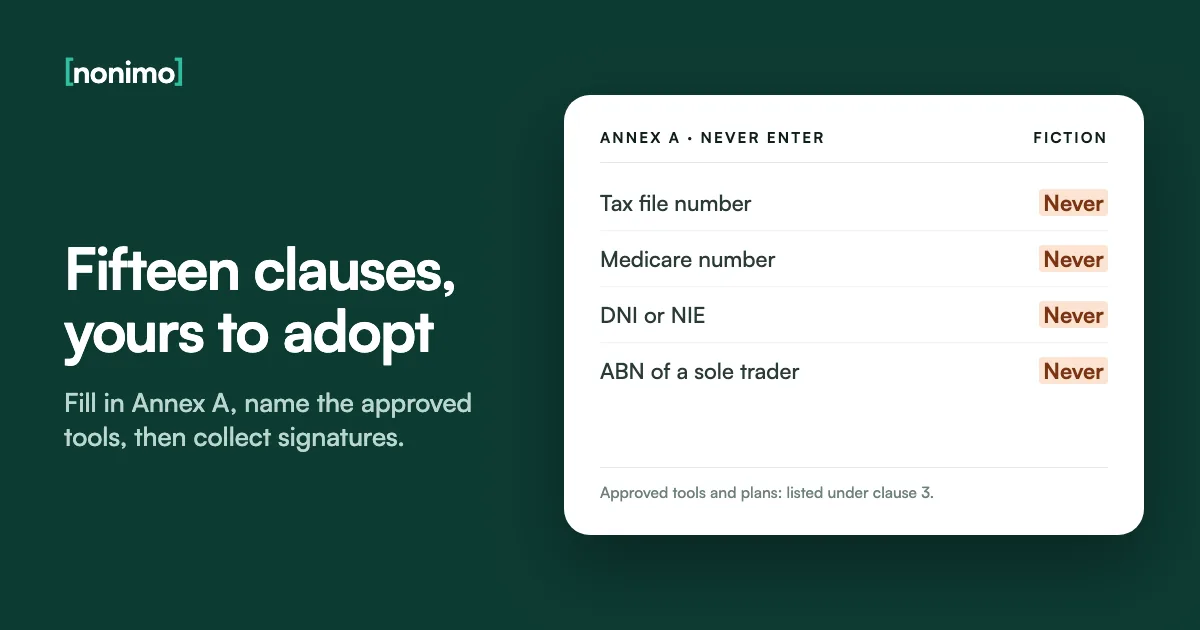
Download the Word or PDF version, or copy the 15 clauses below. Before anyone signs, fill in Annex A with the data that must never reach an AI tool, name the approved tools and plans under clause 3, and collect each person's acknowledgement on Annex C.
AI policy template: how to use it, and what it does not cover
Read it end to end once before you edit a word. Then fill in Annex A, because the never-paste list for your own data is the one part nobody outside your organisation can write. Clause 3 comes next: which tools are approved, and who approves the next one.
The template sets rules for how people behave. It isn’t a data protection impact assessment, it doesn’t tell you whether a particular tool is lawful for you, and it says nothing about building models. Have whoever advises you on employment and data law read your edited version before you adopt it.
Nor will it stop a paste. A signed policy lets you respond once a rule is broken, no more. Anyone who says a document keeps data from leaving the building is passing paper off as a control. I prefer a first version with one named owner and no clause you won’t enforce.
Which part of the template comes first for you?
Three questions about where your organisation is today.
Are people already using AI tools for work?
Do you know which tools, and on which accounts?
Are any of those accounts personal or free plans?
Our suggested order for this template. Every route ends with the signed acknowledgement in Annex C.
The 15 clauses of the AI acceptable use policy
Each clause is short on purpose: a rule staff cannot recite is one they will not follow. Below each clause is a line on why it’s there, which stays on this page and isn’t in the download. I’d resist adding clauses before the first review: every extra line is one more thing people forget.
1. Purpose and scope
This policy governs the use of artificial intelligence tools in the course of work for [Organisation]. It applies to all employees, contractors, temporary staff, volunteers and directors, on any device including their own, and whether or not [Organisation] provided the tool.
It covers tools reached through a browser, an application, a plugin, an extension, a feature embedded in another product, or an API. Where it conflicts with a client engagement term or a professional obligation, the stricter requirement applies.
Why: the riskiest use is often a tool nobody approved, on a phone nobody manages. A scope that stops at company laptops leaves both out.
2. Definitions
AI tool means any system that generates, summarises, classifies, transcribes or predicts using a model, including features embedded in products you already use. Input means anything a user types, pastes, uploads, dictates or connects to one. Output means what it returns.
Client information means any information relating to a client’s affairs, whether or not the client provided it. Personal information has the meaning given by the privacy law applying to [Organisation].
Why: ask staff what counts as an AI tool and most will name a chatbot, not the transcription feature in their video calls. Counting uploads and connected mailboxes as input closes the other gap.
3. Approved tools, and how a tool gets approved
Only tools on the approved list in Annex B may be used for work, and only with input that clause 5 allows. The list names the tool, the plan or tier, the account type and the approver.
A tool is added only after a named person has checked, in writing: what the vendor does with input, whether input trains models and whether that can be switched off, where data is stored, how long it is kept, and whether the contract is with [Organisation] rather than an individual.
Free and personal tiers are not approved.
Why: a brand name tells you little. One vendor can sell a consumer plan and a business plan on different training and retention terms, as the vendor table further down shows.
4. What must never go into an AI tool
The data types listed in Annex A must never be entered into any AI tool, approved or not, in any form, including inside a screenshot, a pasted table, an uploaded file or a connected mailbox. This prohibition has no approval path.
If a task seems to require it, stop and escalate to the person named in clause 15.
Why: give "never" an exception route and it stops meaning never. That's also why Annex A should stay short.
5. What may go in, and on what condition
Input not listed in Annex A may be entered into an approved tool once it has been cut to the minimum the task needs and direct identifiers removed or replaced.
Removing a name is not removing an identity: a matter number, a rare job title, or a date plus a location can identify a person on its own. Replacing an identifier with a code does not take the information outside privacy law for [Organisation], which holds the mapping.
Keep the mapping between codes and real values outside the AI tool.
Why: whoever holds the key that links codes back to people still holds personal data. Codes in place of names are pseudonymisation, not anonymisation, and a policy implying otherwise creates the very exposure it was written to prevent.
Would this prompt pass clause 5?
Paste a draft prompt or email extract. Use invented details if you're unsure.
This checker works locally in your browser, so the draft goes nowhere. It spots card numbers, IBANs, US Social Security and UK National Insurance numbers, IPv4 addresses, common API keys, emails and international phone numbers by format. It won't find names or street addresses; for those, follow the line between de-identified and anonymised text.
6. Client confidentiality is a separate duty
Confidentiality obligations apply to AI tools as to any other third party. Entering client information into a tool run by another organisation is a disclosure to a third party.
Where an engagement letter, retainer, professional rule or contract requires client permission before such a disclosure, that permission is obtained before the information is entered, and recorded.
Why: confidentiality and data protection are separate tests. A firm can satisfy privacy law in full and still breach an engagement letter that forbids disclosure without the client's consent.
7. Personal information and privacy law
Personal information may be entered into an approved tool only where that is consistent with the purpose it was collected for and permitted by the privacy law applying to [Organisation]. [Organisation] remains responsible for it after it enters a tool, including for its security.
Where the regulator recommends against a category of input, that recommendation is followed unless a named person records a reason not to.
Why: privacy regulators have begun publishing views on generative AI, mostly as guidance rather than bans. Australia's regulator is one example, and its recommendation on commercial AI products shows why the clause asks you to record any departure.
8. Consent, engagement letters and notices
Where clause 6 requires client permission, it is obtained in the engagement letter, a signed consent or an equivalent written record, and states what will be disclosed, to whom, where the data will be stored, and that AI tools may be used.
Privacy notices and the privacy policy describe the use of AI tools in terms an individual can understand.
Why: "we may use technology providers" tells a client nothing about where their file goes. For wording that names the recipients, see an AI clause written for Australian engagement letters.
9. Human review before reliance
Output is a draft. No output may be sent to a client, filed, published, relied on in advice, or used to decide something about a person until a competent human has checked it against a source. The reviewer is accountable for the content as if they had written it.
Citations, figures, quotations, legislative references and calculations are checked one by one against the primary source, never against another AI tool.
Why: the error that reaches a client is the expensive one, and "the tool wrote it" is no defence for anyone who signed it off.
10. Disclosure and marking of AI assisted work
Where content generated or materially altered by an AI tool is published, given to a client, or filed with a court, tribunal or regulator, [Organisation] discloses that fact where a rule, contract or professional obligation requires it, and wherever a reader would otherwise be misled.
Staff do not remove or defeat any marking or metadata a tool attaches to its output.
Why: in the EU, Article 50 of the AI Act splits this between two parties. Marking output is the provider's job; disclosing deep fakes and some public interest text falls on the deployer, which is you.
Who owes the Article 50 marking and disclosure duties
Clause 10 covers your column. The vendor's column is why marks start appearing on output.
| Duty | Who carries it | From |
|---|---|---|
| Mark synthetic audio, image, video or text in a machine-readable format, Article 50(2) | The provider of the AI system | 2 August 2026; 2 December 2026 for systems already on the market before 2 August 2026 |
| Disclose deep fakes, and AI text published to inform the public on matters of public interest, Article 50(4) | The deployer: your organisation | 2 August 2026 |
| Exception for that text: it went through human review or editorial control, with editorial responsibility held by someone | The deployer | 2 August 2026 |
Regulation (EU) 2024/1689, Articles 50 and 113; Article 111(4) as added by Regulation (EU) 2026/1744. Whether the Act reaches an organisation outside the EU is a separate question.
11. Records: the use case register
[Organisation] maintains the register in Annex D. Each approved use case records the tool, the purpose, the categories of input, who approved it, the date, and the next review. Prompts and outputs on client matters are kept in the matter file under normal record keeping rules, not only inside the tool’s own history.
Why: the register answers "what do we use AI for?" on one page instead of in a month of emails. A client's security questionnaire usually wants it next to the policy.
12. Accounts, plans and vendor terms
Work input is entered only through accounts held in [Organisation]‘s name, on the plan named in the approved list. Personal accounts, personal email addresses and consumer tiers are not used for work input.
Where a tool offers a setting controlling whether input trains models, or how long it is retained, the setting is recorded in the approved list and checked at each review.
Why: the gap this closes is a personal account used for a work task, which no logo on an approved list will reveal. You only find it by checking the account itself.
13. Devices, browsers and extensions
Browser extensions, plugins, desktop assistants and integrations that can read a page, a document or a mailbox are installed only from the approved list. Staff do not connect an AI tool to a mailbox, a document store, a practice management system or a code repository without approval under clause 3.
Why: an extension allowed to read every open tab sees far more than a chat window ever will.
14. Incidents
If prohibited data has been entered into an AI tool, or anything into an unapproved one, the user reports it to the person named in clause 15 the same day. Nobody is disciplined for reporting promptly.
[Organisation] records what was entered, when, into which tool and under which account; asks the vendor to delete it and records the answer; and assesses whether the incident is notifiable. Under Australia’s Notifiable Data Breaches scheme, the test includes whether a reasonable person would conclude it would be likely to result in serious harm.
Why: facts are easiest to recover in the first hour after a paste. The last sentence uses Australia's breach scheme as an example; replace it with the notification test, and the deadline, of the law you operate under.
15. Owner, review cycle and changes
This policy is owned by [named role]. It is reviewed at least every twelve months, and whenever a tool is added to the approved list, a regulator publishes guidance that changes a clause, or an incident under clause 14 exposes a gap. Every version carries a date and a change log.
Staff are notified of material changes and acknowledge again using Annex C.
Why: a policy with no owner and no date tends to resurface in a dispute years later, contradicting what everyone actually does.
Annex A: data that must never be entered
The two filled columns use Australia and Spain as worked examples. Swap them for the identifiers your own country issues, and add any sector numbers your staff handle, such as patient or policy numbers.
I’m wary of an Annex A longer than one screen: people remember a short list and skim a long one. If you’re unsure where client data hides beyond the obvious numbers, what counts as client data once names are gone covers matter details and combinations.
Rows to add for your country
Pick where you operate. Add these to Annex A alongside, or in place of, the example columns.
Social Security number, ITIN, driver's licence or state ID number, Medicare Beneficiary Identifier, bank routing and account numbers.
National Insurance number, NHS number, driving licence number, passport number, sort code with account number.
PPS number, Individual Health Identifier, passport and driving licence numbers, IBAN.
Social Insurance Number, provincial health card number, driver's licence number, bank transit and account numbers.
National identity card number, tax identification number, social security number, IBAN, and any health insurance number.
Common identifiers in each place, not a complete list. Your data protection regulator and any sector rules may add more.
Annex A, as it appears in the download
| Category | Australia | Spain |
|---|---|---|
| Government identity number | Tax file number (TFN) | DNI, NIE |
| Health identifier | Medicare number, Individual Healthcare Identifier | Número de la Seguridad Social |
| Business number tied to a person | ABN of a sole trader | NIF de autónomo |
| Bank and card details | BSB and account number, card number | IBAN, card number |
| Client names and matter details | Any | Any |
| Property identifiers | Title reference, full address | Referencia catastral, full address |
| Health information | Diagnoses, records, results | Health data (Article 9 GDPR) |
| Criminal history | Charges, convictions, police records | Criminal records |
| Biometric data | Face, voice, fingerprint templates | Biometric data |
| Credentials | Passwords, API keys, tokens | Passwords, API keys, tokens |
Annex B: the one page sheet
Print it and put it where people work.
This is the part most staff will actually read, so it carries no clause numbers. If it were my firm, this sheet would sit beside every printer while the full policy stayed on the intranet. Before you print, compare the right-hand column with our fuller list of what to redact in a document.
Annex B: yes and no at a glance
| Yes, with an approved tool | No, never |
|---|---|
| Rewriting your own draft with no client details | Anything in Annex A |
| Summarising a public document | Client names and matter details |
| Drafting a template letter with no client details | Uploading a client file |
| Generating test data | Pasting a whole document to “check” it |
| Explaining a concept you then verify | Anything you would not email to a stranger |
| Code with no credentials or client data in it | Credentials, keys and tokens |
Approved tools, plans and accounts: _______________________ (this list is clause 3; keep it current).
Annex C: acknowledgement
A signature doesn’t make anyone careful, but it fixes which version each person saw. Collect it at onboarding and again whenever clause 15 brings a material change.
I wouldn’t accept a reply-all “noted” as the acknowledgement. Insurers and clients increasingly ask whether staff were told the rules, and the AI section of an insurance questionnaire is easier to answer with a dated signature per person.
Annex C, ready to copy
I have read the [Organisation] AI acceptable use policy dated [date]. I understand that it applies to any device I use for work, including my own, and to AI features inside tools I already use. I understand which data I must never enter, that my work is checked before it is relied on, that I must report a mistake the same day, and that reporting promptly will not be held against me.
Name: ______________ Signature: ______________ Date: ______________
Annex D: use case register
One row per approved use: its purpose, which tool on which plan, the categories of input allowed, the approver, and the date it comes up for review. Clause 11 keeps it current.
For a five-person team, a shared spreadsheet with these six columns is enough. The column I care most about is the review date: an overdue row is a tool nobody has rechecked. Larger organisations sometimes route AI traffic through a gateway that logs every call, which shows which uses are missing from the register.
Annex D, blank
| Use case | Tool and plan | Input categories | Approved by | Date | Next review |
|---|---|---|---|---|---|
Annex D filled in for a fictional practice
Brindle & Oake, an invented eight-person surveying firm, after its first month.
| Use case | Tool and plan | Input categories | Approved by | Date | Next review |
|---|---|---|---|---|---|
| Summarising site notes into report drafts | Copilot, firm's business tenant | Survey observations, addresses removed | T. Achebe, practice manager | 2 March 2026 | March 2027 |
| Translating letters from overseas clients | Gemini, firm's Workspace account | Letter body, names and references replaced | T. Achebe | 16 March 2026 | September 2026, overdue |
| Rewording marketing copy | Claude, Team plan | Public website text only | L. Marsh, partner | 30 March 2026 | March 2027 |
Invented firm, people and dates. The translation entry was due for review in September 2026 and nobody chased it.
Which AI tools to approve: Copilot, Gemini and Claude business terms
Clause 3 asks a named person to check what the vendor does with input before any tool is added. For the large assistants, the answer depends far more on the plan than on the product name.
An entry that names a product but no plan is one I’d send back, because the plan and its settings decide the answer. Microsoft’s commitments, for instance, apply to work accounts, which is why whether Copilot trains on your data depends on how people sign in.
What each vendor's own documentation says about work input
Copy the plan and the setting into Annex B's approved list, as clause 12 asks.
| Tool and plan | Is input used to train models? | Also on the vendor's page |
|---|---|---|
| Microsoft Copilot, work account | No: prompts, responses and data reached through Microsoft Graph aren't used to train foundation models | Admins can set retention for Copilot interactions in Microsoft Purview |
| Gemini in Google Workspace | Not without the customer's prior permission or instruction | Content is not human reviewed |
| Claude for Work and the Anthropic API | Not by default | Input can be used if someone sends feedback or the customer opts in |
| Claude Free, Pro and Max | The user decides, through Model Improvement in Privacy Settings | A personal choice, so clause 12 keeps these plans off work input |
Microsoft Learn, data, privacy and security for Microsoft Copilot; Google's Generative AI in Google Workspace Privacy Hub; Anthropic Privacy Center. Read 10 November 2026; vendors change these pages without notice.
ChatGPT has the same split between consumer and business plans; how OpenAI treats business data sets out which settings to record under clause 12.
Does the EU AI Act require an AI policy? Article 4 on AI literacy
Not by name. Article 4 has applied since 2 February 2025 and originally asked providers and deployers to ensure, to their best extent, “a sufficient level of AI literacy” among staff using AI on their behalf. Regulation (EU) 2026/1744, adopted on 8 July 2026, replaced that wording.
The new text asks them to “take measures to support the development of AI literacy”, without guaranteeing “any specific level” for anyone. That seems more honest to me: no employer can promise what an employee knows. Whether the Act reaches you at all depends on where your AI output ends up.
The European Commission’s question and answer page says no certificate is needed; an internal record of training or other guidance can serve instead. Its own example is staff using ChatGPT to draft advertising text, who should be told about risks such as hallucination. Supervision and enforcement rules apply from 2 August 2026.
Could you show your AI literacy measures today?
Tick what you could put on the table if a market surveillance authority asked.
0 of 5 in place
Thin. Circulate Annex C with a short risk briefing and log the date.
A reasonable start. The unticked items are the ones to add before the next review.
That's a record you could hand over as it stands.
Based on Article 4 as replaced by Regulation (EU) 2026/1744 and the European Commission's AI literacy questions and answers, updated 20 October 2026.
NIST AI RMF or a company AI policy: which do you need first?
Where does the NIST AI Risk Management Framework fit in? NIST released it on 26 January 2023, says it is intended for voluntary use, and is revising version 1.0. It helps you manage AI risk across an organisation; it isn’t a set of rules for staff to sign.
So the two answer different people. A framework guides whoever governs AI use and how decisions are escalated; an acceptable use policy tells the person at the keyboard what they may paste. For a firm under fifty people, I’d get the policy signed before opening any framework.
If you’re in the US, our American version maps these clauses to NIST’s functions and adds the state rules that change a line. Federal law already reaches AI use: announcing Operation AI Comply in September 2024, the FTC’s then chair, Lina Khan, said there is no AI exemption from the laws on the books.
Policy, framework or law: what each one is for
| This template | NIST AI RMF | EU AI Act, Article 4 | |
|---|---|---|---|
| Written for | Staff who use AI tools | Organisations managing AI risk overall | Providers and deployers of AI systems |
| Binding? | As an internal rule, once adopted | No, intended for voluntary use | Yes, for organisations the Act reaches |
| What you end up with | A signed policy and a register of uses | Your own risk management practice | Measures supporting staff AI literacy |
NIST AI Risk Management Framework page; Regulation (EU) 2024/1689, Article 4, as replaced by Regulation (EU) 2026/1744.

Rolling out your AI usage policy: where paper stops
Clause 4 carries the rest, and a busy person breaks it without noticing: a client’s card number inside a pasted email thread, an identity number in a screenshot. A policy deals with that afterwards; it can’t step in. The Word and PDF files wait in the download box above the clauses.
That gap is why I’d pair Annex A with something that catches the identifier at the moment of pasting, and why the cheapest controls to add before the next paste go beyond writing things down.
One prompt, before and after clause 5
What Annex A asks staff to remove by hand, on an invented example.
Draft a reply to Odile Ferrant about the overdue invoice. Her card ending 4417 was declined twice; call her on +1 202 555 0129 or write to odile.ferrant@example.com.
Draft a reply to [CLIENT_1] about the overdue invoice. Her card ending [CARD_1] was declined twice; call her on [PHONE_1] or write to [EMAIL_1].
Invented person and details; the phone number sits in a range reserved for fiction. The draft is just as useful with the labels.
Nonimo’s signed apps for Mac and Windows run that check on the computer, and with a browser extension installed by policy they also read what’s pasted into the AI tool. Our security page explains why your text never reaches us.
To try it on a prompt of your own, start from the Nonimo home page.
Sources
- Regulation (EU) 2024/1689, the AI Act: Article 4 as first adopted, Article 50(2) and 50(4), and the dates in Article 113.
- Regulation (EU) 2026/1744 of 8 July 2026, in the Official Journal of 24 July 2026 on EUR-Lex: the new Article 4 and the 2 December 2026 deadline it adds as Article 111(4).
- European Commission, AI literacy questions and answers: no certificate needed, internal records, supervision from 2 August 2026.
- NIST, AI Risk Management Framework: released 26 January 2023, voluntary, version 1.0 under revision.
- FTC, crackdown on deceptive AI claims and schemes: Operation AI Comply, 25 September 2024; “no AI exemption from the laws on the books”.
- Microsoft Learn, data, privacy and security for Microsoft Copilot: prompts, responses and Graph data kept out of foundation model training; retention set by admins in Purview.
- Google, Generative AI in Google Workspace Privacy Hub: customer data not used for training without prior permission or instruction.
- Anthropic Privacy Center, commercial products: inputs and outputs not used for training by default.
- Anthropic Privacy Center, consumer plans: the Model Improvement setting.
Accessed 10 November 2026.
Common questions
Is this AI policy template free to download?
Yes, both the Word file and the PDF download without an email address. The 15 clauses and four annexes are also printed on this page, so you can copy them instead.
What should an AI acceptable use policy include?
Approved tools, banned data, human review and a named owner. Add a register of uses, an incident route and a signed acknowledgement; Annexes A to D of this template supply those.
Does the EU AI Act require companies to have an AI policy?
No, not in those words. Article 4 asks deployers to take measures supporting their staff's AI literacy. A signed policy plus a record of briefings is a practical way to show that.
Is there an AI policy template for Australia?
Yes, this one fits Australian organisations too. Annex A already lists the TFN, Medicare number and BSB details. Have the privacy and confidentiality clauses checked against the Australian Privacy Principles.
How often should an AI policy be reviewed?
At least once a year, under clause 15. Review it sooner when a tool joins the approved list, when new guidance changes a clause, or after an incident exposes a gap.
Should employees sign the AI policy?
Yes, ideally every person who uses AI for work. Annex C records that they read the current version, which is the page you'll want if a rule is ever broken.