· Updated

Joaquín Trapero in AI and privacy expert, and founder of Nonimo.
A state ID card follows the AAMVA design of a driver’s license: same DD number, same barcode on the back, no driving codes. Those shared parts are walked through field by field in the guide to redacting a driver’s license copy, and this page won’t repeat them.
What it covers instead is what the license page can’t: who usually holds this card, whether its number may follow you to a license later, what changes when the card belongs to a teenager or a retiree, and who actually needs a copy. The tool above does the covering in your browser.
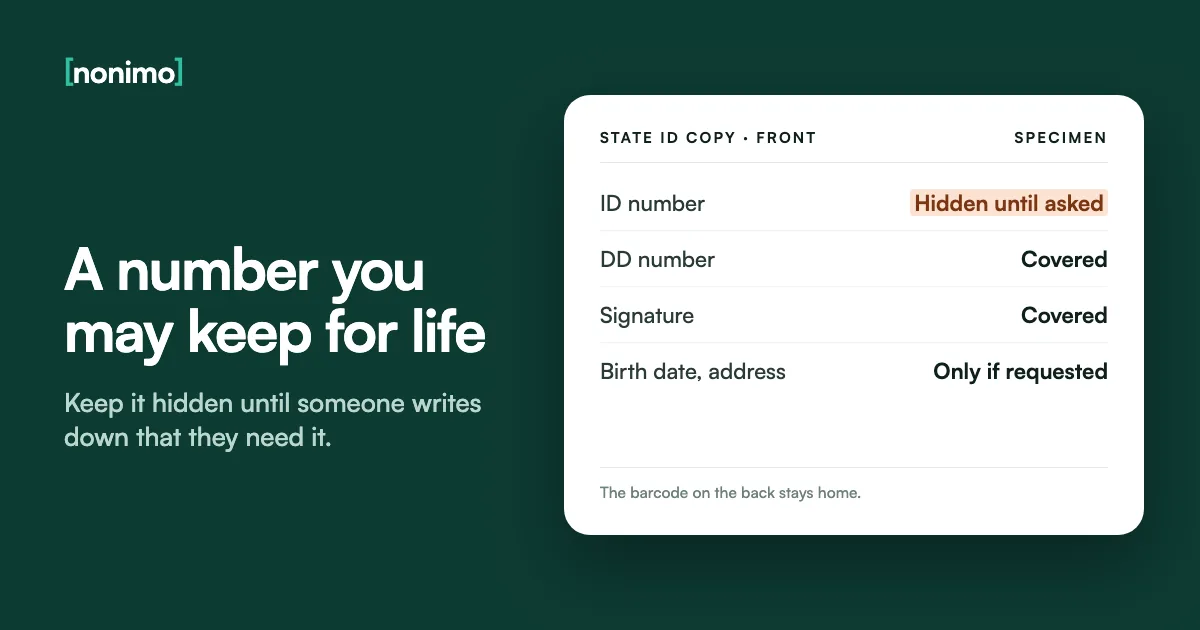
Cover the DD number and signature, plus the ID number, birth date and address unless the request names them. Expect to keep the ID number for life: New York says it identifies you, not the card, and no DMV page I checked promises a new one with a later license. Send the front only.
What to black out on a state ID copy, and what a license copy adds
The front of a non-driver card has the license fields minus vehicle class, endorsements and restrictions. The cover-or-leave calls barely move: DD and signature go every time, date of birth and address go unless the copy is about your age or where you live.
What changes is the weight of the number. For plenty of holders this card is their only state record, and on some cards it stays current for a decade. A stricter rule than on a license makes sense to me here: the number stays hidden until someone writes down that they need it.
One design, two kinds of card
Same call as on a license
DD number: coverSignature: coverBarcode on the back: leave the back out, or cover the whole blockBirth date and address: cover unless namedDifferent on a non-driver ID
ID number: may be your only state number, and may carry overNo class or restriction codes to think aboutHolder may be a child, with a parent filling in the formSenior and free cards can stay current 8 to 10 yearsFields from the AAMVA DL/ID Card Design Standard (2025), as covered on the license page. Validity periods from the California DMV and New York DMV, below.
The reasoning behind each box applies beyond ID cards, and the guide on which personal details to remove from a file lays it out more widely.
Is a state ID number the same as a driver’s license number?
It depends on the state, and the DMV pages say less than the question deserves. New York prints a 9-digit ID number near the top of a license, permit or non-driver ID, and says that number identifies you and doesn’t change when you replace the card.
Pennsylvania prints an eight-digit number, the DLN on a license or the IDN on a photo ID, and notes that the DD isn’t it. Florida went the other way: since July 31, 2024, license and ID card numbers carry at least four random digits, assigned at the next renewal or replacement.
None of the agency pages I could open, in New York, New Jersey, Pennsylvania, California or Missouri, states outright that an ID card’s number carries over when you later get a license. Until your DMV says otherwise, my working assumption is a number for life.
What your state says about the number on the card
One 9-digit ID number on the front of a license, permit or non-driver ID. It identifies you and doesn't change on replacement. The document number, on the back of most current cards, changes with each one.
Cover the 9-digit number unless asked. A new card won't retire it.
An eight-digit DLN on a license or IDN on a photo ID. License holders may also get a photo ID. The DD at the bottom center is neither number.
Cover the eight-digit number unless asked, and the DD always.
From July 31, 2024, a renewal or replacement brings a new number with at least four random digits. After that, it changes only if your last name does.
Cover it unless asked. On a card issued before July 31, 2024, the number shown changes at your next renewal or replacement.
New Jersey's ID page and California's don't address it. Missouri's nondriver FAQ doesn't either.
Assume the number stays with you. Ask the counter clerk when you switch cards.
New York DMV, sample photo documents; PennDOT, driver's license and photo ID number FAQ and photo ID page; FLHSMV bulletin of July 2024.
If you’d rather not hand a lifelong state number to a landlord at all, a passport card copy with no home address on it is the lighter alternative, provided the request accepts it.
State ID for a minor: what a child’s or teen’s copy should show
Unlike a license, a non-driver ID can belong to a child. California and New York set no minimum age, Pennsylvania starts at 10 and New Jersey at 14. A child under 18 generally has no credit report, the FTC notes, so there’s usually no report for a parent to watch.
Fewer places need that copy than parents expect. TSA doesn’t require ID from under-18s flying within the United States. For a first job, Form I-9 lets a minor with no List B document use a school record, report card, or a clinic, doctor or hospital record instead.
On a child’s card, my default is to cover the number, birth date and address and let the form argue for each one. A teenager’s first job also brings the List C document, and the Social Security card copy for that onboarding file deserves the same care.
| Who asks about a minor | What they rely on | Copy of the state ID? |
|---|---|---|
| TSA, domestic flight | No ID required under 18 | Not needed |
| Employer, Form I-9 | Original List B card, or a school, clinic or day-care record | Not for the I-9 itself |
| Social Security office | Child’s state ID among accepted proofs, originals only | No: photocopies are refused |
| Anyone else | Usually name and photo | Front only, number and birth date covered |
Senior and no-fee state ID cards: why the copy stays current longer
Validity is where a non-driver card can part ways with a license. California’s standard ID runs six birthdates, and its no-fee senior card, from age 62, runs eight. In New York a standard card lasts 10 years at 62 or older, for $6.50, or for nothing on SSI.
That matters on a copy. A picture of a 10-year card issued in 2026 looks current to whoever holds it until 2036. On a long-lived card I would cover the number even in cases where I might leave it on a four-year card.
How long a state ID copy can look current
| State | Card | Valid for |
|---|---|---|
| California | Standard ID | Six birthdates |
| California | No-fee senior ID, 62 or older | Eight birthdates |
| New York | Standard or REAL ID, under 62 | 4 or 8 years |
| New York | Standard, 62 or older or on SSI ($6.50; no fee at 62+ with SSI) | 10 years |
| New York | REAL ID, 62 or older or on SSI ($6.00; no fee at 62+ with SSI) | 8 years |
| New York | Any card, on public assistance, SNAP or Medical Assistance (no fee) | 4 years |
California DMV identification cards page and New York DMV non-driver ID fees, checked November 7, 2026. Other no-fee cards: Missouri gives one nondriver license at no fee to anyone who needs photo ID to vote, New Jersey charges $6 for a disability ID with no renewal fee, and California and Pennsylvania have free IDs for people experiencing homelessness.
New York’s reduced-fee card can’t be ordered online; you apply by mail or at an office. For a card that stays valid this long, I like a dated line on every copy, and you can watermark the state ID with its recipient and month after redacting it.
Who needs a copy of your state ID: Form I-9, landlords and benefits offices
On Form I-9, USCIS puts a state ID card in List B if it has a photo or details such as name, birth date, sex, height, eye color and address. For a non-driver it’s the identity half, paired with a List C document like a Social Security card. The employer sees the original.
E-Verify employers must copy a passport card, Green Card or work permit when you show one; state IDs aren’t on that list. Holding both a state ID and a passport card, my pick is the state ID, which leaves no copy behind. A remote I-9 review differs: clear copies of front and back, unredacted.
Benefits offices see plenty of these cards, and New York waives the fee for people on SNAP or public assistance. SNAP rules make the office accept any document that reasonably establishes identity. Social Security takes originals or issuer-certified copies, never photocopies. That’s my reading of the rules, not legal advice.
Who's asking, and what stays readable
For a pre-hire packet: name, photo, expiration date. For a remote I-9 review: everything, front and back.
On the pre-hire copy: ID number, DD, signature, birth date, address.
Name and photo. Birth date only if they say a screening needs it.
ID number, DD, signature, address. The FTC says a landlord doesn't need your Social Security number until you agree to rent, and the same restraint fits the ID number.
Name, photo and whatever the caseworker names. Any document that reasonably shows who you are must be accepted.
DD and signature. Ask the caseworker what else they need before deciding on the number.
Nothing: a copy won't be accepted.
Bring or mail the original state ID, or a copy certified by the agency that issued it.
USCIS Form I-9 acceptable documents and M-274 section 4.1; FTC, Rental Listing Scams; 7 CFR 273.2(f)(1)(vii); SSA, documents for a Social Security card.
A bank is the request where most fields stay readable, which the license page covers. A permanent resident might show a Green Card instead of a state ID, and redacting a Green Card copy deals with its A-Number.
Redact your state ID in the browser, step by step
1. Add the card
Drop a photo or PDF, or choose one; on a phone that opens the camera or your photo library. The card stays in your browser and is never uploaded to us. JPG, PNG, WebP, HEIC and PDF all open. If the photo shows the table around the card, tap Use just the document.
2. Choose what to cover
Every field starts visible, the number included. The tool gives a chip to each field it finds by its printed label or a number it can read. Tap the chips for what the request doesn’t need. State layouts differ, so some fields won’t get one.
3. Cover anything else by hand
Redact by hand lets you drag a box over any area, with a fingertip on a phone. Use it for a DD, signature or address left without a chip, and for the whole barcode if the back has to go. The zoom on the preview is the step I would never skip.
Before you tap Download, look at the preview
| Check | Why |
|---|---|
| The ID number box reaches both ends of the number | A last digit left showing narrows the guess |
| The DD is covered, front or back | Some states print it on the back |
| Name, photo and expiration date are still legible | Otherwise the recipient asks again |
| The barcode box runs past the edges | A partly covered barcode may still scan |
View larger opens the preview at full size. New York prints its document number on the back of most current cards and on the front of some older standard ones.
4. Check the watermark
It’s on by default, dated this month and year. Edit the line to name who the copy is for, such as For Pell Street Commons lease file only, then pick Repeated or Stamp, or switch it off.
5. Download
Save it as PNG, JPG or PDF. The boxes are burned into a new image with no EXIF, GPS or camera data. A box drawn in some PDF viewers can leave the original picture under it; this one can’t.

Three holders, three state ID copies
The card is the same plastic for a 15-year-old, a 40-year-old who never drove and a retiree on a ten-year senior card. What changes is who the number belongs to and how long the copy stays believable.
| Holder | Keep readable | Cover |
|---|---|---|
| Teenager, first job or school form | Name, photo | Number, birth date, address, DD, signature |
| Adult who doesn’t drive | Name, photo, dates; the number only when named | DD, signature, address unless it’s proof of address |
| Senior on a long-lived or no-fee card | Name, photo, expiration date | Number unless named, DD, signature, address |
A number that may follow you onto a license deserves more care than the plastic it’s printed on. Of the three, the senior copy worries me most, because nothing on it will look stale for years.
If your office takes in state IDs from tenants, patients or new hires and then pastes details into AI tools, Nonimo for Mac and Windows swaps those numbers and names for tags before the text leaves the computer.
Sources
- New York DMV, sample photo documents. The 9-digit ID number identifies you and stays on replacement; the document number changes.
- New York DMV, non-driver ID fees. Fees and validity by age, SSI and public assistance, SNAP or Medical Assistance; reduced-fee applications by mail or in person, not online. The DMV’s separate “Get a non-driver ID” page says a person with lawful status of any age can apply.
- FLHSMV bulletin, July 2024. New license and ID numbers with at least four random digits from July 31, 2024.
- PennDOT, find your driver’s license or photo ID number and PennDOT, get a photo ID. Eight-digit DLN and IDN; the DD at bottom center isn’t either; minimum age 10; license holders may apply; link to the free ID for people experiencing homelessness.
- NJ MVC, non-driver identification card. Age 14; $24 fee; $6 disability card with no renewal fee.
- California DMV, identification cards. Any age; standard card six birthdates; no-fee senior card at 62 for eight birthdates; reduced-fee card with form DL 937; no-fee card for homeless people under the McKinney-Vento Act.
- Missouri Secretary of State, voter ID. One nondriver license at no charge for Missourians who need photo ID to vote. (Missouri DOR’s driver license FAQ pages, read for the number question, don’t address it and aren’t linked.)
- USCIS, Form I-9 acceptable documents and USCIS, M-274 section 4.1. List B state ID; under-18 alternatives; E-Verify copy list; remote review copies.
- SSA, documents for a Social Security card. State-issued non-driver ID accepted as identity; originals or certified copies only.
- 7 CFR 273.2. SNAP identity verification by any reasonable document or a collateral contact.
- TSA, identification. No ID required for under-18s on domestic flights.
- FTC, Rental Listing Scams and FTC, protecting your child from identity theft. Fake landlords asking for a picture of your driver’s license and paystubs; no Social Security number needed until you agree to rent; a child under 18 generally has no credit report; free freeze for under-16s; reporting at IdentityTheft.gov.
Checked on November 7, 2026.
Related guides
Common questions
What should I black out on a state ID copy?
The DD number and your signature, always. Cover the ID number, birth date and address unless the request names them. Keep your name, photo and dates, and leave the back out.
Is my state ID number the same as my license number?
It depends on the state. New York prints one 9-digit number that identifies you on a license, permit or non-driver ID. Pennsylvania names them separately, DLN and IDN. Ask your DMV before assuming either way.
Is it safe to send a picture of my ID through email?
Not as a first choice. An emailed picture stays in two mailboxes indefinitely. Confirm the request by phone, cover what isn't needed, and use the recipient's upload portal when there is one.
Why would a scammer want a picture of my ID?
To pass checks that accept a photo of an ID. The FTC warns that fake landlords ask for a license picture and paystubs; a state ID serves them as well. Cover the number and birth date.
What should I do if I sent my ID to a scammer?
Report it at IdentityTheft.gov and ask your DMV about a replacement card. In Florida, replacing a card issued before July 31, 2024 brings a new number. For a child under 16, the FTC suggests a credit freeze.
How old do you have to be to get a non-driver ID?
It depends on the state. California and New York set no minimum age, Pennsylvania starts at 10 and New Jersey at 14. Your DMV's ID card page lists the documents a minor needs.