Engagement letter AI clause in Australia: solicitors and tax agents
· Updated · Written and maintained by Joaquín Trapero, Nonimo
No Australian statute or conduct rule requires an engagement letter AI clause by name. None says a practice must tell its clients it uses artificial intelligence. A practice that only asks a chatbot to tidy up its own newsletters has nothing in particular to disclose.
That changes once client information goes into the tool. Registered tax and BAS agents already work under Code item 6, which forbids passing anything about a client’s affairs to an outsider without the client’s say-so. Since 22 July 2026, the Tax Practitioners Board has said that an AI tool can be that outsider.
Solicitors work under rule 9, where the client’s authority is the safest footing. On top of that, three regulators and seven law societies have asked for openness with clients about AI. What AI changes in a law practice more broadly is on our law firms page.
So in Australia the real question is not “must I disclose AI?”. It is “do I have authority or permission for what my staff actually paste?”. The answer sits in three documents: the costs agreement or letter of engagement, the costs disclosure, and the privacy collection notice. This guide covers each one, then gives clause wording with two versions of the paragraph on client data.
When an Australian practice needs an engagement letter AI clause
It depends on your profession and on what goes into the tool, not on which chatbot you picked. Five sets of Australian rules touch the question, and they carry different weight:
| who you are | the rule | what it asks about AI |
|---|---|---|
| solicitor | ASCR rule 9 | the client’s authority before confidences leave the practice |
| solicitor | joint statement, NSW guide, seven societies’ checklist | transparency with the client, recommended |
| tax or BAS agent | TASA Code item 6, TPB(GS) 55/2026 | permission before client information reaches a third party, AI tools included |
| CA ANZ, CPA or IPA member | APES 305, paragraphs 3.6 and 3.7 | provider and location of outsourced or cloud services |
| any APP entity | Privacy Act, APP 1 and APP 5 | the provider as a usual recipient, and any overseas country |
Sources: the documents listed at the end of this guide, each read in full on 24 September 2026.
The TPB wording is the closest thing to a rule
Of all these documents, the TPB’s comes closest to an instruction, and even it is conditional. Putting client information into an AI tool “can” be a disclosure to an outsider, “depending on how these tools are configured and used”.
If your AI tool never receives client information, you may have nothing to seek permission for. If your staff paste whole schedules, you plainly do. The law societies’ guidance draws the same line. That is why the clause further down comes with two data paragraphs, and you pick the one that matches what happens at your desks.
Put together, the rules in this guide come down to five questions. Each “yes” tells you what the client should hear, and in which document.
Are you a tax or BAS agent, and will information about a client's affairs go into the tool?
YesGet the client's permission first, under Code item 6. A signed letter of engagement can carry it.
NoGo to the next question.
Are you a solicitor, and will client confidences go into the tool?
YesGet the client's express authority, as rule 9 allows. The costs agreement is the cheapest place to sign it.
Are you a CA ANZ, CPA or IPA member in public practice, using a cloud AI tool?
YesTell the client the provider, the location and how their information is stored, as APES 305 asks.
In a law practice, will AI change what the client pays, through a charge, time saved or a refusal?
YesSay so in the costs disclosure: section 174 of the Uniform Law, or your state or territory's own provision.
Is your practice an APP entity, and can the AI provider see personal information?
YesName the provider as a usual recipient in the APP 5 notice, with any overseas country.
None of them: no rule makes you tell the client, but regulators and law societies ask for openness, and the letter is the place.
The sections below take the questions in turn: solicitors first, then costs, tax agents and the privacy notice. The clause itself comes after that, ready to adapt.
Declaring AI use to a court is a different audience, with its own rules. For the NSW Supreme Court, see our guide to its practice note on AI. This guide is only about the client.
Solicitors: rule 9 and what three regulators expect you to tell clients
Rule 9.1 of the Australian Solicitors’ Conduct Rules keeps client confidences inside a small circle. It takes in the partners, principals, directors and employees of the practice, a barrister, and anyone “otherwise engaged” by the practice to deliver or administer legal services to that client. Every state and territory now has a version of these rules. The Northern Territory was the last, from 1 September 2025.
Could an AI vendor count as someone otherwise engaged? No court has said so, and no regulator’s guidance relies on the idea. The Law Society of NSW’s guide leans the other way. It treats client material typed into a public generative AI system as effectively published.
Implied authority reaches less far than it seems
That leaves rule 9.2.1: disclosure the client authorises, expressly or by implication. Victoria’s regulator, the Legal Services Board + Commissioner (VLSB+C), explains implied authority with a conveyance. There the other side, the bank and the government agencies must receive what the transaction needs.
A language model vendor sits outside that logic, and few clients would picture it. The same VLSB+C page is blunt about doubt: if you are not sure you have consent, get express authority. A clause signed with the costs agreement is the cheapest way to do it.
What the December 2024 joint statement asked for
In December 2024 the VLSB+C, WA’s Legal Practice Board and the Law Society of NSW issued a joint statement on AI in legal practice. It lists points lawyers “should also consider”. One is being open about AI. Another is recording and telling clients when and how AI was used in their matter and, if the client asks, how that use shows up in costs.
It also suggests offering clients the practice’s AI policy on request. Writing that policy for staff is a separate job, covered by our AI policy template. The clause only needs to say the policy exists and how to ask for it.
So a solicitor faces two different asks. Openness is what the regulators recommend. Authority is what rule 9 turns on. Tax agents face the same split, with Code item 6 in place of rule 9.
The difference matters when you draft. A notice is a paragraph the client simply reads. Authority or permission is something the client gives, so the letter has to say exactly what they are agreeing to. The table puts the two side by side.
| telling the client | getting authority or permission | |
|---|---|---|
| who asks for it | the joint statement, the NSW guide, the seven societies’ checklist | rule 9.2.1 for solicitors, Code item 6 for tax and BAS agents |
| force | a recommendation | the safest footing for solicitors, a requirement for tax agents |
| what is enough | a plain notice of which tools, for what, and who checks | the client agrees to a named provider, and to where the information goes |
| where in the letter | clauses 15.1 to 15.3 | clause 15.4, version B, and clause 15.5 |
| separate signature | no | no: signing the costs agreement or letter of engagement can give it |
| when | before or as part of the retainer | before client information goes into the tool |
| if the client says no | the opt out; the estimate may change | the tool stays off that file, or off those documents |
Sources: ASCR rule 9, TPB(GS) 55/2026 and the three documents on openness, all listed at the end of this guide.
The NSW guide and the seven societies’ model
The Law Society of NSW updated its guide in January 2026. Its pre-adoption checklist on page 9 has one line on this: “Ensure your client is aware and approves” of generative AI in their legal services. On page 6, discussing rule 4, it says it may be appropriate to tell a client that a generative AI program was used.
Outside NSW, seven law societies led by the Queensland Law Society released an AI selection and use checklist on 23 February 2026. Page 5 says that in most cases clients should be told about AI data sharing, perhaps before or as part of the retainer agreement. Annexure B, on page 11, is a model disclosure with an opt out. It is the Australian model the clause below builds on.
Read Annexure B line by line before adopting it whole. One of its sentences tells the client the firm’s own AI may be trained on material from their matter. That suits a practice running its own model. Most small practices do not run one, and would be asking for a permission they have no use for.
Costs disclosure: where AI changes what the client pays
Costs disclosure was not written with AI in mind. Yet it is where AI most often becomes something the client is entitled to hear about. Section 174(1)(a) of the Legal Profession Uniform Law applies when instructions are given, or as soon as practicable after. The practice must then disclose the basis on which legal costs will be calculated, and an estimate of the total.
Section 174(3) adds a duty to take reasonable steps to be satisfied that the client understands and agrees. The joint statement links AI to sections 172 and 173. Time and work billed should reflect legal work actually done. And AI should not leave the client paying more than traditional methods would, for instance for time spent fixing its output.
Three situations the disclosure has to cover
Each of these puts AI into the disclosure, for a different reason.
| situation | what the disclosure says | where it comes from |
|---|---|---|
| the practice passes on a fee for an AI platform | the per matter fee and its rate, since it is not a true disbursement | Law Society of NSW, Costs Guidebook |
| AI cuts the time a task takes | the saving shows in the bill, and an estimate on hourly rates assumes the shorter time | NSW guide, page 5: a contract prepared in half the time |
| the client refuses AI | that working without it costs more, before the client chooses | section 174(1)(b): update after a significant change to the estimate |
Sources: the Uniform Law, the NSW guide and the Costs Guidebook, listed at the end of this guide.
In all three cases the disclosure and the AI clause should tell the same story. A client who reads one and then the other should not find two versions of what the tools cost.
The Uniform Law applies in New South Wales, Victoria and Western Australia. The ACT, Queensland, Tasmania, South Australia and the Northern Territory each keep costs disclosure provisions in their own legislation.
Commercial and government clients, such as public companies, are exempt from disclosure under section 170. They still sign terms of engagement, though, and the AI clause travels with those. The confidentiality side, in brief, is on the law firms page.
Tax and BAS agents: Code item 6 and the client’s permission
For registered tax and BAS agents, the rule is years older than chatbots. Code item 6 sits in section 30-10 of the Tax Agent Services Act 2009. It bars a tax practitioner from passing on information about a client’s affairs to anyone outside the relationship without the client’s permission, unless the law requires it.
TPB(GS) 55/2026, dated 22 July 2026, applies that rule to AI. The statement itself says it creates no obligations beyond the Act. So the permission rests on Code item 6, not on the guidance.
The guidance statement, paragraph by paragraph
Five paragraphs do the work. Paragraph 23 is the one people quote, and its conditional wording is the part to read twice.
| paragraph | what it says |
|---|---|
| 21 | a third party is any entity other than the client and the practitioner |
| 22 | the information only has to concern the client’s affairs, not belong to the client |
| 23 | permission comes before client information is divulged to a third party, which “can include” entering it into AI tools |
| 23, continued | tell the client to whom and where, where data will be stored, and whether AI tools may be used |
| 24 | permission can come from a signed letter of engagement, a signed consent or a fact find; a general authority may also be acceptable |
| 26 | tax file numbers add the 2015 TFN Rule: take your own advice on how it applies to AI |
Source: TPB(GS) 55/2026, issued 22 July 2026.
Paragraph 24 is the practical one. It means the letter of engagement can carry the permission, provided the letter says what paragraph 23 recommends. A bare “we may use AI” does not.
Paragraph 26 leaves the TFN question to your own advice. For what OpenAI holds on to once a return is pasted, read how long OpenAI keeps a pasted return.
APES 305 already asks about cloud tools
Accountants who belong to CA ANZ, CPA Australia or the IPA and work in public practice also answer to APES 305, Terms of Engagement. The current version is effective for engagements from 1 January 2025, and it never mentions AI. Paragraph 3.6 says a member using outsourced services shall communicate the provider, where the services are performed, and their nature and extent.
Paragraph 3.7 covers cloud computing that is not outsourcing. It defines that as computing resources a third party provides over the internet, software and applications included. A chatbot subscription looks like exactly that. Here the member should communicate the provider, the location, and how the client’s confidential information will be stored.
A practice doing both tax and accounting work can meet the TPB’s recommendation and APES 305 with one paragraph. The TFN side of the same statement, with a rental schedule before and after, is on our accountants page.
APP 5 collection notice: naming the AI provider as a recipient
If your practice is an APP entity, the clause has a second home. That is the notice given when personal information is collected, often part of the engagement letter or sent with it. APP 5.2 lists what the individual should be told. It includes who you usually disclose that kind of information to, whether it is likely to go to overseas recipients and, where practicable, in which countries.
The OAIC has applied this to AI. Its guidance for businesses using ready-made AI products was first published in October 2024 and revised on 17 January 2025. It says that if the developer of an AI system has access to personal information processed through it, “this is a disclosure that should be included in an APP 5 notice”. APP 1 asks for the matching information in the privacy policy.
The sketch below sums up which of the three documents carries which part of the AI wording. The clause further down is written so that each piece can be lifted into the right one.
Practices under the $3 million line
Plenty of small practices fall under the small business exemption and are not APP entities. That boundary moved on 1 July 2026 for lawyers and accountants who provide designated services under the AML/CTF regime. Our Privacy Act guide on choosing AI tools sets out the exceptions.
Being outside the Privacy Act does not take a practice outside rule 9 or Code item 6. The engagement letter still needs its AI paragraph. The privacy notice line is the piece an exempt practice can drop.
The automated decision making duties that begin on 10 December 2026 are a separate matter. They attach to decisions a program makes, or substantially helps make, that could significantly affect someone. Drafting a letter or summarising a file is not that.
Clause 15: the AI wording, numbered for a costs agreement
The wording below is numbered as clause 15 of an Australian costs agreement or letter of engagement, though the number is yours to change. Square brackets mark what the practice completes or strikes out.
It follows the order of the seven societies’ Annexure B: tasks, review, confidentiality, and the client’s choice. Then it adds what the TPB, APES 305 and APP 5 ask for.
15.1 to 15.3: the notice, identical for every practice
These three paragraphs go into every letter, whatever your practice does with client data. They tell the client which tools you use and for what, who checks the result, and how to say no.
In carrying out your matter we may use AI tools for [summarising material, preparing first drafts and chronologies, checking correspondence]. We will tell you if that list changes.
AI tools do not advise you or make decisions in your matter. A [solicitor / registered tax agent] of this practice checks anything an AI tool produces before it is relied on or sent to you. We are responsible for that work in the same way as for all other work we do for you.
You may tell us at any time, in writing, that AI tools are not to be used in your matter or on particular documents. If you do, we will let you know whether our estimate of [costs / fees] changes.
Clause 15.2 keeps the work yours: a person at the practice checks what the tool produces. Clause 15.3 is what turns the notice into a choice rather than an announcement. It mirrors the Annexure B opt out. For a tax practice, it also records that the client’s permission under Code item 6 can be refused or narrowed.
15.4 and 15.5: the data paragraph, written two ways
Clause 15.4 is where practices differ. Use version A if identifying details are swapped out on your own computers before anything goes into the tool. Use version B if matter documents go in as they are. Version B needs clause 15.5 as well, because that is where the client gives authority or permission.
Before any text is entered into an AI tool, we replace the details that identify you and other people with placeholders, on this practice's own computers. Those details include names, addresses, dates of birth, tax file numbers, Medicare numbers, ABNs, account numbers and our file references. We also review the text for anything that could still identify a person from context.
The record matching each placeholder to the real detail stays on our computers. The AI tool receives the facts and questions we are working on, without those details.
For those tasks we may enter documents and information from your matter, including personal information about you and other people, into [name of tool and subscription]. The tool is supplied by [name of provider]. The provider processes the information in [Australia / country] and [holds it for (period) / does not hold it after responding], under terms that [do not allow the provider to use it to train its models].
15.5 By signing this agreement you [authorise us to disclose your confidential information to that provider for those tasks / give your permission for us to disclose information about your affairs to that provider for those tasks].
Version A suits a practice that can do the swap every time. Version B is the honest choice when it cannot. The test is not which one reads better, but which one describes what your staff really do.
Why version A names the practice’s own computers
The seven societies’ checklist is the Australian authority for the idea behind version A. On page 5 it says that replacing names with labels before prompting avoids “some of the immediate confidentiality risk”. It adds that this “is not a panacea”. The paragraph is drafted to keep both halves.
It names the practice’s own computers for an Australian reason. A service that strips details on its own servers has received them first. That makes it a recipient in its own right under APP 5, and APP 8 comes into play if its servers sit outside Australia.
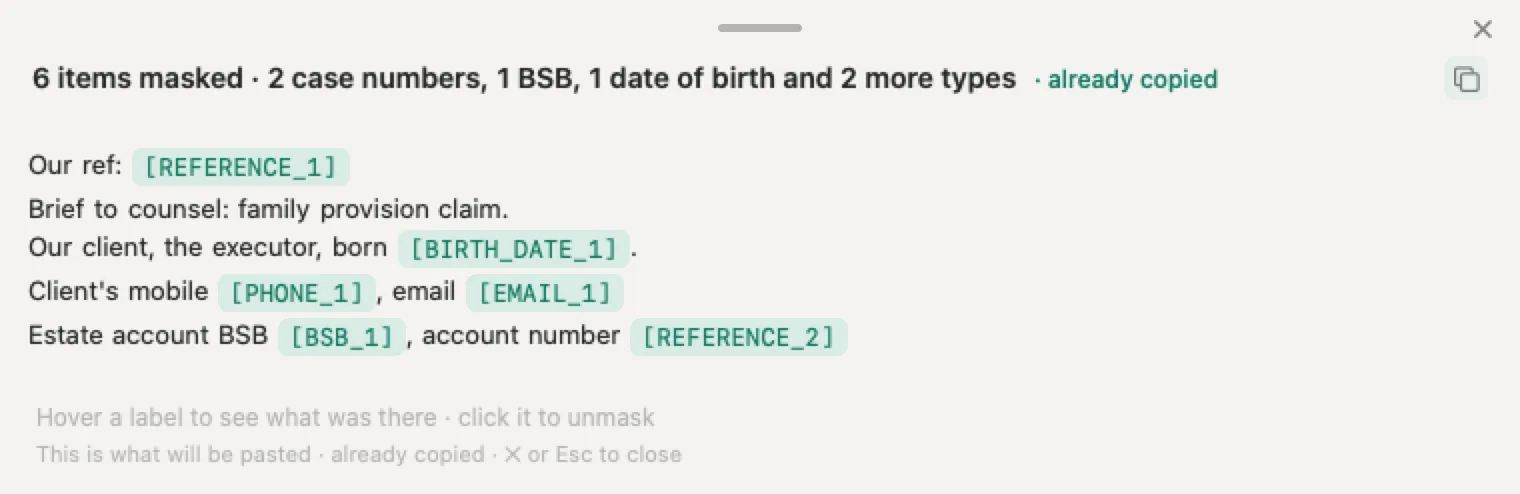
Version A also admits that the facts still travel. Under the Privacy Act, a placeholder the practice can reverse is still personal information for the practice. So version A does not take the provider out of your privacy notice. Our guide to de-identified and pseudonymised data explains where the line sits.
What version B asks you to fill in
Each bracket in version B answers one of the TPB’s four recommended points: to whom, where, where stored, and that AI is used. If you cannot fill them in, the checklist has already said why, on page 4. Free or trial services may not come with clear terms, and wide data access is often the price, which “is usually inappropriate for professionals”.
The plan matters as much as the brand, as our guides to Claude and Copilot show. Clause 15.5 is the authority or permission itself. Its first alternative is drafted for rule 9.2.1 in a law practice, and the second for Code item 6 in a tax practice.
15.6 and the costs line
The last two pieces are written to be copied into other documents. Clause 15.6 goes into the APP 5 notice as well as the letter. The costs line goes into the costs disclosure.
We may disclose personal information to providers of AI tools that we use to deliver our services[, including providers located in (countries)]. The providers we currently use are listed in our privacy policy at [address].
We do not charge separately for AI tools. [or: We charge (amount) per matter for access to AI tools, and that charge is included in the estimate above.] Where an AI tool reduces the time a task takes, we bill only the time actually spent.
With 15.6 in both places, the letter and the privacy policy name the same recipients. Update both whenever you change tools. That way the client finds the same list of providers, and the same account of charges, wherever they look.
What to strip from an AI clause found online
Search results on this topic are dominated by American templates, and they travel badly. Four kinds of sentence should not survive into an Australian costs agreement.
| the sentence | why it does not belong |
|---|---|
| American vocabulary: ABA Formal Opinion 512, Model Rule 1.6, “attorney” | it tells the client the document was not written for them, and points to duties that do not bind an Australian practitioner |
| a consent with nobody in it: “We may use technology, including AI” | it gives the client nothing to agree to; the TPB recommends naming to whom and where, and rule 9.2.1 authority is only as wide as what the client was told |
| “Your information never leaves our systems.” | with version B it does, and with version A the facts of the matter do; the checklist (page 5) calls anonymising useful, not complete |
| “The client accepts all risks of AI.” | the practice answers for fair and reasonable costs (section 172) and for the work (rule 4 and the TPB’s competency obligations); the sentence will not help in a costs assessment or a complaint |
Sources: the seven societies’ checklist, TPB(GS) 55/2026, the Uniform Law and the conduct rules, all listed below.
The third row is the one most likely to be believed by the practice that wrote it. If something does reach a provider that should not have, the question is no longer this clause. Our guide to data breaches and ChatGPT takes it from there.
Existing clients: when the letter has to go out again
A new template covers new matters. For clients you already act for, the question is whether starting to use AI is a change big enough to put in writing. For tax practitioners, the TPB has already answered.
Its guidance statement on letters of engagement, TPB(GS) 34/2019, recommends reviewing ongoing arrangements, preferably every year. One change that should prompt a new letter is a change to the third party recipients of client information. Under Code item 6, that needs the client’s prior consent.
Sending client information to an AI provider for the first time is exactly that change. A practice that has just approved a tool for staff under an internal AI policy is usually standing at that point.
A letter of variation for a law practice
Solicitors have no equivalent list, but the reasoning carries over. A retainer signed before the practice used AI gave no authority to disclose anything to an AI provider. A short letter of variation containing clauses 15.1 to 15.5 is the way to get express authority for matters in progress. If the change significantly affects what the client will pay, section 174(1)(b) requires updated disclosure as soon as practicable.
Clients use AI too. The Queensland Law Society publishes a template warning for clients about what their own use can do to privilege. It is worth sending with the variation. But it is a separate document, about the client’s own conduct rather than the practice.
Nonimo and the data paragraph in your clause
Version A is only honest if it happens every time, at every desk, including at five to five on a Friday. That single step is the whole of what Nonimo does, on Mac or Windows. Someone highlights the passage and hits one key. Whatever identifiers it recognises turn into placeholders on that computer, before the text reaches whichever chat assistant is open, and when the answer comes back they turn back into the real details on the same screen.
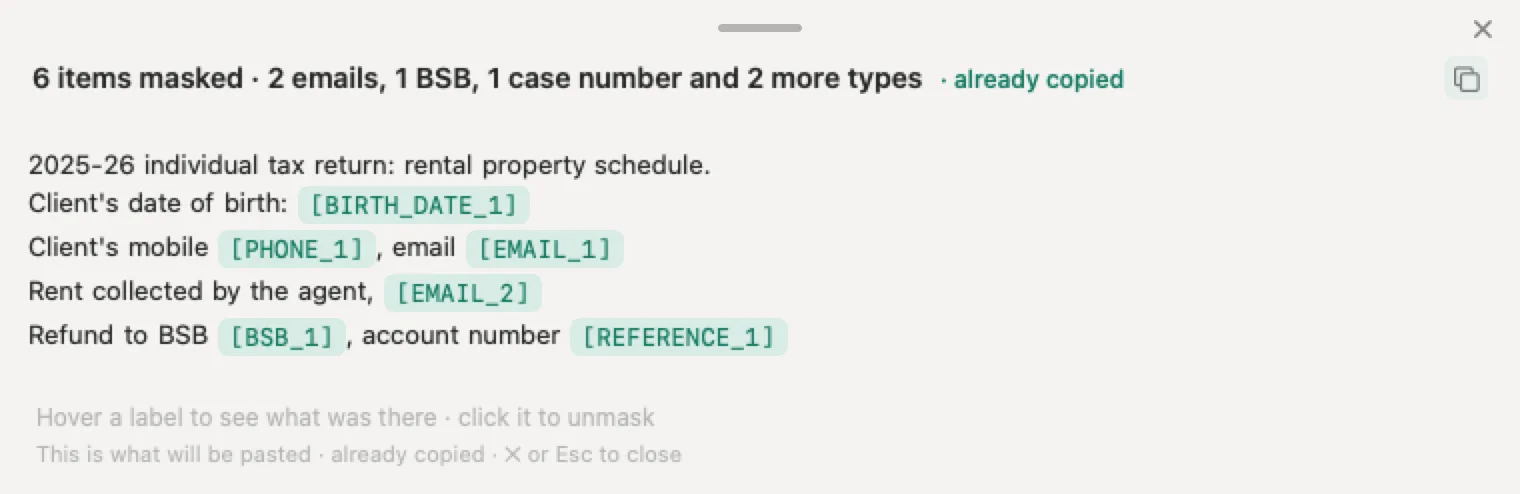
Nonimo runs on the practice’s computer, so “on this practice’s own computers” in clause 15.4 describes what happens. What it keeps on the computer, and how, is set out on our security page and in our privacy policy.
It does not understand the matter. A job title, a country town or a family relationship can still point to a client, and that is why clause 15.4 promises a human review. For a rollout across a whole practice, see our page for organisations. The licence terms are on the licence page.
The clause above is general information for Australian practices, not legal advice about your own terms. Whoever looks after risk and privacy in your practice should adapt it before it goes to a client.
Sources
Each with the fact it supports.
- Law Society of NSW, Legal Practice Board of Western Australia and Victorian Legal Services Board + Commissioner, Statement on the use of artificial intelligence in Australian legal practice, December 2024. Page 1: confidentiality under rule 9.1 and costs under ss 172 and 173; page 2: transparency with clients about when and how AI was used and how it is reflected in costs, and AI policies available to clients on request.
- Law Society of NSW, A solicitor’s guide to responsible use of artificial intelligence, updated January 2026. Page 5: s 172 and s 174 and time saved reflected in the bill; page 6: disclosure under rule 4 and public AI under rule 9; page 9: “Ensure your client is aware and approves”.
- Queensland Law Society with the Law Institute of Victoria and the law societies of South Australia, Western Australia, the ACT, the Northern Territory and Tasmania, AI selection and use checklist for legal practitioners, February 2026, released 23 February 2026 (release). Page 4: free or trial services and unclear terms; page 5: clients informed of AI data sharing, anonymising as partial protection, US policy and confidentiality assurances; page 7: transparency with clients; page 11, Annexure B: model AI disclosure with opt out.
- Queensland Law Society, Template: Warning to Clients, use of AI tools. A handout about the client’s own use of AI and privilege, to be given ideally at the point of retainer.
- Law Council of Australia, Australian Solicitors’ Conduct Rules, 24 August 2015 version. Rules 4.1, 9.1 and 9.2.1. Adoption by jurisdiction, including the Northern Territory from 1 September 2025, on the Law Council’s ASCR page.
- Victorian Legal Services Board + Commissioner, Disclosure where there is express or implied consent. The conveyancing example of implied authority, and securing express authority where in doubt.
- Legal Profession Uniform Law (WA), official version, the same Uniform Law text applied in New South Wales and Victoria. Section 170 (commercial or government clients outside the costs disclosure Part), section 172 (fair and reasonable costs), section 174(1), (3) and (6) (basis of costs and estimate, client understanding, in writing), section 178 (consequences of non compliance).
- Law Society of NSW, Costs Guidebook. Charges that are not disbursements to be specified with their rate in the disclosure or costs agreement.
- Tax Practitioners Board, TPB(GS) 55/2026 The use of Artificial Intelligence and the Code of Professional Conduct, issued 22 July 2026. Paragraphs 21 to 24 (third party, permission, what to tell the client, signed letter of engagement or general authority) and 26 (TFN Rule); the disclaimer that it creates no obligations beyond the TASA.
- Tax Practitioners Board, TPB(GS) 34/2019 Letters of engagement. Letters of engagement not required by the Code but strongly encouraged; paragraph 16, a new letter when third party recipients of client information change.
- Accounting Professional and Ethical Standards Board, APES 305 Terms of Engagement, effective for engagements from 1 January 2025. Paragraphs 3.6 (outsourced services) and 3.7 (cloud computing), and the definition of cloud computing.
- Office of the Australian Information Commissioner, Guidance on privacy and the use of commercially available AI products, published 21 October 2024, updated 17 January 2025. A developer with access to personal information is a disclosure for the APP 5 notice; privacy policies updated for AI.
- Office of the Australian Information Commissioner, Read the Australian Privacy Principles. APP 1.4 (content of the privacy policy) and APP 5.2 (usual recipients and overseas recipients).
Nonimo is the software that does this on your own computer: it masks client names and IDs before your text reaches ChatGPT . No account, and your client's details never leave your machine.
Common questions
Does any rule require an engagement letter AI clause?
Not one that names AI. Tax and BAS agents have Code item 6, which the TPB now reads as covering some AI tools. Solicitors have rule 9, where the client's authority is the safest footing. A clause in the letter is the practical way to get both in writing before the work begins. Nonimo can make the data half of that clause shorter to write.
Can a solicitor rely on implied authority when a matter goes through an AI tool?
It is thin ground. Rule 9.2.1 covers disclosure a client impliedly authorises. The Victorian regulator's example is a conveyance, where the other side, the lender and the land registry obviously need the details. A chatbot vendor is not on anyone's mental list. The same regulator says that where authority is uncertain, you should get it expressly, and a signed costs agreement is the obvious place.
Is a signed engagement letter enough permission for the TPB?
It can be. TPB(GS) 55/2026 lists a signed letter of engagement first among the ways to get permission, alongside a signed consent or a fact find. It adds that a general authority may also be acceptable. But the permission only works if the letter told the client what the TPB recommends: to whom and where the information goes, where it is stored and whether AI tools may be used.
Should the clause name the AI provider?
For a tax agent, in practice yes: the TPB recommends telling the client to whom the disclosure is made. For an accountant bound by APES 305, a cloud tool's provider and location are among the details members should give. For a solicitor, naming it is what makes the client's authority express. A general description can sit in the letter, with the current list in your privacy policy, as long as the letter says where to find it.
What if a client says no to AI on their file?
Then the practice works without it on that file, and the costs estimate may change. The seven law societies' model disclosure of February 2026 says as much: a client who prefers no AI can say so, and a revised cost or time estimate may apply. For a tax agent the refusal has legal weight. Code item 6 permission belongs to the client, who can withhold it for all documents or some.
Does AI have to appear in the costs disclosure?
Only where it changes what the client pays, and that happens more often than people think. Section 174 of the Uniform Law requires the basis on which legal costs are calculated, and an estimate. If the firm charges for a tool, the charge belongs there. If AI cuts the time a task takes, the Law Society of NSW wants the saving visible in the bill. The disclosure and the clause should tell the same story.
What should the clause say about offshore processing?
The country, if it is practicable to name it. APP 5 asks whether personal information is likely to go to overseas recipients and, where practicable, where they are. The TPB recommends telling the client where information will be stored. The seven societies' checklist adds a warning of its own: shifts in US government policy may make a vendor's confidentiality assurances less credible than they read on paper.
Do existing clients need a new engagement letter?
For a tax agent who starts sending client information to an AI tool, usually yes. The TPB's guidance on letters of engagement expects a new letter when the third party recipients of client information change, because that needs the client's prior consent. For a solicitor, a short letter of variation does the same job. Costs disclosure must be updated if the change significantly affects what the client will pay.
What does Nonimo change in the data sentence?
It lets a practice sign version A without relying on memory. Highlight the passage on the practice computer and hit one key. The identifiers Nonimo recognises, a TFN or ABN with its label in front for instance, turn into placeholders before the chatbot sees them, then return in the reply. It records nothing of what it swapped, and judging whether the facts point to the client stays with you.