De-identified vs pseudonymised under Australia's Privacy Act
· Updated

Joaquín Trapero in AI and privacy expert, and founder of Nonimo.
People use de-identified and pseudonymised as if one were a stronger dose of the other. Australian privacy law doesn’t. The Privacy Act defines de-identified as an outcome, and never mentions pseudonymised at all.
That gap decides what you can safely call a file, and which privacy principles still follow it when it leaves. Whether a given AI tool is allowed in the first place is covered in which AI tools the Privacy Act lets you use.
De-identified is a legal status; pseudonymised is a technique. Under section 6(1) of the Privacy Act, information is de-identified when no one in it is identifiable or reasonably identifiable, and the Act stops applying. Pseudonymised data has identifiers replaced by codes, with a way back kept. For whoever holds it, it is still personal information.
Is de-identified the same as pseudonymised?
No, and the statute shows why. Compilation No. 104 of the Act, dated 4 June 2026, defines personal information and de-identified, one the mirror of the other. Open it on the Federal Register of Legislation and search for “pseudonymis”: nothing comes up.
The nearest words, pseudonym and pseudonymity, belong to APP 2. It gives a customer the option of dealing with you under a made-up name. Where the law needs identity, as with a rental application, the applicant can still limit reuse by sending a Victorian licence copy watermarked for that agent.
The OAIC’s APP 2 guidelines say using a pseudonym “does not necessarily mean that an individual cannot be identified”. Written about customers, it fits a file of [PERSON_1] labels just as well. Overseas law splits the words differently, as the UK, EU and US vocabulary guide shows.
Three states a file can be in
Only the last one changes how the Privacy Act treats it.
| Identified | Pseudonymised | De-identified | |
|---|---|---|---|
| Names and numbers | In the file | Replaced by codes or labels | Gone, and so are the clues that point back |
| A way back | Not needed | Kept by someone: a key, a lookup table, a reversible method | None reasonably available to whoever holds it |
| Word in the Act? | Personal information, s 6(1) | No | Yes, s 6(1) |
| APPs apply? | Yes | Yes, for anyone who can reverse it; for a health or union detail, the stricter rules too | No, in that context |
Privacy Act 1988, s 6(1), Compilation No. 104. The pseudonymised column is my reading of the Act with the OAIC's de-identification guidance; the Act itself is silent on the word.
Another word for de-identified, and words that only sound like it
Anonymised is the word most people reach for, and in Europe it does the job de-identified does here. Health research has its own vocabulary. The ALRC noted in 2008 that the National Statement on research ethics avoided “de-identified data” because its meaning was unclear.
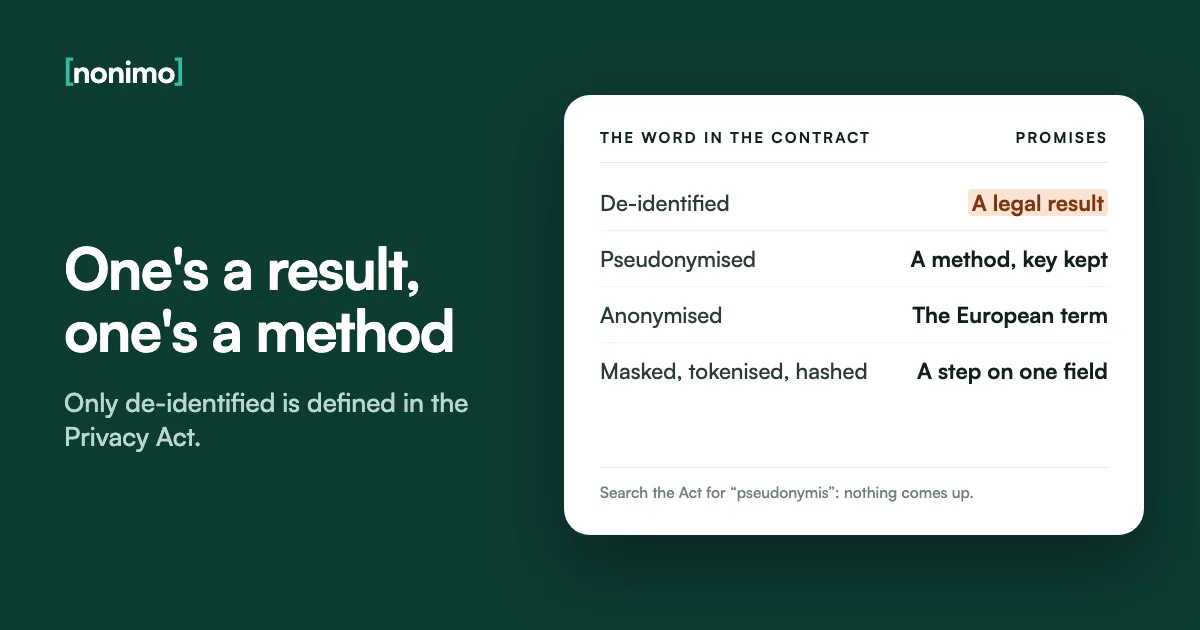
Contracts and vendor pages add a third layer: masked, tokenised, hashed, coded. Those name what was done to a field, not where the file ended up. In Victoria, OVIC quotes a description of pseudonymisation as masking with a pseudonym, and says plainly that it doesn’t make information de-identified.
When a supplier’s contract says “anonymised” with no method beside it, ask for the method in writing. Pick a word below to see what it promises.
The word in the contract, and what it promises
Pick the word you were given.
Outcome word, borrowed. Closest to de-identified, but no Australian statute defines it. Ask which test was applied and in whose hands.
Outcome word, research usage. The 2007 National Statement's category for data no one could re-identify. It lines up with de-identified when that holds where the data lands.
Technique. A study number replaces the name and a master list sits somewhere. The ALRC recorded the view that whoever holds the master list holds identifiable information. Same idea in a spreadsheet: the lookup table lives in its own file.
Technique. The OAIC says hashing and encryption obscure an identifier rather than remove it. A hashed client number in a CSV export can still be matched back.
Technique, reversible by design. A vault swaps values for tokens and hands them back under policy, which is how a data privacy vault such as Skyflow works.
Technique, often cosmetic. A field shown as ●●●● may still sit underneath. In a PDF, a drawn box and an applied redaction are different things. In Word, black highlighting leaves the words underneath.
Sources: ALRC Report 108, paras 6.67 and 6.70; OVIC, Key concepts, para 1.48; OAIC, De-identification and the Privacy Act. The grouping into outcome and technique words is mine.
Pseudonymised data and the APPs: which ones still apply
Whoever holds the key holds personal information, and every principle that applies to them keeps applying. The OAIC’s de-identification guide makes the point with a custodian who keeps the original. The same dataset can be personal information on that desk and de-identified with another entity.
So ask twice: what the file is in your hands, and what it becomes in the recipient’s. A labelled extract sent to an overseas contractor who could identify anyone still raises APP 8. Councils answer to state law instead, set out in which privacy law covers an Australian council.
What surprises people is APP 11.2. Keeping a pseudonymised copy with its key is not destroying or de-identifying anything.
APPs that follow a pseudonymised file
The holder of the key, compared with a recipient who has no key and can't reasonably identify anyone.
| Principle | You, with the key | Recipient, no key, nobody identifiable |
|---|---|---|
| APP 2, anonymity and pseudonymity | About how customers deal with you, not about your files | Same |
| APP 6, use or disclosure | Sending the extract counts as a disclosure if the recipient could identify someone. Pasted into a chatbot, that's how a client file in ChatGPT can become a breach | Not personal information there; the OAIC still suggests treating APP 6 as risk management |
| APP 8, overseas disclosure | Applies when an overseas recipient could identify someone | Same advice as APP 6 |
| APP 11.1 and 11.3, security | Protect the file and, above all, the key; reasonable steps include technical and organisational measures, which a cyber insurer will ask about | Same advice |
| APP 11.2, destroy or de-identify | A labelled copy with the key kept meets neither | Not engaged |
Privacy Act 1988, Schedule 1; OAIC, De-identification and the Privacy Act (21 March 2018) on APPs 6, 8 and 11 as risk management. The APP 11.2 row is my reading, not an OAIC statement.
In Victoria, agencies and councils looking at AI tools run the same comparison under the PDP Act, whose s 3 definition of de-identified is close to word for word the federal one.
Can de-identified data be re-identified? The reasonable likelihood test
Yes, and that is the whole test. The OAIC treats information as de-identified when there is no reasonable likelihood of re-identification, which it also puts as a very low risk. Possible isn’t enough; likely is what counts.
As a floor, the OAIC uses a motivated intruder: a competent person with no specialist skills, holding the data, the internet and public documents. It also looks at the data access environment, in four parts: other data, people, infrastructure and governance. A locked research lab and a shared inbox score differently.
OVIC goes further and tells Victorian agencies to assume unit-record data can be re-identified once it meets other data. A client spreadsheet deserves the same suspicion: one row per person is exactly what that warning is about.
Is my dataset de-identified, pseudonymised or still identifiable?
Answer for the copy you plan to share, in the hands of whoever receives it.
Are names, addresses, phone numbers, emails or ID numbers still in it? A NSW licence card number counts.
Were they replaced with codes, labels, hashes or tokens, and could the recipient, or anyone it shares with, turn them back?
Do rare details remain: an unusual job, exact dates, a small town, a rare condition, an outlier amount?
Could a motivated intruder link it to someone using the internet and public records, given who can see it at the other end?
Built on the OAIC's "no reasonable likelihood" test, its motivated intruder minimum and its four parts of the data access environment. The questions are my own ordering, not an OAIC checklist, and not a ruling on your data.
De-identified data examples from two OAIC cases
Two published OAIC matters show both outcomes, and they’re more useful than any definition. In 2016 the Department of Health put MBS and PBS claims for a random 10% sample of people on data.gov.au. Service dates were shifted by up to 14 days, and provider numbers were encrypted.
The encryption was reversible. University of Melbourne researchers told the ABS on 8 September 2016, and the Commissioner later found patients weren’t reasonably identifiable but providers were. That split, inside one release, is the clearest picture of pseudonymised against de-identified I know of.
I-MED went the other way: the Commissioner was satisfied its patient data had been de-identified sufficiently. That finding sits in a report on preliminary inquiries (31 July 2025), not a determination, and the OAIC says it isn’t an endorsement. Clinics weighing their own data should also read the Ahpra AI guidelines on patient data.
Two datasets called de-identified, two outcomes
| MBS/PBS sample, 2016 | I-MED to Annalise.ai, 2020 to 2022 | |
|---|---|---|
| Size | Random 10% sample of people in the Medicare system | Under 30 million patient studies, plus reports |
| Identifiers | Provider numbers encrypted, reversibly | Two hashing techniques on IDs, names, addresses and phones |
| Dates | Shifted up to 14 days | Shifted to a random date within set years |
| Other steps | Published openly | Outliers grouped into large cohorts; text in or near the image edge redacted; contract banning re-identification |
| Outcome | Patients not reasonably identifiable; providers identifiable, with APP 1, 6 and 11 breaches and an enforceable undertaking (23 March 2018) | Commissioner satisfied it was de-identified sufficiently to fall outside the Act; inquiries closed with no determination; a very small number of errors, deleted or de-identified |
OAIC, MBS/PBS data publication investigation report; OAIC, Report into preliminary inquiries of I-MED (31 July 2025).
Pseudonymised vs de-identified: one client record three ways
Here is a made-up note a bookkeeper might want help with, treated three ways. The first version names everyone. The second swaps identifiers for labels, which is the step a desktop tool can do. The third is the rewrite only a person who knows the job can do.
The labels took out the name, birth date and address, which is worth having. They didn’t touch the trade or the town, and the town’s only mobile dog groomer is easy to find. The accountants’ page lists the identifiers that turn up most in that kind of file.
The same record, three treatments
Imogen Thackeray, born 14/07/1979, 3 Pardalote Lane, Brolga Creek. Sole trader, the only mobile dog groomer in Brolga Creek. Paid $18,400 in May to fit out her grooming van. Can she claim it this year?
[PERSON_1], born [DATE_1], [ADDRESS_1]. Sole trader, the only mobile dog groomer in Brolga Creek. Paid $18,400 in May to fit out her grooming van. Can she claim it this year?
A sole trader running a mobile service business paid about $18,000 this financial year to fit out a work van. How can the fit-out be claimed?
Invented example: Imogen Thackeray, Pardalote Lane and Brolga Creek don't exist. The third version is de-identified only on my judgement that nobody could find the client from it.
The third version keeps the tax question whole. The same discipline applies to a TFN, which comes out of a prompt before anything else.
In a Word file, check the reviewer comments as well, because tracked changes and comments can still carry the client’s name.
Pseudonymised client data in ChatGPT and other AI tools
The OAIC’s guidance on commercially available AI products, published 21 October 2024, has a worked example: insurer staff paste a claim into a public chatbot. The OAIC calls that a disclosure to the chatbot’s owners, which puts APP 6 in play.
Its best practice line is to keep personal information, and particularly sensitive information, out of publicly available generative AI tools. It also asks for the minimum input a task needs. Labels help with the minimum. They don’t settle whether anyone is still reasonably identifiable at the provider’s end.
Tick what’s still in your labelled text. Towns and first names are the easiest to overlook.
What did the labels leave behind?
Tick each thing still in the text you plan to paste. Matter files at law firms and tenancy applications at real estate agencies are full of them.
Ticked: 0 of 7
Nothing left that points back, on your reading. Check what the account keeps: ChatGPT, Claude, Gemini, Copilot.
The text is pseudonymised, not de-identified. Rewrite those details in general terms first. If it has already gone in, deleting the chat clears your copy, not the disclosure.
My list of details labels usually miss, applied to the OAIC's reasonably identifiable test. Not an OAIC checklist.
Court material sits under an extra layer in NSW, where the Supreme Court’s AI practice note looks at the platform rather than the labels.
De-identified or pseudonymised: wording for a privacy or AI policy
The two words make different promises in writing. “De-identified” commits you to a legal result someone can test. “Pseudonymised” commits you to a method you can show you followed. When the second is the true one, I’d write the second: it’s the promise you can keep.
The same care belongs in the data paragraph of an engagement letter, where a loose word becomes a promise to a client.
In our AI policy template they belong in clause 5, on what may go in and on what condition.
Two lines for the policy
Before any client text is entered into an AI tool, names and identifying numbers are replaced with labels on our own systems. The key stays with us. A staff member checks the remaining text for details that could identify the client.
We treat labelled client text as personal information while we hold the key, and apply the Australian Privacy Principles to it on that basis.
Sample wording of my own, not legal advice; adapt it to what your practice does.
The first line describes a technical step. Practices with their own software often build it on the open-source Presidio library, though the proxy around it still has to be written.

Calling a file de-identified: the check before it leaves
Before anything goes out, ask about the reader: holding only this text, could they work out who it’s about? If the answer is “maybe”, I wouldn’t let the word de-identified anywhere near it.
A tool that puts the real values back after the model replies keeps a key by design, as Limina’s re-identify route shows. Whoever runs it is holding personal information, whatever the output looks like.
Nonimo is built that way too, and doesn’t claim otherwise. On a practice computer in Australia it swaps names and numbers for labels, shows each swap, and restores the originals in the reply you copy.
Where the labels stop
Nonimo does, on your computer
Stays with you
So the file stays personal information on your side, and the judgement about the story remains yours. Your text never reaches us, as the security page explains.
The plans are on the pricing page.
Sources
- Privacy Act 1988 (Cth), Compilation No. 104. s 6(1) definitions of personal information and de-identified; APP 2.1 and 2.2; APP 11.2 and 11.3; no use of pseudonymised or pseudonymisation.
- OAIC, De-identification and the Privacy Act. No reasonable likelihood test, motivated intruder, custodian example, four parts of the environment, hashing obscures rather than removes.
- OAIC, Report into preliminary inquiries of I-MED. The steps taken, the scale, the outcome and the non-endorsement.
- CSIRO, A framework for data de-identification. The De-identification Decision-Making Framework with the OAIC: audit, risk analysis and control, impact management.
- OVIC, Key concepts. PDP Act s 3 definition; not a permanent state; pseudonymised information isn’t de-identified (paras 1.43 to 1.48).
- ALRC, For Your Information (Report 108), What is not personal information?. National Statement terms; master lists and coded data; identifiability as contextual.
Accessed 7 November 2026.
Common questions
Is de-identified the same as pseudonymised?
No. De-identified is a legal result in section 6(1) of the Privacy Act: nobody is reasonably identifiable. Pseudonymised is a technique that swaps identifiers for codes, and whoever can reverse the codes still holds personal information.
What is another word for de-identified?
Anonymised is the closest everyday word. Health research has used non-identifiable instead, and the Act's own wording is no longer reasonably identifiable. Coded, masked and hashed describe techniques and don't mean the same thing.
Can de-identified data be re-identified?
Yes, and then it is personal information again. Victoria's regulator says de-identified is not a permanent state. New datasets, a leaked key or a reversible code can all bring a person back.
Is de-identified the same as anonymous?
Not in Australian privacy law. Anonymity under APP 2 means a person deals with you without giving any identifiers at all. De-identified describes information about someone that was later stripped until nobody is reasonably identifiable.
What is the De-identification Decision-Making Framework?
A practical OAIC and CSIRO Data61 guide from September 2017. It covers auditing your data situation, analysing and controlling risk, and planning for after release. Both bodies now say parts may be dated.
What does reasonably identifiable mean for a dataset?
It means identification is reasonably likely, not merely possible. The OAIC weighs the data, what else the holder can reach, and a motivated intruder with internet access and public records but no special skills.
Does Nonimo de-identify documents?
No, and it doesn't claim to. On your computer it swaps names and numbers for labels such as [PERSON_1], shows each swap, and keeps the originals there to restore the reply. The file stays personal information in your hands.