NSW Supreme Court AI practice note: what you need to do
· Updated

Joaquín Trapero in AI and privacy expert, and founder of Nonimo.
Practice Note SC Gen 23 decides what generative AI may do in a NSW Supreme Court matter, and it binds self-represented parties as well as lawyers. A paragraph-by-paragraph recital is little use when the affidavit is due at 4pm and someone has already opened a chatbot.
So this page is built around the three calls you have to make: whether your tool counts, whether this material may go in, and whether this document needs a disclosure. Firms after the wider picture of what a litigation file carries can start at our law firms page.
SC Gen 23 allows generative AI for chronologies, summaries, briefs and draft submissions, but not for generating or rephrasing evidence. Affidavits, witness statements and character references must say so. Suppressed, Harman, subpoenaed and statute-restricted material stays out unless paragraph 9A's conditions are met. Expert reports need leave first.
Which version of Practice Note SC Gen 23 applies today
Use the text issued on 28 January 2025, which commenced on 3 February 2025. It replaced the version first issued on 21 November 2024, and the difference bites: commentary from that first round talks about a single paragraph 9, which the amendment split into 9A and 9B.
A review opened in November 2025 and I can’t find a published outcome. Put a recheck of the Court’s page into your AI policy as a step before filing, because a summary of this note, mine included, could go stale the day a new version lands.
The SC Gen 23 timeline
If what you're reading cites plain "paragraph 9", it predates the row in bold.
| Date | What happened |
|---|---|
| 21 Nov 2024 | First version issued, to start on 3 February 2025 |
| 28 Jan 2025 | Amended: paragraph 9 becomes 9A and 9B. Clarifying changes to 6, the last sentence of 10, and 17, which gains the word "solely" |
| 3 Feb 2025 | Commences for all proceedings. UCPR amendments reflecting aspects of the note start the same day |
| 17 Nov 2025 | Chief Justice Bell invites submissions on the note, due 18 December 2025 |
| March 2026 | UNSW's list of court guidance still marks the note as under review |
| 7 Nov 2026 | The amendment history in the Court's PDF still stops at 28 January 2025 |
SC Gen 23 and its amendment history; the Court's announcement of 28 January 2025; the Chief Justice's statement of 17 November 2025; UNSW Centre for the Future of the Legal Profession.
Does my tool count as generative AI under the note?
Product names won’t settle it. Paragraph 3 lists ChatGPT, Claude, Grok and Co-Pilot, and also Lexis Advance AI, Westlaw Precision and CoCounsel Core. Paragraph 6 then carves out functions, so the question is what this feature did to your words.
Paragraph 4 catches open-source models too, which means running one on your own server doesn’t take you outside the note. Open source isn’t the same as maintained either: LLM Guard, an open-source LLM security toolkit, is now archived.
One overlap is untidy. Paragraph 3 names AI Media and Read AI as examples, while paragraph 6 excludes transcription. My reading is that a plain transcript is out and the summary the same app adds is in, though the note doesn’t spell that out.
Is this feature generative AI?
What does it do with your text?
SC Gen 23, paragraphs 3, 4, 6, 9B and 12. The reading of mixed features is mine, not the Court's.
Can subpoena, Harman or suppressed material go into an AI tool?
Paragraph 9A overrides the permissions in 9B. A chronology is allowed only if the documents feeding it were allowed in. The duty sits with the practitioner or person responsible for the conduct of the proceeding, and if you’re self-represented that’s you.
The record of what you typed is a problem of its own. Deleting the chat won’t undo the upload, as our guide to clearing ChatGPT history explains, and the NSW Bar Association warns that AI inputs and outputs may themselves be obtained by subpoena or regulator’s notice.
Can this material go in?
What is it?
SC Gen 23, paragraphs 9A and 9B. Law Society of NSW guide, updated January 2026. NSW Bar Association guidelines, 12 July 2023. For a live matter, get the supervising solicitor to read the file before relying on this.
The Privacy Act adds its own layer for personal information in the same file, including when the provider is overseas: see the Privacy Act guide.
If protected material has already gone in, this data breach guide deals with what comes next.
What an enterprise AI platform must promise under paragraph 9A
These conditions describe where the material goes and what the supplier may do with it. A consumer chatbot with training switched on fails before anyone types. An enterprise service might pass, so read the contract, never the sales page: our Copilot guide goes through one line by line.
Plans differ within a single brand, as our Gemini guide shows for workplace accounts.
ChatGPT works the same way, under OpenAI’s rules, account by account. Tick only what you could show a judge in writing.
Are you satisfied of all of it?
Tick only what the contract or settings support. Paragraph 9A requires every line.
0 of 4
Keep restricted material out of this tool.
The conditions look met on paper. Keep the terms, the plan name and the date in the matter file, because the satisfaction is yours to explain.
SC Gen 23, paragraph 9A, split into four lines by me because (a) has two limbs. Keeping the paperwork is my suggestion, not a term of the note.
Where a firm runs its own tools, that environment includes whatever an AI gateway logs on the way to the model.
Hosting a model yourself is another route to the same test, and this comparison of a private LLM and a privacy proxy covers when that’s worth the bother.
Does removing names make subpoena material safe for AI?
On the wording of paragraph 9A, I don’t think so, though I can’t find a ruling either way. Labelled payroll records still look like material produced on subpoena. Taking identifiers out does help with ordinary client confidences, and what still identifies someone once the numbers are gone is worth reading first.
We ran the test on an invented file note of the kind a litigation solicitor might want turned into a timeline. The After is what Nonimo returned, with nothing edited by hand.
The labels take the people. The story stays.
File note, 14 August 2026
Matter: Quirke v Birchgrove Joinery Pty Ltd, 2026/00184512
Client: Ms Narelle Quirke, DOB 03/05/1979, mobile 0491 570 159, narelle.q@example.com
Birchgrove Joinery Pty Ltd (ABN 30 537 218 490) produced its payroll records on subpoena.
Mr Lachlan Brunskill, the site manager, says the only Year 10 apprentice on the Penrith job saw the fall. The Court has suppressed the apprentice's name. Draft a chronology.
File note, 14 August 2026
Matter: [PERSON_1] v [COMPANY_1], 2026/00184512
Client: [PERSON_2], DOB [BIRTH_DATE_1], mobile [PHONE_1], [EMAIL_1][COMPANY_1] (ABN [ABN_1]) produced its payroll records on subpoena.
Mr [PERSON_3], the site manager, says the only Year 10 apprentice on the Penrith job saw the fall. The Court has suppressed the apprentice's name. Draft a chronology.
Invented note: the names, company, file number, email, mobile and ABN are fictional. Highlights are ours and mark what the labels leave behind.
That apprentice is still identifiable, and the note still says subpoena. On my reading of paragraph 9A it could go only to a platform meeting every condition, labels or no labels. Our NDIS case note guide works through the same habit of reading what a story gives away.
A real file note kept in Word can carry more than its page shows, such as an address deleted with Track Changes on.
Do I need an AI disclosure in this affidavit, witness statement or expert report?
Paragraph 13 sets the disclosure for three kinds of document and paragraph 14 narrows it for annexures. Submissions get a verification instead, and expert reports start with an application for leave.
What does this document need?
Which document?
Did AI generate, alter or rephrase any of its content?
Was it prepared or created for these proceedings?
Do you want AI to help prepare it?
SC Gen 23, paragraphs 9A to 24. The last point about annexing a chronology is my reading.
Paragraph 10 permits work “merely preparatory” to drafting, while the disclosure speaks to content. My reading: an AI chronology used to prepare a proof needn’t stop an honest disclosure, if nothing it wrote reaches the witness’s words. The note doesn’t say so in terms, so check with the solicitor on the record.
Paragraph 22’s record of prompts and settings is a fair test of any setup. A chatbot’s history isn’t an annexure, and how long it survives depends on the plan, as our note on what Claude keeps shows.
Practice note SC Gen 23 example: disclosure wording you can adapt
The note sets the content and leaves the words to you. These drafts stay close to its own language. They’re my wording, not the Court’s, and a solicitor should settle them for your document.
A friend writing a character reference won’t have heard of any of this, and the requirement still lands on their page. Give them the sentence and ask how they wrote the reference before they sign.
Clean the final file as well, since tracked changes left in a Word draft carry deleted wording into every copy.
Three drafts to start from
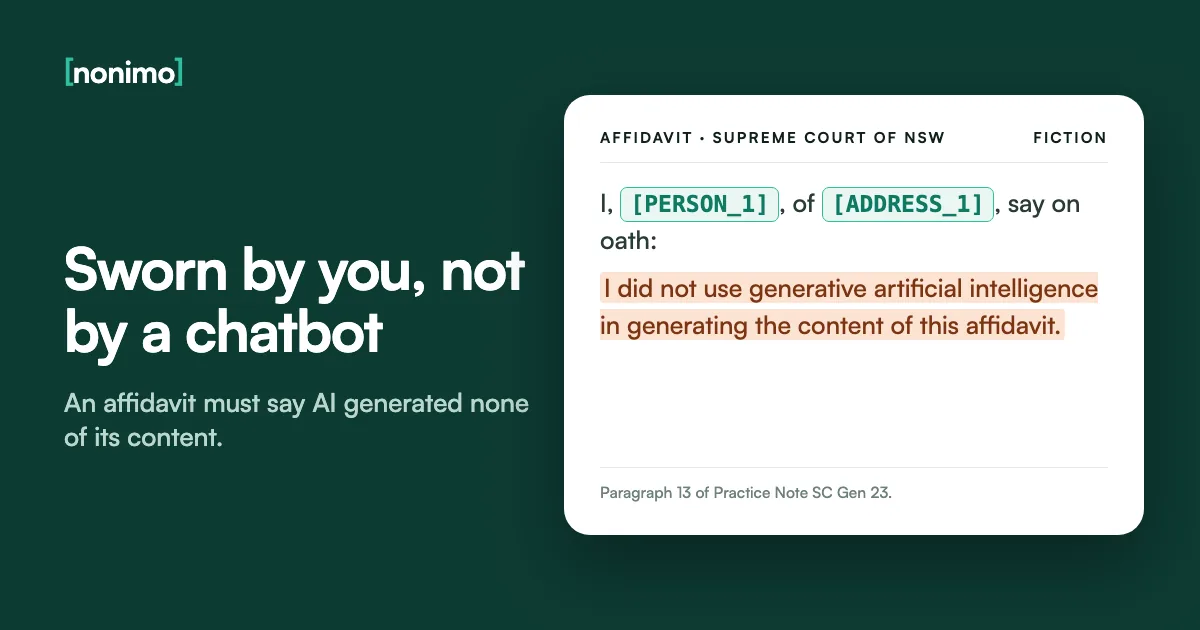
I did not use generative artificial intelligence in generating the content of this affidavit, including by altering, embellishing, strengthening, diluting or rephrasing my evidence, or in generating the content of any annexure or exhibit I prepared for the purposes of my evidence.
Generative artificial intelligence was not used in generating the content of this reference, including by altering, embellishing, strengthening, diluting or rephrasing what I say in it.
Generative artificial intelligence was used in preparing these submissions. I have verified, and not solely by using a generative AI tool, that all citations, authorities and legislative references, and all references to evidence, exist, are accurate and are relevant to these proceedings.
Suggested wording only. SC Gen 23 prescribes no form of words. It puts the disclosure in the affidavit, statement or reference itself, and the verification in the body of the submissions.
Can a self-represented party or a junior use ChatGPT for court documents?
They can, inside the same limits, and May v Costaras [2025] NSWCA 178 is the case to read. A self-represented respondent’s list of authorities included Tate v Ragg, with pinpoint paragraphs. No such case exists. Bell CJ assumed AI had produced it and called that a matter of profound concern.
Bell CJ also said at [15] that unrepresented litigants are subject to SC Gen 23 even if they don’t know its terms, and at [16] that a judge may legitimately ask whether AI was used.
Have your answer ready. Nobody gets a pass for not knowing, which strikes me as fair.
What falls on you
Pick your role.
Self-represented. Paragraph 9A speaks to the person responsible for the conduct of the proceeding. Disclosure rules apply to your affidavits, and paragraph 24 makes you tell any expert about the note. Open every case you cite in the original, because a chatbot's confirmation doesn't count on its own.
Solicitor or barrister. Paragraph 18 leaves your duties untouched. In Mata v Avianca, a lawyer asked ChatGPT if its cases were real and was told they were. After Dayal, Victoria's regulator varied a practising certificate. Insurers have started asking about AI too, as our cyber insurance guide explains.
Principal or supervisor. Murray v Victoria involved a junior's footnotes that were mostly non-existent or wrongly cited, found through Google Scholar. The Court found a failure of supervision contributed. So a tool's label won't protect you: someone senior has to check.
Expert. No AI in any part of the report without prior leave (paragraph 20). With leave, you disclose the parts and the program, annex how you used it, and annex any code of practice that deals with AI (paragraph 22).
May v Costaras [2025] NSWCA 178 at [11], [15]-[16]. SC Gen 23. Mata, Dayal and Murray as reported in the Law Society of NSW guide, pages 6 and 7.
Local Court, Land and Environment Court, SC Gen 25: other courts’ AI rules
The Local Court adopted SC Gen 23 from 12 January 2026, as amended from time to time, so a character reference for a Local Court sentence hearing works to the same paragraph 13.
The Land and Environment Court trips people up through old commentary. Its first note, signed 28 November 2024, had a flat ban in paragraph 9 with no platform conditions. The version in force since 12 February 2025 follows SC Gen 23, 9A and 9B included, so check which text an article was quoting.
Match your court to its AI document
| Court | Document | What to know |
|---|---|---|
| NSW Supreme Court | SC Gen 23 | This page |
| NSW Local Court | Practice note, from 12 Jan 2026 | Adopts SC Gen 23 for all proceedings |
| Land and Environment Court | Own note, from 12 Feb 2025 | Follows SC Gen 23, including 9A and 9B. It replaced a November 2024 text with a flat ban and no platform conditions |
| District Court, NCAT, Personal Injury Commission | Their own documents, on the Law Society's list | Not summarised here: open the one for your forum |
| Supreme Court of Victoria | SC Gen 25, from 14 May 2026 | Nothing confidential in public tools (6.8), check closed tools' terms (6.9), be ready to identify AI portions (7.6) |
| Supreme Court of Queensland | Practice Direction 5 of 2025 | A named individual responsible for written submissions (5, 6), with referral or personal costs at stake (14) |
| Federal Court | GPN-AI and GPN-LIP, on the Law Society's list | Not summarised here: open the note itself |
Each court's own note, except rows pointing to the Law Society of NSW's table, dated 14 May 2026.
If you end up filing a redacted copy in any of them, drawn boxes aren’t enough, as this guide to redacting a PDF explains.

My order of work for SC Gen 23: sort the file, sign last
The disclosure takes one sentence and describes one document on one day. Paragraph 9A covers every tool anyone opened in the weeks before, and nothing in the signed page shows it. Sort documents when they arrive, because nobody does it later.
The guides on using AI with client data take the platform question tool by tool.
Before this matter goes near a tool, and again before filing
0 of 6
Something's still open. Fix that before anyone signs.
Ready for a solicitor's last look, or yours if you're running this yourself.
My own list, drawn from SC Gen 23, paragraphs 9A, 13, 15 to 17, 21 and 24. Your matter may need more than this list.
For the client material that’s allowed out, our Australian page shows how selecting a chronology brief and pressing a key swaps the identifiers Nonimo recognises for labels, on the Mac or Windows computer holding the file. Every change is shown and can be undone.
Your text never reaches us, as the security page sets out.
A practice comparing options can see the plans.
Sources
- Supreme Court of NSW, Practice Note SC Gen 23, issued 28 January 2025, with its amendment history.
- Supreme Court of NSW, Generative AI page, last updated 23 March 2026: the review, the Chief Justice’s statement of 17 November 2025 and the announcement of amendments.
- Law Society of NSW, A solicitor’s guide to responsible use of artificial intelligence, updated January 2026: rule 9, Harman, Dayal, Mata and Murray.
- Law Society of NSW, Court Protocols on AI, dated 14 May 2026: the list of courts and their documents.
- NSW Bar Association, Issues Arising from the Use of AI Language Models, 12 July 2023: inputs and outputs reachable by subpoena.
- Supreme Court of Victoria, SC Gen 25, 14 May 2026: paragraphs 1.5, 6.8, 6.9 and 7.6.
- Supreme Court of Queensland, Practice Direction 5 of 2025: paragraphs 5, 6 and 14.
- UNSW Centre for the Future of the Legal Profession, Practice notes and guidance from Australian courts and legal regulators, March 2026: SC Gen 23 listed as under review.
- May v Costaras [2025] NSWCA 178, 8 August 2025.
- Local Court of NSW, Practice Note on Generative Artificial Intelligence, issued 12 December 2025.
- Land and Environment Court of NSW, Practice Note on Use of Generative Artificial Intelligence, signed 11 February 2025, commencing 12 February 2025, replacing the version signed 28 November 2024.
Accessed 7 November 2026.
Common questions
What is Practice Note SC Gen 23?
It is the NSW Supreme Court's rulebook for generative AI. It has applied to all proceedings since 3 February 2025, and covers what may enter a tool, evidence, submissions and expert reports.
Can lawyers use ChatGPT under NSW court rules?
Yes, for some jobs and within limits. Chronologies, summaries and draft submissions are allowed, subject to paragraph 9A. Generating affidavit content is not, and client confidences raise rule 9 problems in a public tool.
Can ChatGPT act as a lawyer?
No, it can't stand in for one. Paragraph 18 leaves every professional and ethical obligation with the author of the submissions. Self-represented people also answer for what they file, as May v Costaras shows.
Is AI accepted in court?
Yes in NSW, for some tasks and never for a witness's words. The Supreme Court allows it for chronologies, summaries and submissions. Affidavits and character references must state it generated none of their content.
Is ChatGPT considered attorney-client privilege?
No, and using it can put privilege at risk. Australians usually say client legal privilege. The Law Society of NSW warns clients may lose it when confidences go into a publicly available AI system.
What is the District Court AI practice note?
It is a separate NSW document, not SC Gen 23. The Law Society of NSW lists District Court General Practice Note 2 with a Generative AI Practice Note. Read the District Court's own text before filing there.
Is there a Federal Court AI practice note?
Yes, the Federal Court has its own, called GPN-AI. SC Gen 23 is a NSW Supreme Court document, so read the federal note itself. The Court also has a separate note for litigants in person.
What is SC Gen 25?
It is the Supreme Court of Victoria's AI practice note, issued 14 May 2026. Court users may prepare documents with AI if they comply, and must be able to identify those portions and explain the verification.