Ahpra AI guidelines: what patient data stays out of ChatGPT
· Updated

Joaquín Trapero in AI and privacy expert, and founder of Nonimo.
Ahpra’s AI guidance doesn’t ban ChatGPT or AI scribes from a practice. It reads the codes practitioners already answer to against a new kind of software, and leaves every consequence with the person who signs the note.
That puts two very different tools under one set of rules: the scribe listening in the consult room, and the chatbot a tired clinician opens at 7 pm to tidy a letter. Which accounts hold up under the Privacy Act is in the guide to choosing an AI tool.
Disability support has its own version of the question, in what to take out of an NDIS case note.
No identifiable patient data goes into a public chatbot, and no scribe runs without a yes. Ahpra asks for informed consent before a patient's data goes into an AI tool, ideally noted in the record. The RACGP says ask at the start of each consult, and never enter identifying data into ChatGPT-style tools.
What are the Ahpra guidelines for using AI in practice?
The page is called Meeting your professional obligations when using Artificial Intelligence in healthcare, reviewed 22 August 2024. It creates no offence. Through five principles, it shows how the existing codes of conduct apply to AI, and a complaint about a leaked note would be judged against the code.
Which code depends on your profession. Twelve National Boards share one Code of conduct, from physio and OT to pharmacy. Doctors, nurses, midwives and psychologists have their own board’s code, which is what Ahpra’s “or equivalent” covers. Under all of them, health details are sensitive information under the Privacy Act.
The principle people skim is understanding. Ahpra expects you to know where a tool keeps data and whether it retrains on it, before the first patient. That’s a vendor question nobody else in the practice is going to ask for you.
Ahpra's five principles, read for patient data
The fourth row is the one a scribe or a chatbot trips over first.
| Principle | What Ahpra asks | Where patient data comes in |
|---|---|---|
| Accountability | You stay responsible for care and records, TGA approval or not | A scribe's error in a signed note is your error |
| Understanding | Read the product information: intended use, limits, how data retrains the tool, where it's stored | Before the first consult, not after a breach |
| Transparency | Tell patients you use AI; more detail when a tool records consults | Ahpra notes that with public generative AI, personal information "becomes public domain" |
| Informed consent | Involve patients when a tool needs their personal data; ideally note their answer in the record | A recording tool should ask for explicit consent as its first step |
| Ethical and legal issues | Confidentiality, privacy and health records law; bias; indemnity cover | Know whether identifiable data ends up in the model's training data |
Ahpra, Meeting your professional obligations when using AI in healthcare, page reviewed 22 August 2024. Wording condensed.
Is it illegal to put patient information through AI?
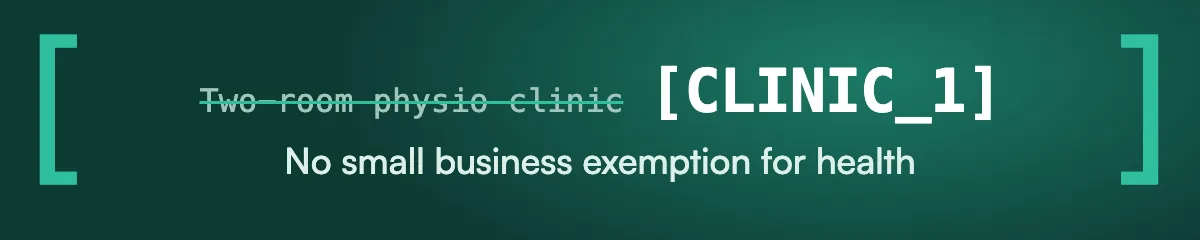
Not as such: no Australian statute names ChatGPT. But size is no escape. Section 6D(4)(b) of the Privacy Act says anyone who provides a health service and holds health information isn’t a small business operator, so a two-room physio clinic is covered like a private hospital group.
Health information is sensitive information under section 6(1). The OAIC’s guidance on commercially available AI, published 21 October 2024, says privacy obligations attach to anything put into an AI system. It recommends against entering personal, and particularly sensitive, information into publicly available generative AI tools.
So the paste is a use or disclosure that has to fit APP 6. A Medicare number adds APP 9, which allows a government related identifier out only for listed reasons, like verifying identity. Polishing a letter isn’t one. Whether it’s also a notifiable breach is a separate test.
Can this go into this tool?
Pick the tool in front of you. Consent comes up at a different step in each.
Which tool is it?
Does the practice's AI policy name this scribe as allowed?
Has the patient, and everyone else in the room, said yes at the start of this consult?
Does it suggest diagnoses or treatments you never said aloud?
Does the text still carry a name, birth date, address, phone, Medicare number or IHI?
Could the story alone point to one person: a rare condition, a small town, an exact date?
Do you know where it stores data, for how long, and whether it trains on it?
Will identifiable patient data go in?
Built from Ahpra's AI guidance and case studies, the RACGP's pages on AI scribes and conversational AI, and the OAIC's 2024 AI guidance. The order of the questions is mine.
Can ChatGPT be used for medical notes?
For the prose, yes. The RACGP’s conversational AI resource, first published June 2025 and updated September 2025, lists clinical letters, notes and discharge summaries among the jobs these tools can help with. The same page says GPs should never enter sensitive or identifying data into them.
Ahpra’s first case study is exactly this: findings dictated into ChatGPT. The data may sit offshore, and the patient would have to agree explicitly that others could use, view or sell it. Taking the patient out is easier than that chat. See what OpenAI keeps from a paste.
Names and numbers are the easy half. The story is harder: the supermarket, the month, the husband’s first name. Cutting those is a judgement call, not a legal finding, because de-identified has a stricter meaning. Here is an invented psychology note, line by line.
A session note, line by line, before it goes near a chatbot
The highlighted line is the one no name-and-number filter will catch.
| In the note | Why it points at her | What the chatbot gets |
|---|---|---|
| Teodora Vukasin, DOB 11/03/1968 | Name and birth date | A client in her late fifties |
| 8 Quoll Rd, Tarrawong NSW, mob 0491 570 110 | Address and phone | Regional NSW, no phone |
| Medicare 0000 00000 0 | A government related identifier, under APP 9 | Nothing: the prose never needs it |
| Referred by Dr Hamish Okonkwo on a Mental Health Treatment Plan | The GP's name narrows it to one practice | Referred by her GP on a Mental Health Treatment Plan |
| Still avoiding the Tarrawong IGA, where she was assaulted in June | One shop, one town, one month: a local reader knows who it is | Still avoiding a local shop linked to an assault earlier this year |
| Husband Ruben sat in for 10 minutes | A family member's first name | Partner attended briefly |
| Drafted in Word, with comments on | Author names and old wording ride along in comments and tracked changes | Plain text, pasted, not the file |
Made-up example: the client, the doctor, Quoll Rd and Tarrawong are invented, and the phone number is from a fictional range. When the note arrives as a PDF, a black box over the text isn't removal.
Labels alone leave text that is pseudonymised, not de-identified; the Australian difference is in de-identified vs pseudonymised.
Other numbers hide in referral packs too, like the card number on a NSW licence attached for identity.
If identifiable text already went in, deleting the chat clears your history, not the disclosure.
Do you need patient consent for an AI scribe?
Yes, every time. The RACGP’s AI scribes resource, last updated October 2025, says get consent at the beginning of each consultation. Ask your MDO whether it wants that in writing; if not, verbal consent recorded in the notes will do, and some scribes write that line themselves.
Ahpra explains the timing. Recording a private conversation without consent can carry criminal implications, so the software should ask for explicit consent as its first step. Ahpra also wants the answer noted in the health record, which makes a scribe’s own consent line useful, not decorative.
A waiting-room poster isn’t the yes. The OAIC says consent can’t be implied just because someone was notified: signage tells patients, the question in the room asks them. Accountants settle it up front with an AI clause in an engagement letter; a consult can’t.
AI scribe consent, before you press record
Tick what's true for today's consult.
Ticked: 0 of 9
Not ready. Leave the scribe off for this one and type the note.
Close. Check the boxes you left: the person beside the patient and your MDO's view on written consent are easy to miss.
Covered on what Ahpra and the RACGP ask. Your MDO may still ask for more.
Items drawn from Ahpra's AI guidance (consent, transparency, record), the RACGP AI scribes resource (policy, privacy policy, each consult, MDO, review) and the OAIC on voluntary consent. My list, not an official one.
Can you say no to your doctor using an AI scribe?
Yes. The OAIC’s guide to health privacy says valid consent is informed, voluntary, current, specific, and given with capacity. A yes the patient couldn’t refuse fails the voluntary part. If no means a shorter consult or a raised eyebrow, the practice has a design problem, not a difficult patient.
Victoria’s Surveillance Devices Act, s 6(1), catches recording a private conversation you’re not a party to without each party’s consent. The clinician is a party; whether the vendor’s software counts as someone else is a lawyer’s question. The RACGP says some jurisdictions make recording without consent an offence.
Ahpra and the RACGP say nothing about carers or interpreters. My rule is stricter: everyone who’ll speak gets asked, and one no keeps the scribe off. Support workers often sit in, which is why the NDIS providers page treats care teams as part of the record.
Who's in the room, and who gets asked
Ask the patient, at the start. Say what's recorded and where the text goes, then note the answer.
Ask each adult who'll speak. Their voice is in the recording too. If one says no, I'd leave the scribe off: my rule, not one Ahpra or the RACGP sets.
Ask the interpreter as well, and ask the patient through them. Check the scribe handles two languages before relying on it.
Ask on the call, before recording starts. Anyone off camera at the patient's end counts as someone in the room.
Ask the substitute decision-maker, the way the shared Code handles informed consent, and involve the patient as far as they can follow.
Turn it off and carry on. Type the note as before. Nothing in the care, the booking or the bill should change.
The patient and substitute decision-maker panels follow Ahpra's AI guidance, the OAIC's elements of consent and the shared Code of conduct, 4.2. The carer, interpreter and telehealth panels are my caution, not a published rule. Recording laws differ by state.
Is doctor-patient confidentiality a law in Australia?
It’s both a professional duty and, in parts, the law. Section 3.3 of the shared Code calls privacy an ethical and legal obligation. It asks for informed consent before disclosing, and written consent before sharing someone’s information even when they aren’t named.
The legal layer depends on who employs you. A private practice answers to the Privacy Act. The Act’s definition of organisation leaves out state authorities, so public hospitals sit under state privacy law, the split that decides which privacy law covers a council.
That split is the least intuitive part to me: the same note falls under a different Act depending on who pays your wages. For a question about one patient’s record, ring your MDO before acting on anything here.
Three layers that follow a consult note into an AI tool
| Layer | Where it comes from | What it means for AI |
|---|---|---|
| Professional duty | The shared Code, 3.3, or your board's own code | Consent before disclosing; a complaint is judged against the code |
| Privacy law | Privacy Act 1988 for private practices, whatever their turnover (s 6D(4)(b)); state law for public bodies, as with councils using AI | Health information is sensitive; a paste is a use or disclosure under APP 6; Medicare numbers under APP 9 |
| Recording law | State and territory surveillance devices Acts | Who must agree before a scribe records the room |
Ahpra, shared Code of conduct, 3.3; Privacy Act 1988, Compilation No. 104 (4 June 2026), ss 6(1), 6D(4)(b) and APPs 6 and 9; Surveillance Devices Act 1999 (Vic).
An AI policy for a healthcare practice: scribes, chatbots and the TGA
The RACGP puts the scribe decision with the practice owner: write down which scribes are allowed, tell tenant GPs and staff, and say so if the answer is none. A scribe policy silent on ChatGPT is half a policy. A starting draft is in our AI policy template.
Ahpra and the RACGP both say scribes usually aren’t medical devices, because they summarise what was said. Ahpra’s second case study is the exception: a scribe added a plausible diagnosis to a referral letter. That met the definition, so the tool should have been on the ARTG unless an exemption applied.
An invented diagnosis is the feature I’d want switched off before rollout, and a practice-wide setup makes that one decision instead of twenty.
What the practice manager settles before the first recorded consult
Steps 1 to 4 and 8 follow the RACGP AI scribes resource and Ahpra's guidance and case studies; step 5 follows the RACGP's conversational AI page and the OAIC.
Keeping patient data out of ChatGPT before the letter leaves your screen
Most of this comes down to a habit at the keyboard: the header, the numbers and the giveaway details out, the clinical question in. Outside the consult room the list of identifiers runs longer, and the Australian ones a document tends to carry are worth knowing by sight.
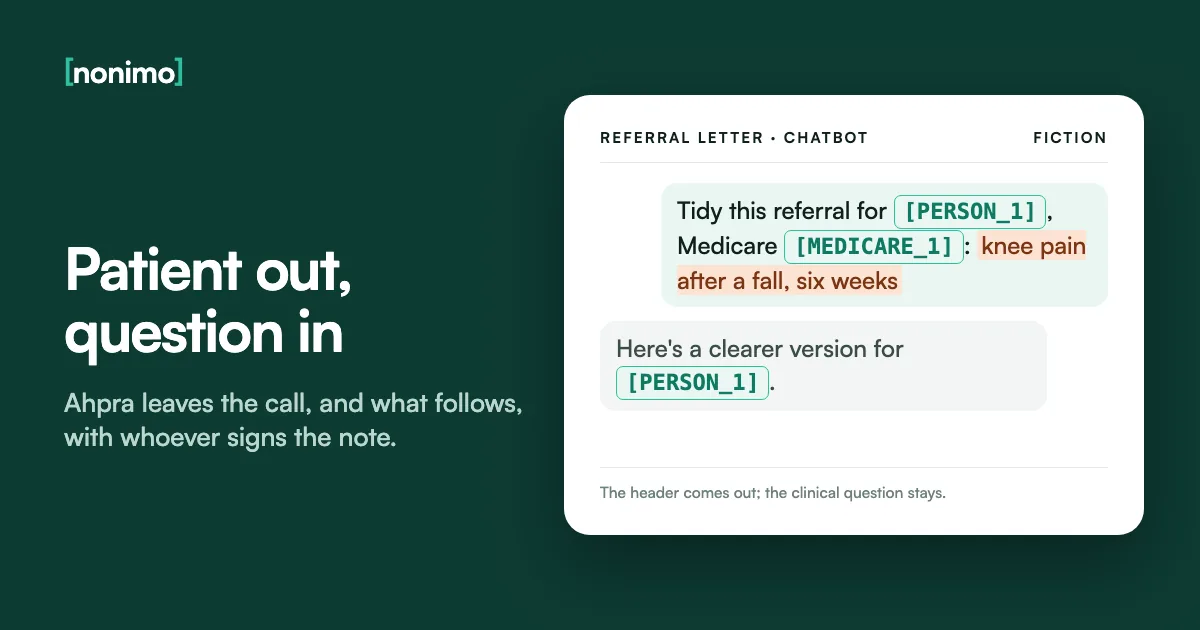
A referral letter carries most of the patient in its header, so that’s the part worth automating. Nonimo for an Australian practice clears the name, Medicare number and contact lines from the draft before it reaches the chatbot. The shop, the town and the month are still yours to rewrite.
None of the draft is sent to us; the security page covers how. Paste a letter below and see which fixed-format numbers survived your own edit.
What's still in this draft?
Runs in your browser; nothing is sent. It finds Medicare, TFN, ABN and ACN numbers by their check digits, plus NDIS numbers, BSBs, passports, phones and emails by format. It doesn't read names, addresses or licence numbers, and a WA card has a second number on the back.
Sources
- Ahpra, Meeting your professional obligations when using AI in healthcare. Five principles; consent noted in the record; explicit consent step before recording; scribes usually not TGA-regulated. Page reviewed 22 August 2024.
- Ahpra, AI in healthcare case studies. ChatGPT dictation and offshore storage; a scribe adding a diagnosis meets the medical device definition.
- RACGP, Artificial intelligence (AI) scribes. Consent at the start of each consult, MDO and written consent, practice policy, privacy policy, overseas storage, TGA. Last updated October 2025.
- RACGP, Conversational artificial intelligence. Letters and notes as uses; never enter sensitive or identifying data.
- OAIC, Guidance on privacy and the use of commercially available AI products. Obligations attach to AI inputs; sensitive information out of public tools; consent not implied by notice.
- OAIC, Guide to health privacy: introduction and key concepts. Health information includes name and Medicare number; elements of valid consent.
- Privacy Act 1988, Federal Register of Legislation. Compilation No. 104: s 6(1), s 6D(4)(b), APP 6 and APP 9.2.
- Surveillance Devices Act 1999 (Vic). Section 6(1), version 048.
Accessed 7 November 2026.
Common questions
What are the privacy risks of AI in healthcare?
Mostly, where the data ends up. Ahpra flags offshore storage, developers reusing what's typed in, and identifiable data reaching training sets. Scribes add a recording of the consult and, sometimes, a diagnosis nobody made.
What are the Ahpra AI guidelines for using AI in medical practice?
They're guidance, not a new rule. Ahpra's August 2024 page applies the existing codes through five principles: accountability, understanding, transparency, informed consent, and ethical and legal issues.
Do you need patient consent for an AI scribe?
Yes, at the start of each consultation. The RACGP says ask your MDO whether it wants written consent; otherwise get it verbally and record it in the notes.
Can you say no to your doctor using an AI scribe?
Yes, and the consult should go ahead without it. The OAIC lists voluntary as one element of valid consent, so a refusal shouldn't change your care, your booking or your bill.
Can ChatGPT be used for medical notes?
For the wording, yes; for the patient, no. The RACGP lists letters and notes as possible uses, then says GPs should never enter identifying data into these tools.
Is doctor-patient confidentiality a law in Australia?
Partly. Confidentiality is a professional duty in the codes Ahpra's boards enforce, and the Privacy Act covers every private health service provider holding health information, whatever its turnover.
Is information entered into ChatGPT confidential?
Not in the sense a patient means. Ahpra warns the data may be stored offshore and used by the developer, and calls putting patient data into a public tool something needing explicit consent.