Special category data under GDPR: what to keep out of AI
· Updated · Written and maintained by Joaquín Trapero, Nonimo
Special category data under GDPR is the short list in Article 9. It covers what reveals someone’s ethnic background, politics, religion or beliefs and union membership, together with genetic data, biometrics used for identification, health, and a person’s sex life or sexual orientation. Processing any of it is prohibited unless an exception applies, and putting it into an AI tool is processing.
In an Irish office it rarely arrives labelled. It sits in a payslip line, a GP’s cert, the narrative of a WRC complaint or a note on a family law file. The practical rule that follows is simple to say: when the task needs the category, keep the category and take out the person. The rest of this guide shows where that line falls.
It is written for solicitors, accountants, HR advisers and practice managers who already use ChatGPT, Copilot or Gemini for drafting. Clinical letters have their own guide, on patient data and AI in an Irish practice, so health appears here only where it turns up in employment and legal files. The provider side of the question, contracts and training, is in our guide to which AI is GDPR compliant.
Special category data under GDPR: the Article 9 list and the word “revealing”
The DPC’s page on the subject gives the categories in the order the Regulation uses and states the rule in a single line: no processing, except in the limited circumstances that Article 9 sets out. What that page cannot show is where each category lives in ordinary Irish paperwork. That is the part that matters when someone is about to select a page of text and send it.
| category in Article 9(1) | where it tends to sit in an Irish file |
|---|---|
| Racial or ethnic origin | an equality complaint on the race or Traveller ground |
| Political opinions | a dispute about a councillor’s canvassing or a party role |
| Religious or philosophical beliefs | time off asked for a religious feast, a school enrolment letter |
| Trade union membership | the weekly SIPTU or Fórsa deduction on a payslip |
| Genetic data, and biometrics used to identify | a family history note in a claim, a fingerprint clock |
| Data concerning health | a sick cert, an occupational health report, a disability ground |
| Sex life or sexual orientation | a next of kin form, a harassment complaint, a family law affidavit |
Categories from Article 9(1) GDPR; examples are typical Irish documents, not an exhaustive list.
The table is the reason the question is hard. None of those documents is a medical file or a union register, and nobody who handles them day to day thinks of them as sensitive. Yet each one carries a category the moment it is read in context.
Revealing is wider than labelled
Article 9(1) does not say “data stating” a person’s religion or union membership. It says data revealing it. A payslip that never contains the word member still reveals membership through the deduction. Asking for a day off for a funeral Mass can point to a religion, and a reference to someone’s husband can reveal a sexual orientation. The text does not have to announce the category for it to be there.
That is why a search for words like “health” or “union” will not find the risk. The category is in what a reader, human or model, can infer. When you decide what a model should see, read the text the way the model will: as a whole, looking for patterns.
Criminal records sit in Article 10
Convictions and offences are missing from the Article 9 list. They have an article of their own, Article 10, and Irish rules in section 55 of the 2018 Act. In practice they deserve the same care, so a vetting disclosure on an employment file should be handled like a cert.
The PPS number is not on the list either. It has a separate regime, set out in our guide on whether a PPSN is personal data.
Five Irish papers that carry it without saying so
Most Irish firms that handle these categories are not hospitals or unions. They are payroll bureaus, employment solicitors, HR consultancies and family law practices, and the data arrives inside documents built for another purpose. Five of those documents account for most of it.
The payslip and the union line
A payroll deduction for SIPTU, Fórsa, the INMO or the TUI sits on the payslip every week. It is there because the employee signed up to it, and to the payroll it is a routine item. It also reveals trade union membership, which Article 9(1) lists by name. An accountant asking a model why net pay dropped this month does not need that line, and certainly not beside the employee’s name and PPSN.
Payroll bureaus should also bear in mind that they usually act for the employer as a processor. The employer’s authority over the data does not extend to new providers automatically, a point our guide to an engagement letter AI clause covers for accountants.
The medical cert behind a sick leave day
Section 5(9) of the Sick Leave Act 2022 requires an employee claiming statutory sick leave to give the employer a medical certificate stating that they are unable to work. That is all the Act asks the cert to say. Many certs name the condition anyway, and HR files keep them.
The Data Protection Commission looked at what happens next in a 2022 case study on sick leave. An employer used an employee’s medical details to run sick leave and sick pay, which was legitimate. But the specific nature of the illness reached the local HR office, and the DPC found that excessive, with security and fairness failures to match.
For a model drafting a letter about the return to work, the same logic applies: the dates matter, the diagnosis usually does not.
The equality complaint to the WRC
The Employment Equality Acts prohibit discrimination on nine grounds: gender, civil status, family status, sexual orientation, religious belief, age, disability, race (including colour, nationality, ethnic or national origins) and membership of the Traveller community. Read against Article 9, at least four of them fall inside the list on their face: sexual orientation, religious belief, disability and race. The Traveller ground is best handled the same way, as data revealing ethnic origin.
So an equality file is, almost by definition, a file of Article 9 data. The ground is the case. WRC hearings have been open to the public from 29 July 2021, and decisions carry the parties’ names unless special circumstances are found, a point our guide on pseudonymised data takes further. The WRC’s own examples of such circumstances include a party with a medical condition they would rather not reveal.
The family law file
Family law proceedings are held in camera, and the WRC’s own guidance mentions them as a reason not to name parties. Section 5 of the Courts and Civil Law (Miscellaneous Provisions) Act 2013 lets the press attend, but allows the court to restrict attendance or reporting.
Among the matters the court must weigh is whether sensitive personal information, taken together with other information, would be likely to identify a party or a child. Irish law, in other words, already treats identification as a matter of combinations. A county, a school and a parish can do the work of a surname.
Affidavits in these cases regularly touch health, sexual orientation, sex life and religion, because those are what disputes about children and marriages are made of. If a fee earner wants help restructuring an affidavit, the model can work on the facts. The names, the addresses, the schools and the parish belong in the firm. What the High Court now expects from anyone filing material prepared with AI is covered in our reading of HC 142.
The fingerprint clock and the face on the card
Biometric data falls under Article 9 when it is processed to identify someone, and it is easy to collect without noticing: a terminal that clocks staff in by fingerprint, a building access system, a face match at registration. The clearest Irish example is the State’s own. On 12 June 2025 the DPC announced its decision on the facial matching used by the Department of Social Protection in registration for the Public Services Card.
The DPC reprimanded the Department, imposed fines totalling €550,000 and found infringements of Articles 5(1)(a), 6(1) and 9(1), because at the time of the inquiry no valid lawful basis had been identified for collecting the facial templates. In 2021 the Department held templates for 70% of the population.
For a private firm the lesson is narrower but real: an attendance export from a biometric clock is not an ordinary spreadsheet, and it should not go into a chatbot for a quick analysis of absence patterns.
What Article 9 adds once an AI tool is involved
For ordinary personal data, a firm needs one of the lawful bases in Article 6. For the Article 9 categories it needs two things: that basis, and an Article 9(2) exception on top. Ireland has filled in the second part in its own statute. The Data Protection Act 2018, in section 45, points to section 41 and sections 46 to 54, or otherwise to Article 9 itself.
The important word is step. A firm may be entitled to hold an employee’s cert or a client’s affidavit, but that entitlement is tied to a purpose. Sending the text to an outside AI provider is a further operation, and it has to fit the same purpose and be needed for it.
The provider, for its part, will usually be your processor under a contract, which is a separate question covered in our guide to what ChatGPT keeps.
Section 47 and the word necessary
For solicitors the relevant exception is section 47 of the Act. It covers processing that is needed to give or get legal advice, for claims and proceedings, whether under way or in prospect, and more generally to establish, exercise or defend legal rights. It is a broad section, and unlike most of its neighbours it does not add a requirement of suitable and specific measures.
Broad is not the same as unlimited. The section turns on necessity, and necessity is assessed for what you actually do. Using a model to tighten a WRC narrative can be part of the legal work. Giving the model the client’s name, PPSN and address to do it is harder to call necessary, because the model does the same job without them.
Section 46 comes with conditions attached
Employers, payroll bureaus and HR advisers usually rely on section 46, which covers processing necessary for rights and obligations under employment or social welfare law. It applies subject to suitable and specific measures being taken to safeguard the people concerned.
Section 36 lists what such measures can include: limits on access within the workplace, time limits for erasure, targeted training, logging, and pseudonymisation and encryption. An HR team that sends full sick certs to a public chatbot would struggle to point to any of them. Our guide on the PPSN looks at what pseudonymisation does and does not buy you under Irish law.
What the WRC told parties about AI tools in May 2026
The Workplace Relations Commission published guidance on AI tools for parties preparing submissions, first on 20 October 2025 and in a second version on 26 May 2026. Most of it is about accuracy: invented case law, wrong quotations, submissions nobody can explain at the hearing. One paragraph is about data, and it is unusually direct.
Under its best practices, the guidance tells parties to be very careful with public AI tools and not to paste in names, PPS numbers, “medical information, financial details or commercially sensitive information” unless it is necessary and safe to do so. It also warns that free online tools may store or reuse what is typed into them.
That is an Irish statutory body naming health data and the PPSN, in writing, as things to keep out of a chatbot. It was written for complainants and respondents, many of them without a solicitor, but it describes the files that employment practitioners handle every day. It also answers the objection that careful handling is excessive: the body deciding the case has asked for it.
The guidance does not forbid AI and does not require disclosure; it suggests disclosure as good practice. For firms, the useful reading is practical. If the adjudication officer expects a lay complainant to keep the medical detail and the PPSN out of a chatbot, it would be hard for a professional adviser to argue for a lower standard. Microsoft users will find the enterprise terms in our guide to what Copilot does with your data.
Keep the category, lose the person: a test in four steps
Most tasks people give a model need the category. An equality narrative about harassment on the ground of sexual orientation is meaningless without it, and a plan for someone’s return to work needs to know there was an illness. What the task almost never needs is the identity of the person. The four questions below turn that into a routine.
Does the task need the category at all?
YesKeep it, in the most general words that still do the job.
NoTake it out: the union line, the diagnosis, the feast day.
Does the task need to know who it is about?
YesStop. That is work for your own systems, not an outside model.
NoReplace the name, PPSN, address, phone, email and bank details.
Could what is left point to one person?
YesGeneralise: the town, the employer, the job title, the dates.
Does the text name people who are not your client?
YesTheir identifiers come out too. Nobody asked them.
If the answers still leave you unsure, the text stays in the firm.
The second question is the one that saves most trouble. A model asked to improve the structure of a complaint, summarise a sick leave history or draft a letter does not need a name. The third question is where Irish work differs from work in larger countries. In a town the size of Athlone, a warehouse operative of eleven years who is a Traveller and has a husband may be one person, whatever the name has become.
The fourth question is easy to forget. A harassment complaint names the alleged harasser, the witnesses and sometimes a partner. None of them are your client and none of them agreed to anything. The same test covers them too, and our guide to an engagement letter AI clause explains why a client’s signature does not cover the people named in the file.
What generalising looks like on the page
Generalising is not the same as deleting. The aim is to leave the model everything the task needs, in words that could describe many people rather than one. A few examples from the kind of files discussed above show how small the edits usually are.
| as written | what the task usually needs |
|---|---|
| diagnosed with depression by Dr Brennan in Mullingar | a mental health condition, certified by a GP |
| weekly SIPTU deduction | nothing, for most payroll questions |
| father’s funeral Mass at St Mary’s | leave for a family funeral |
| warehouse operative for eleven years | a long serving operative |
| his husband, Mark | his spouse |
Illustrative edits on invented text. Keep the specific version where the task turns on it.
The last row is the delicate one. In an equality complaint on the ground of sexual orientation, “his husband” may be the very fact the case turns on, and replacing it with “spouse” would strip the narrative of its point. That is the first question of the test at work: when the category is the task, it stays. What goes is the name beside it.
The same applies to the diagnosis. A letter asking a model to draft reasonable accommodation proposals may need to know the condition affects concentration, and an honest summary will say so. It still does not need the GP’s name, the town or the date the cert was signed.
Details nobody in the office flags
Some Article 9 data is obvious: a cert, an occupational health report, a disability ground. The items below are the ones that go into prompts because nobody thinks of them as sensitive. Each is common in Irish files.
- The union deduction. Membership, revealed by a payroll line. Irrelevant to almost any payroll query a model can help with.
- Leave for a religious occasion. A day for Eid, a Holy Day of Obligation, a funeral Mass. Each can point to a belief.
- Dietary notes. The staff party list with halal or kosher meals, forwarded for a model to tidy into a seating plan.
- Next of kin. A spouse or partner of the same sex, named on an HR form, reveals orientation as clearly as any statement would.
- Pharmacy and clinic receipts. Expense claims that name a clinic or a prescription are health data for the person claiming.
- Attendance exports. A download from a fingerprint clock is biometric data if the system uses it to identify staff.
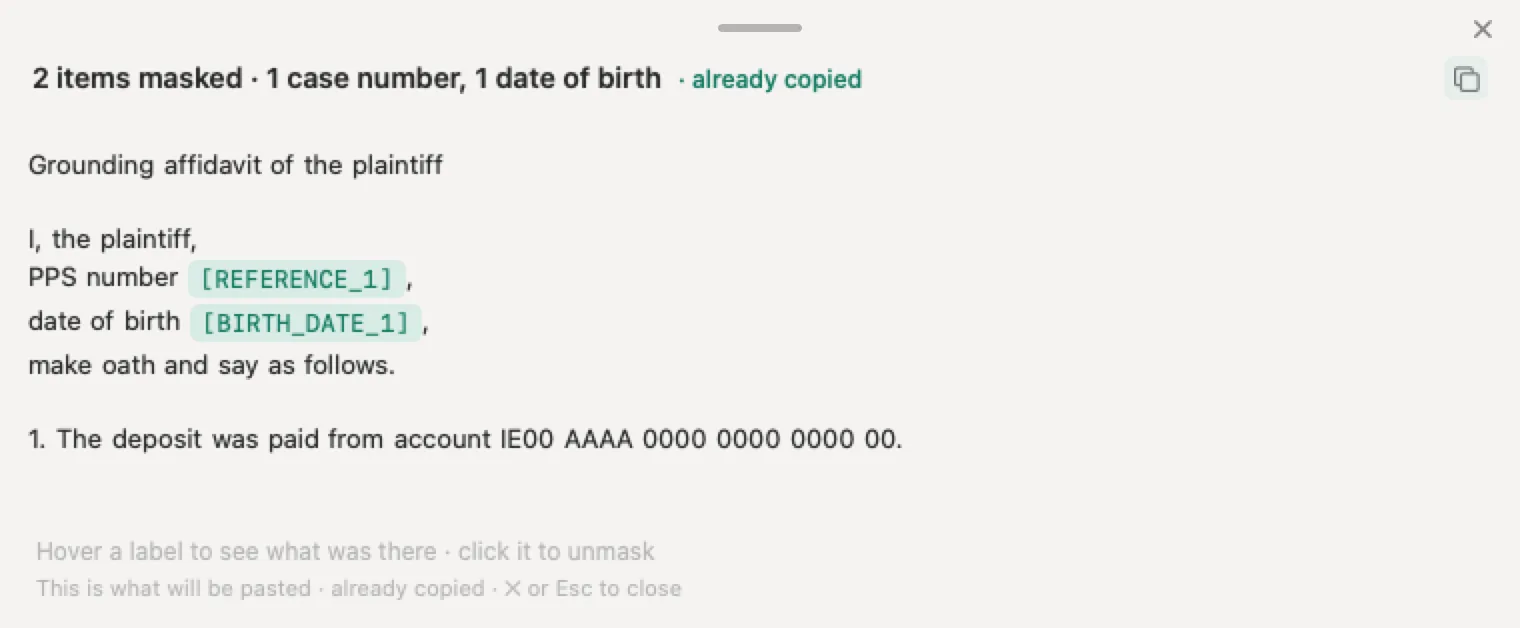
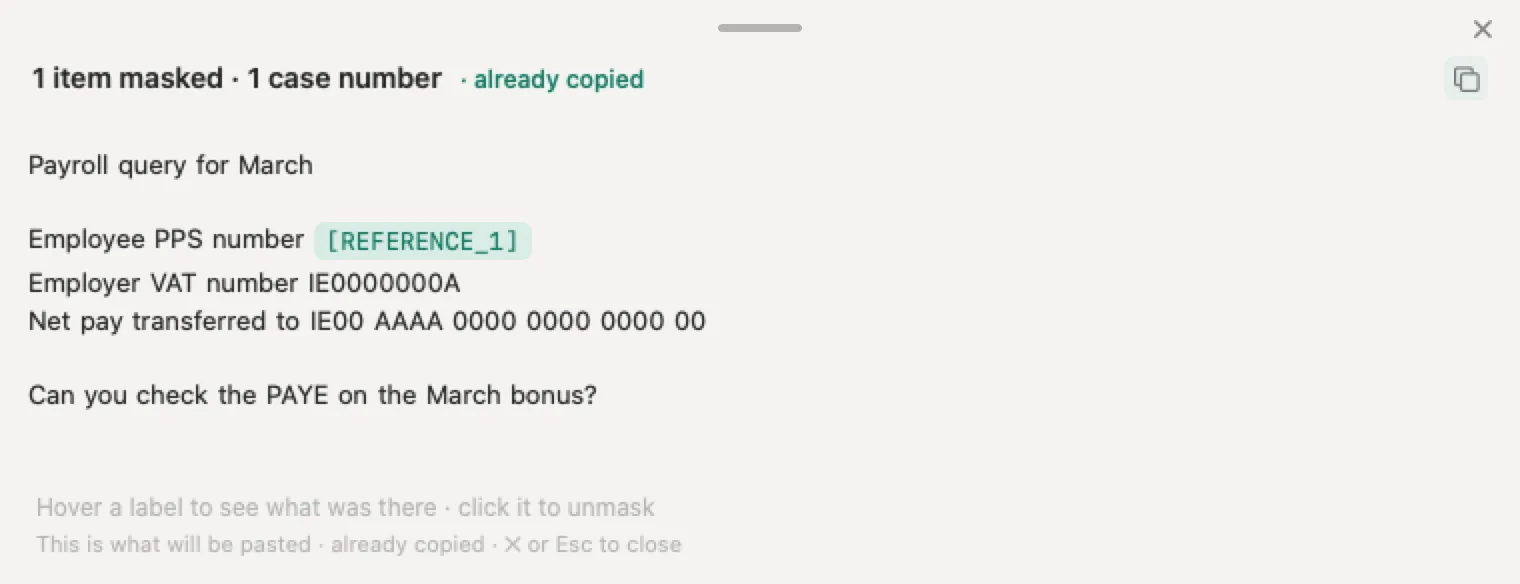
For accountants and payroll bureaus, the first and fifth come up most. Our page for Irish accountants shows a payroll query with the PPS number replaced before it reaches a model.
None of these items would trip a keyword search, and most would pass a quick read by someone in a hurry. That is the argument for a short routine rather than a policy nobody opens: before a prompt goes, one look for the six items above.
An attendance note, masked with Nonimo 0.2.8
Nonimo is a desktop app for Windows and Mac. Highlight a passage, press the shortcut, and on your own computer the details that tie a sensitive fact to a person are swapped for markers; only after that does anything reach ChatGPT, Copilot, Gemini or Claude. The reply comes back with the real values restored, so the draft you keep reads normally.
To show it on the kind of file this guide is about, we wrote an attendance note like those an employment solicitor keeps before drafting a WRC complaint, and ran it through release 0.2.8 on 25 September 2026.
| in the note | sent to the model |
|---|---|
| Client: Declan Ward | Client: [PERSON_1] |
| Mobile: 087 765 4321 | Mobile: [PHONE_1] |
| PPS number: 2468135K | PPS number: [REFERENCE_1] |
| Address: 22 Riverside Close, Athlone, Co. Westmeath N37 B0B0 | Address: [RECORD_FIELD_1] |
| Email: declan.ward@example.ie | Email: [EMAIL_1] |
| Mr Brian Keane … his husband, Mark Ward | Mr [PERSON_2] … his husband, [PERSON_3] |
| IE29 AIBK 9311 5212 3456 78 | [IBAN_1] |
Invented note, processed by Nonimo 0.2.8 on 25 September 2026. The client, the supervisor, the husband and every number are made up.
The identity goes; the facts stay. The Traveller ground, the union deduction and the diagnosis all remain in the text, and inside the firm that document still counts as special category data. Our page for Irish solicitors shows the same flow on a court document.
Our security page describes what the app keeps: the map that puts the values back is stored encrypted on your computer, and what it sends us once a day is a usage count, with not one word of your text.
Sources
- GDPR, Articles 6, 9 and 10. Article 9(1) lists the categories and prohibits processing; 9(2) sets the exceptions; Article 10 covers criminal convictions. EUR-Lex
- Data Protection Commission, special category data. The categories and the prohibition, in the regulator’s words. dataprotection.ie
- Data Protection Act 2018, section 45. Processing of special category data lawful where authorised by sections 41 and 46 to 54, or by Article 9. irishstatutebook.ie
- Data Protection Act 2018, section 46. Employment and social welfare law, subject to suitable and specific measures. irishstatutebook.ie
- Data Protection Act 2018, section 47. Legal advice and legal proceedings, where necessary. irishstatutebook.ie
- Data Protection Act 2018, section 36. The list of suitable and specific measures, including access limits, pseudonymisation and encryption. irishstatutebook.ie
- Data Protection Act 2018, section 55. Criminal convictions and offences. irishstatutebook.ie
- Sick Leave Act 2022, section 5(9). The cert must state that the employee is unable to work. irishstatutebook.ie
- DPC case study, processing of special category data (2022). The nature of an employee’s illness shared with local HR found excessive. dataprotection.ie
- DPC decision on the Public Services Card, 12 June 2025. Fines of €550,000; Articles 5(1)(a), 6(1) and 9(1); templates for 70% of the population in 2021. dataprotection.ie
- WRC, guidance on the use of AI tools, version 2 of 26 May 2026. Parties told not to paste names, PPS numbers or medical information unless necessary and safe. workplacerelations.ie
- WRC, employment equality. The nine grounds of the Employment Equality Acts. workplacerelations.ie
- WRC, guidance on the 2021 Act. Public hearings and named decisions from 29 July 2021; a medical condition and in camera family proceedings listed among special circumstances. workplacerelations.ie
- Courts and Civil Law (Miscellaneous Provisions) Act 2013, section 5. Press attendance at family law hearings and information that identifies when taken together with other information. irishstatutebook.ie
Nonimo is the software that does this on your own computer: it masks client names and IDs before your text reaches ChatGPT . No account, and your client's details never leave your machine.
Common questions
Is it lawful to put special category data under GDPR into an AI tool?
Not automatically. Article 9 prohibits processing it unless one of its exceptions applies, and in Ireland most of them are spelt out in sections 46 to 54 of the 2018 Act. Each is tied to a purpose, and sending the text to a chatbot is a new step that must be necessary for that purpose. Usually the task needs the facts, not the name. Nonimo replaces the identifiers on your computer first.
Does a union subscription on a payslip reveal anything protected?
Yes. Article 9(1) covers personal data revealing trade union membership, and a weekly SIPTU or Fórsa deduction reveals exactly that, even though the payslip never uses the word member. For a payroll query, the model rarely needs the deduction line at all. Take it out or leave it with no name beside it. Nonimo covers the name and PPS number; deciding about the line is yours.
Does a sick cert in Ireland have to give the diagnosis?
Not for statutory sick leave. Section 5(9) of the Sick Leave Act 2022 asks for a medical certificate stating that the employee is unable to work. Many certs name the condition anyway. In a 2022 case study the DPC found that sharing the nature of an employee's illness with local HR was excessive. If a model is drafting a letter about the return to work, the diagnosis can usually stay out.
Is Traveller identity covered by Article 9?
It is best treated as data revealing ethnic origin, which Article 9(1) lists first. Irish employment law already handles it as a distinct ground: membership of the Traveller community is one of the nine grounds in the Employment Equality Acts. In an equality complaint the ground is the point of the file, so it stays. What comes out is who the complainant is: name, PPSN, address and employer.
Can a solicitor rely on section 47 when using a chatbot?
Section 47 of Ireland's 2018 Act covers processing needed for legal advice, claims or proceedings. The test is necessity, step by step. Using a chatbot to tighten a narrative is part of the work, but the model can do it without the client's name. Keeping the identifiers out is the reading of necessary that is easiest to defend.
Where do criminal convictions fit, if not in Article 9?
In Article 10 of the GDPR, with Irish rules of their own in section 55 of the 2018 Act. They are not special category data, but they are treated just as carefully. A vetting disclosure or a note of a past conviction in an employment file deserves the same handling: the fact may matter to the task, while the person's identity usually does not.
Does taking out the name take the text outside Article 9?
Not on its own. Your firm still holds the original, so the masked version is pseudonymised in your hands and still counts as personal data. The provider, though, gets a diagnosis or a union deduction with nobody attached. If the remaining details point to one person, as small Irish workplaces often do, generalise them too. That last step is judgement, and no tool does it for you.
Does Nonimo judge which texts fall under Article 9?
No. It makes no judgement about the category and does not make a text anonymous. On your Windows or Mac computer it swaps out the details that link the sensitive fact to a person: names after a title or label, PPS numbers, addresses, phone numbers, emails and IBANs. You see the replacements before anything is sent. What the text is about, and whether it should go at all, stays your decision.