GDPR patient data and AI: what an Irish practice keeps out
· Updated · Written and maintained by Joaquín Trapero, Nonimo
GDPR patient data can go into an AI tool only when the practice can say which Article 9 exception covers that particular step, has a contract with the provider, and has taken out everything the task does not need. For a referral letter or a discharge summary, that last condition is where the decision is made, because the model needs the clinical story and almost none of the identifiers around it.
In Ireland the answer has layers that a British or American guide will not give you. Ireland’s 2018 Data Protection Act adds its own conditions for health data, and two of the numbers on a typical letter, the PPS number and the Individual Health Identifier, carry statutes of their own. The Medical Council then adds a professional test on top of both.
This guide works through those layers, then takes one invented referral letter and shows, line by line, what a tool can take out today and what is still left for the person sending it. It is written for GP practices, consultants in private rooms, physiotherapy and dental practices, and the practice managers who end up writing the policy.
GDPR patient data and AI: where an Irish practice stands
The practice may hold and use health data for care, but that permission does not travel automatically to a chatbot provider. Four sets of rules stack on top of each other, and a paste into ChatGPT has to get past all four.
The first layer says what health data is and forbids processing it without an exception. The second is the Irish exception for care. The third covers two numbers specifically. The fourth is the Medical Council’s own standard, which binds doctors whether or not a data protection officer ever reads the letter.
None of the four bans AI. What they share is a question about necessity: is this piece of information needed for what you are about to do with it? For a chatbot drafting a letter, the name, the birth date and the numbers almost never are. Our guide to which AI tools are GDPR compliant in Ireland covers the provider side of the same test.
What Irish doctors are already doing with AI
This is not a hypothetical. In late 2025 EY Ireland and the Royal College of Physicians of Ireland surveyed more than 500 physicians, and the report they published on 22 April 2026 found that 58 per cent had used AI in their clinical practice in the past year.
Among those users, 60 per cent used it at least weekly and more than one in five every day. Generative tools dominate: 86 per cent of the physicians using AI named generative systems, mostly for documentation, clinical reasoning and administrative work. And 93 per cent of the clinicians surveyed said they needed more training.
The State is moving the same way. On 11 March 2026 the Minister for Health launched AI for Care, the first national strategy for AI in health and social care, and the HSE lists among its first actions AI literacy training and making Copilot Chat available to staff on a large scale. Which Copilot a staff account really is, and what it keeps, varies by licence; the Irish Copilot guide sorts them out.
What the College of GPs wrote in February 2025
The paper on AI in Irish general practice puts its first practical warning before any list of benefits. Doctors should be aware, it says, that patient identifiable information must never be entered as a prompt, because processing and storage by the tool could breach confidentiality.
Its risk table repeats the point for sensitive information generally: input may be stored, logged or accessed. That is the College’s position, not a statute. But a doctor who ignored it would find it quoted back at them in any complaint, and the AI literacy duty that employers now carry is explained for Irish businesses here.
What counts as patient data under Article 9
Article 9(1) of the GDPR prohibits processing data concerning health, and Article 4(15) defines that as personal data about physical or mental health, including the provision of health care, which reveals information about health status. The prohibition lifts only under one of the exceptions in Article 9(2).
Most practices read that and think of the diagnosis. The Regulation reaches much further, and the two places where it does so are exactly the parts of a letter people leave in.
Does it reveal something about the patient's physical or mental health, or the care they receive?
YesIt is data concerning health under Article 4(15).
NoGo to the next question.
Is it a number assigned to identify the patient for health purposes, such as the IHI or a chart number?
YesRecital 35 makes it health data in its own right.
NoGo to the next question.
Does the service or specialty named tell the reader the diagnosis?
YesIt still reveals health data, with no diagnosis written down.
Any yes brings in the prohibition in Article 9(1), which lifts only under one of the exceptions in Article 9(2).
The number on the letter is health data too
Recital 35 lists what personal data concerning health should include, and one item on the list surprises most readers.
“a number, symbol or particular assigned to a natural person to uniquely identify the natural person for health purposes”
That describes the IHI and a hospital chart number, and arguably a medical card number too. Each is health data in its own right, before a single clinical word is attached to it. The same recital takes in information collected when someone registers for care, so the fact that a person is a patient of a particular service is already covered.
The specialty can give the diagnosis away
The Data Protection Commission has a case study on exactly this. An insurer passed an employee’s medical appointments to a broker, including the specialisms of the doctors involved, and the DPC found that disclosing the nature of the appointments was excessive. The DPC took the same view when an employer let its local HR office learn what a worker was ill with, and a sick cert kept by HR deserves that restraint before a model sees it.
The lesson for a letter is direct. A referral addressed to a named psychiatric service, an HIV clinic or a fertility unit tells the reader the diagnosis without stating it. Taking the name out while leaving the service in does not remove the health data; it removes only the easiest route to the person. Our guide to deidentified and anonymised data explains why the other routes still count.
Section 52: why the practice may hold it, and why the chatbot is a separate question
In Irish law the exception for care is section 52 of the 2018 Act, giving effect to Article 9(2)(h). It makes processing health data lawful where it is necessary for preventive or occupational medicine, medical diagnosis, the provision of care or treatment, or the management of health services.
It comes with a condition that matters here. The processing must be carried out by or under the responsibility of a health practitioner, or of someone who owes the patient a duty of confidentiality equivalent to a practitioner’s. Suitable and specific measures must also be in place.
Where the provider fits, and where it does not
A chatbot provider is not a health practitioner and owes no such duty on its own. It can act under the practice’s responsibility as a processor, with a contract under Article 28 that binds its staff to confidentiality, and on a business plan that is the arrangement the large providers offer. On a personal account there is no such contract at all.
Even with the contract, the word “necessary” in section 52 still applies to what you send. Drafting a letter needs the history, the findings and the question for the consultant. It does not need the PPS number, and the provider does not need the name to write “Thank you for seeing this patient”.
The Medical Council’s conditions
Paragraph 28.1 of the Medical Council’s Guide to Professional Conduct and Ethics, in its ninth edition and effective from 1 January 2024, sets the conditions for disclosing identifiable information about patients outside the healthcare team. Read against a chatbot, they look like this.
| the Guide asks | against an AI tool |
|---|---|
| a clear purpose, and consent or another legal basis | the purpose is a draft; the basis is rarely written down |
| compliance with data protection law | Article 9, section 52 and a processor contract |
| no workable anonymised alternative | for drafting, there nearly always is one |
| the minimum, to the minimum number of people | the identifiers are never the minimum |
| recipients who know they owe confidentiality | only under a contract, never on a free account |
Source: Medical Council, Guide to Professional Conduct and Ethics, 9th edition, paragraph 28.1.
The third row is where most pastes fail. If the task can be done with the identifiers removed, the Guide expects them removed, and a written AI policy for the practice is the place to say so once rather than letter by letter.
Consent, and where the professional rule goes further
Section 52 does not rest on consent, and most practices do not ask for it to write a referral. The Guide is stricter in one sentence that is easy to miss. Paragraph 25.3 says that, except where required by law or in the public interest, patient consent is required before information about a patient is disclosed to others within or outside the healthcare team.
The College of GPs lands in the same place from another direction. Its risk table says that new ways of processing data with AI require explicit patient consent, and that the doctor should understand the tool well enough to explain it.
Put together, the professional texts leave two realistic routes for identifiable content: ask the patient, or take the identifiers out. For a letter that has to go this afternoon, only the second can realistically be done before the post goes.
The IHI has an Act of its own, like the PPSN
Irish readers already know the PPS number is special: the Oireachtas narrowed who may use it in section 262 in the Social Welfare Consolidation Act of 2005, and the Irish PPSN guide sets that out. What fewer practices realise is that the Individual Health Identifier has a statute of the same kind.
HIQA describes the IHI as a number that uniquely identifies each person who has used, is using or may use a health or social care service in Ireland, which lasts for life and is never reissued. Its FAQ is explicit that the IHI is not the PPSN and that the PPSN could not be used in its place.
Section 11 puts it on the letter
The Health Identifiers Act 2014 was enacted on 8 July 2014, and its section 11 has been in operation since 31 March 2022. It tells a health services provider, as the Act defines one, to ask the patient for the IHI, to associate it with the record, and to indicate it in any relevant communication.
So the number is not on the letter by accident. The law expects it there, which means that any clinical letter drafted in an Irish practice today may carry an identifier that most redaction habits were never trained to look for.
Section 22 and the relevant purpose
Section 22, in operation since 13 July 2015, says a person shall not process someone else’s IHI for a purpose other than a relevant purpose. Doing so knowingly is an offence, with a fine of up to €100,000 on indictment.
The relevant purposes are broad. The primary one is the present, past or future provision of a health service to the person, and drafting their referral plausibly sits inside it.
The open question is the next reader: a provider outside the health service, with no role in that care. No Irish court has considered whether a prompt is processing for a relevant purpose, and this guide does not pretend to know. What is certain is that no letter gets better because the model saw the IHI.
GDPR patient data in a referral letter: what comes out first
Here is the working order for an Irish clinical letter, from the items a machine can recognise to the ones only a person can judge. It applies equally to a discharge summary, a report for a solicitor or an insurer, and a note typed up after a consultation.
| in the letter | why it matters in Ireland |
|---|---|
| name, including in “Re:” lines and signatures | the direct identifier, often repeated three times |
| date of birth | with a town, it narrows to one person quickly |
| PPS number | section 262 narrows who may use it |
| IHI and hospital chart number | health data themselves under Recital 35 |
| address and Eircode | an Eircode points to a single door |
| next of kin and their mobile | a second person’s data, often forgotten |
| the service, the age, the job and the town | together they identify in a small county |
Sources: GDPR Recital 35; Social Welfare Consolidation Act 2005, s. 262; Health Identifiers Act 2014; Eircode.
The first six rows are mechanical, and a tool helps with most of them. The Eircode deserves its own warning, because it points to one building, not a whole street, which our PPSN guide explains alongside the number itself.
Where the clinical detail identifies the patient
The last row is where clinical letters differ from most office documents. A good referral is specific by design: it says the patient is a retired teacher, that she lives in a particular town, that she was seen on a particular date. Every one of those details helps the consultant, and together they can name her to anyone local.
That matters because what a provider receives is read. Google’s own terms, for example, allow human reviewers to read chats selected for review, and our Gemini guide quotes them. A reviewer abroad is unlikely to know the patient. The point is that the story is read by someone outside the practice, and the practice no longer decides who.
One referral letter, before and after
To make this concrete, here is an invented GP referral to a cardiologist, of the sort a practice might ask a chatbot to tidy. Every name, address and number in it is made up. We ran the whole letter through Nonimo version 0.2.8, the version available today, on 23 September 2026, and the Mac and Windows builds returned the same result.
| what you typed | what the model reads |
|---|---|
| Patient: Siobhán Ní Bhriain | Patient: [PERSON_1] |
| DOB: 14/03/1961 | DOB: [BIRTH_DATE_1] |
| PPSN: 7654321A | PPSN: [REFERENCE_1] |
| IHI: 539301400000000000 | unchanged |
| Address: 12 Oakfield Park, Ballina, Co. Mayo F26 B0B0 | Address: [RECORD_FIELD_1] |
| Mobile: 087 123 4567 | Mobile: [PHONE_1] |
| Dear Dr Ó Ceallaigh … Dr Aoife Brennan | Dear [PERSON_2] … [PERSON_3] |
Output of Nonimo 0.2.8 on an invented letter, measured 23 September 2026. The body paragraph passed through unchanged.
Seven values were replaced and one identifier was not: the IHI went through as typed. In this version the Irish numbers share generic labels, which is why the PPS number reads as a reference and the whole address line as a form field.
What the model can still read
The body of the letter reached the model exactly as it was written.
Thank you for seeing this 65 year old retired teacher from Ballina with a three month history of exertional chest tightness. She has type 2 diabetes, HbA1c 58 mmol/mol, and a past history of depression treated by the community mental health team in Castlebar. ECG in the surgery on 2 September showed new T wave inversion in the lateral leads.
That is correct behaviour for a tool that swaps identifiers: the clinical story is the point of the letter, and it is also health data. But read it as someone in north Mayo would. A 65 year old retired teacher from Ballina, a mental health history treated locally, an ECG on a stated date.
For the model, “a woman in her sixties, formerly a teacher, in the west” loses nothing. Making that change is a clinical judgement, and it stays with you. Our page for Irish practices describes the swap itself.
Business accounts, AI scribes and the processor contract
If a practice decides that some patient content will go to an AI tool, the account matters as much as the paste. Personal and free plans come with consumer terms. Business and enterprise plans add a data processing agreement, which is what makes the provider a processor acting on the practice’s instructions.
Retention periods and reader access differ from plan to plan, and the Irish detail for each is in our guides to ChatGPT’s retention and Anthropic’s rules for Claude. None of those contracts changes the section 52 question: the provider becomes a processor, and necessity still governs what you send it.
What an AI scribe changes
A scribe is a different kind of tool. It listens to the consultation, so there is no moment when a person selects what to send; the whole conversation is the input. The College of GPs gives practices a checklist of questions for scribe vendors, covering the data sharing agreement, where the data is processed, whether it is anonymised, and whether any medical device regulator has approved the product.
Its footnote to that checklist is the sentence to keep. Even where the company provides a DPIA template, conducting the assessment for your own practice is your responsibility. The DPC’s July 2024 note on generative AI and LLMs tells organisations using these systems to consider a formal risk assessment, and asks whether they could honour an access or erasure request for data held inside the AI system.
Testing a tool on real records is another matter
Drafting one patient’s letter is care. Running a structured comparison of an AI tool across many patients’ records to see whether it improves practice can be health research, and the Health Research Regulations 2018 then expect ethics approval and, as a rule, explicit consent obtained before the research starts.
The Medical Council’s paragraph 28.3 separately asks that information used for audit, quality assurance and training be anonymised or coded wherever possible before anyone outside the team sees it.
If a letter has already gone
Mistakes happen. If identifiable patient content has gone into a chatbot on a personal account, treat it as a possible personal data breach under Article 33: record what went, delete the conversation where the provider allows it, and assess the risk to the patient.
The Commission has to hear about it within 72 hours of the practice becoming aware, where that is feasible, unless the incident is unlikely to put the patient at risk, and health content is exactly what makes that risk likely. The notification test is worked through in our breach walkthrough for client data.
The DPC does act in health. On 2 September 2026 it fined the HSE €645,000 over the storage of paper records in two former psychiatric hospitals and other sites. That case was not about AI, and the enforcement picture it belongs to is summarised in our Irish GDPR guide. It shows the regulator takes health records seriously whatever form they take.
What Nonimo does with an Irish clinical letter today
Nonimo is a small app that works locally, on the desk where the letter is written. Highlight the paragraph, press its key, and before anything reaches ChatGPT, Claude or Copilot the identifiers it recognises become labels. The answer comes back carrying those labels, and the app writes the real values back into your copy.
The table that links each label to its value stays on the machine, which is why we call the result pseudonymised rather than anonymised, the same word our Irish home page uses. The screenshot below comes from version 0.2.8 and an invented Irish affidavit rather than a clinical letter; it shows the panel, where every label can be checked before anything is sent.
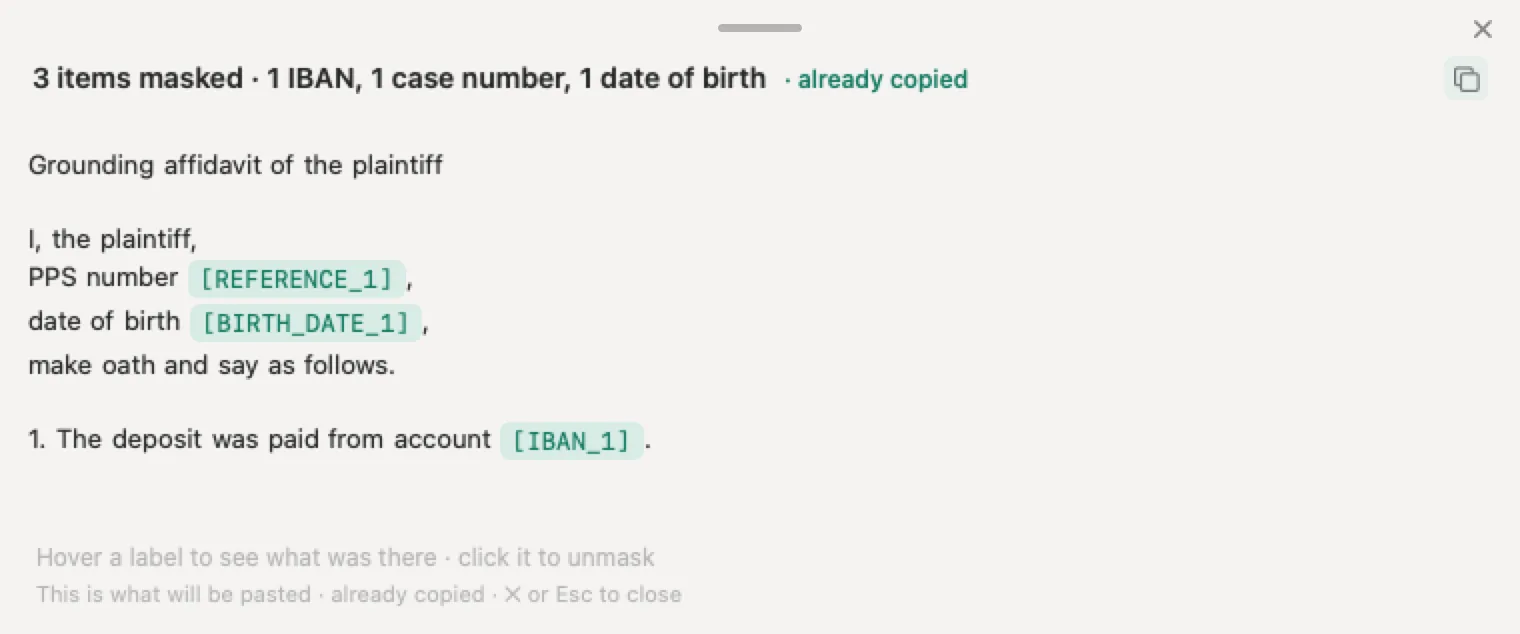
In version 0.2.8 it picks up names beside a label or a title, dates of birth, PPS numbers, chart numbers, addresses and Eircodes, phone numbers, email addresses and IBANs. It does not catch the IHI, so that number has to come out by hand.
Our security page sets out what the app keeps: the map that puts the values back is stored encrypted on your computer.
Before the next letter: five questions for the practice
The rules above turn into five questions that a practice manager can put in writing and a clinician can answer while the paragraph is still highlighted.
- Which account is this? A personal or free plan has no processor contract, and nothing identifiable goes there.
- Does the task need the identifiers? For a draft, it almost never does, and paragraph 28.1 expects them out.
- Have the numbers gone? Name, date of birth, PPSN, IHI, chart number, address, Eircode and next of kin, checked by eye as well as by tool.
- Does the story still point at one person? Read it as a neighbour would, and generalise the town, the job or the date where the clinician does not need them.
- Is it written down? A short policy, a DPIA where the tool is systematic, and a note in the privacy notice if patients’ data is involved.
A practice that can answer those five has done most of what the GDPR, section 52 and the Medical Council ask of a paste. The rest belongs in your practice’s AI policy, which is where a GP partner or a practice manager can make the decision once for everyone.
Sources
Checked 23 September 2026.
- Regulation (EU) 2016/679, the GDPR. Article 4(15), the definition of data concerning health; Article 9(1), the prohibition, 9(2)(h) and 9(3); Recital 35, including numbers assigned to identify a person for health purposes; Articles 28 and 33.
- Data Protection Act 2018, section 52. Processing of special categories for the purposes of Article 9(2)(h), by or under the responsibility of a health practitioner or a person with an equivalent duty of confidentiality.
- Health Identifiers Act 2014, dated 8 July 2014. Section 2, the definitions of primary purpose and relevant purpose; section 11, asking for the IHI and indicating it in any relevant communication; section 22, processing outside a relevant purpose and the €100,000 maximum on indictment.
- Commencement and statutory instruments of the Health Identifiers Act. Section 22 in operation from 13 July 2015 (S.I. No. 294 of 2015); section 11(1) to (5) from 31 March 2022 (S.I. No. 154 of 2022).
- HIQA, National Register of Individual Health Identifiers, and its FAQ on health identifiers. The IHI identifies each person using health or social care, lasts for life and is not reissued; it is not the PPSN, and the PPSN cannot be used instead.
- Social Welfare Consolidation Act 2005, section 262. The restriction on who may use a PPS number.
- Medical Council, Guide to Professional Conduct and Ethics for Registered Medical Practitioners, 9th edition, effective from 1 January 2024. Paragraph 25.3, consent for disclosure to others within or outside the team; paragraph 28.1, the conditions for disclosure outside the healthcare team; paragraph 28.3, anonymised or coded information for audit and training.
- Irish College of GPs, The Use of Artificial Intelligence in Irish General Practice, February 2025. The introduction, that patient identifiable information must never be entered as a prompt; the risk table on sensitive information and on explicit consent for new AI processing; Table 1 for scribe vendors and the footnote on conducting your own DPIA.
- RCPI and EY, Physician Survey on AI in Healthcare, 22 April 2026. Over 500 physicians surveyed in late 2025; 58 per cent used AI in the past year; of users, 60 per cent weekly, more than one in five daily, 86 per cent generative; 93 per cent want more training.
- Department of Health, Minister for Health publishes Ireland’s first national AI for Care Strategy, 11 March 2026, and HSE, AI for Care. The launch, and the rollout of AI literacy training and Copilot Chat for staff.
- Data Protection Commission, Special category data, and the case study Processing of health data. The Article 9 list; the finding that disclosing the specialisms of the doctors was excessive.
- Data Protection Commission, AI, Large Language Models and Data Protection, 18 July 2024. Risks to organisations using AI systems, and whether access and erasure requests can be honoured within them.
- Data Protection Commission, final decision following inquiry into the HSE, 2 September 2026. A fine of €645,000, a reprimand and corrective orders over paper records in external storage.
- Health Research Regulations 2018, S.I. No. 314 of 2018. The definition of health research, ethics approval and explicit consent before the research commences.
Common questions
Can GDPR patient data go into ChatGPT?
Not with the patient's identifiers still in it, unless the practice has an Article 9 exception that covers sending it, a processor contract under Article 28 and a tool it has assessed. The Irish College of GPs wrote in February 2025 that patient identifiable information must never be entered as a prompt. Nonimo takes names, dates of birth, PPS numbers and addresses out on your own computer before the text leaves.
Does health data get the extra protection of Article 9?
Yes. Under Article 9 of the GDPR, data concerning health is one of the special categories, and processing it is prohibited unless one of the listed exceptions applies. Recital 35 adds that a number assigned to someone to identify them for health purposes is itself health data, which takes in the IHI and a hospital chart number. Nonimo covers some of those numbers today; the IHI is not yet one of them.
What does section 52 of Ireland's Data Protection Act allow?
It makes processing health data lawful where it is necessary for diagnosis, care, treatment or the management of health services, and done by or under the responsibility of a health practitioner or someone with an equivalent duty of confidentiality. A chatbot provider is neither. The real test, then, is whether sending it on is necessary, not whether the practice may hold it. Nonimo helps you send less.
Is the IHI the same as a PPS number?
No. HIQA says the Individual Health Identifier is a separate number and that the PPSN cannot be used in its place. Each is governed by a separate statute: for the PPSN, section 262 in the Social Welfare Consolidation Act of 2005; for the IHI, the Health Identifiers Act 2014, whose section 22 makes knowingly processing it outside a relevant purpose an offence. Nonimo picks up the PPSN today, not the IHI.
Can a GP practice use an AI scribe under the GDPR?
It can, with a contract, a data protection impact assessment and patients told what happens to the recording. The checklist the Irish College of GPs gives practices says that even where a vendor supplies a DPIA template, conducting the assessment for your own practice is your responsibility. Nonimo does not work on audio at all: it acts on text you select, so a scribe needs an assessment of its own.
Does removing the name make a clinical letter anonymous?
Rarely. What stays behind, an age, an occupation, a town and a condition, can point to one person, and the Medical Council asks doctors to use anonymised information where they can and to disclose the minimum. A letter with the name swapped for a label is pseudonymised and remains personal data for the practice. Nonimo swaps the identifiers; rewriting the clinical facts stays with the clinician.
What does the Medical Council say about sharing patient information outside the team?
Paragraph 28.1 of its Guide, effective from 1 January 2024, sets conditions before identifiable information leaves the healthcare team: a clear purpose, consent or another legal basis, compliance with data protection law, no workable anonymised alternative, and the minimum disclosed to people who know they owe confidentiality. Nonimo addresses the minimum; the other conditions stay with the doctor who decides to send.
What should a practice do if patient data has already been pasted into a chatbot?
Treat it as a possible personal data breach: record it, delete the conversation where the provider allows it, and judge the risk to the patient. Article 33 gives the practice 72 hours, where feasible, to tell the DPC, unless the incident is unlikely to put the patient at risk. Nonimo is preventive only: it keeps no log of past swaps, so it cannot reconstruct what left.