Practice Direction HC 142: what you sign, what stays in the firm
· Updated · Written and maintained by Joaquín Trapero, Nonimo
Since 1 September 2026, anyone who swears an affidavit or makes a witness statement for the High Court has to state in an opening paragraph that no generative AI tool produced the substance of the evidence. Experts sign a similar line at the start of their reports. Pleadings and submissions carry no declaration, but everything in them has to be checked by a person, and the court can ask at any time how AI was used.
That is the half most summaries cover. The other half sits in the same text and gets less attention: what the firm put into an AI tool before anybody drafted anything. This guide takes both, in order, and it covers the Court of Appeal and Circuit Court directions that followed within weeks. If the question in your office is which tool you may use at all, our page for Irish solicitors deals with that first.
Practice Direction HC 142 since 1 September 2026: what it asks
Mr Justice David Barniville signed Practice Direction HC 142 as President of the High Court. It is dated 29 July 2026 and came into operation on 1 September 2026. It reaches every document used in civil proceedings in the High Court and everyone involved in them, litigants in person included. It also applies to proceedings issued before that date: what decides whether it bites is when the document was prepared, not when the case began.
The core is plain. You may use generative AI. You stay responsible for what goes in front of the court, and anything a tool helped to produce must be verified by a person before it is used. On top of that sit rules that name particular documents, and one rule about material the court has already restricted.
| document | what HC 142 asks | paragraphs |
|---|---|---|
| affidavit or witness statement | a declaration near the top that AI did not generate the substantive content | 27 and 28 |
| expert report | a declaration at the start, and disclosure of any material use | 29 to 31 |
| pleadings | facts, reliefs, authorities and chronologies checked | 23 |
| submissions | every authority, citation and quotation verified against a proper source | 24 |
| any court document | disclosure of AI use when the court directs it | 21 and 22 |
| documents under an order or undertaking | no AI tool where that risks breaching it | 32 |
The rest of this guide goes through those rows. The last one, and the risks listed in paragraph 10, are the part that decides what a tool such as ChatGPT gets to keep from your files in the first place.
Three courts, four texts: the Irish rules on AI in 2026
The High Court did not move first. On 26 March 2026 the Court of Appeal gave judgment in Guerin v O’Doherty, [2026] IECA 48, an appeal in a defamation action in which a litigant in person had filed written submissions prepared with AI. They relied on authorities that did not exist, and counsel for the other side spent time and costs looking for them.
Costello P set out five principles of general application at paragraph 74 of that judgment. The second is the one to remember: a party who uses AI to research its case should expressly inform both the other parties and the court. The court drew no adverse conclusion against the defendant, noting at paragraph 76 that no guidance had yet been published for people representing themselves. Guidance followed within months.
The Court of Appeal follows the High Court on purpose
CA16 was signed by Ms Justice Caroline Costello, President of the Court of Appeal, on 11 August 2026 and also came into operation on 1 September. Its text tracks HC 142 closely, and its first paragraph explains that it is aligned with the High Court direction so the same provisions keep applying on appeal. An affidavit sworn for the High Court and later relied on in an appeal does not meet a second set of rules.
The Circuit Court goes further
The Circuit Court’s CC34, issued by Keenan Johnson as its President, took effect on 21 September 2026 and covers civil and criminal proceedings alike. It is shorter than the High Court text and stricter in two places.
First, it says outright that AI should not be used in preparing affidavits, statements of facts or evidence, apart from administrative or ancillary tasks. Second, where AI is used on legal submissions, the submission should acknowledge it and confirm that the content and every source cited have been checked.
That second rule turns the Guerin principle into routine practice. In the High Court, using AI on submissions does not of itself need disclosing; in the Circuit Court, it does. A firm that runs matters in both courts needs one habit for both, and the office AI policy is the natural place to write it down.
Family law and the in camera rule
CC34 also names a risk the High Court text leaves unspoken. Practitioners are told to be acutely conscious that using AI could breach the in camera rule, and not to use it on in camera matters where that risk exists. For anyone working the Circuit Court’s family lists, that is the paragraph to pin up. Family affidavits often touch health, orientation and religion, and a school or a parish can identify a party without a name.
On 23 September 2026, a keyword search of the practice directions on courts.ie for “artificial”, “generative” or “intelligence” returned these three and nothing else. There is nothing yet from the District Court or the Supreme Court.
What you sign under Practice Direction HC 142
The declaration in paragraph 27 fits in a single sentence, quoted here in full. It sits in one of the first paragraphs of an affidavit or a witness statement unless the court directs otherwise.
“I declare that Generative Artificial Intelligence has not been used for the purposes of generating the substantive content of this [witness statement/affidavit] (including by way or altering, embellishing, strengthening, diluting or rephrasing the evidence set out) and that this [witness statement/affidavit] reflects my personal knowledge, recollection and evidence.”
The text on courts.ie reads “by way or altering”; the Courts Service’s plain language guide on the same site has “by way of”. The form is to be “amended or adapted as appropriate” in any case, so firms can carry the corrected wording into their precedents without anyone thinking twice.
Substantive content, and the five verbs
The declaration concerns the evidence, not whether a chatbot was open on the screen. Altering, embellishing, strengthening, diluting and rephrasing are all things a fee earner might ask a tool to do to a client’s draft without thinking of it as generating anything, and under paragraph 27 each one counts.
That catches the requests that feel harmless. Make this paragraph clearer. Make her account sound more confident. Tighten the chronology. Put it in plain English for the client to approve. If the answer changes how the evidence reads, the deponent can no longer swear that AI was not used for it, and paragraph 26 explains why the court cares: the document must reflect the witness’s own recollection, knowledge and evidence.
What paragraph 28 leaves open
Paragraph 28 carves out administrative or ancillary use unconnected to the substantive content, and gives formatting and spell checking as its examples. Numbering paragraphs, laying out an exhibit list, fixing the style of dates or turning a scanned page into editable text all fall within that exception.
The words “similar functions” will be argued at the edges. A writing assistant that proposes a better sentence is closer to rephrasing than to spell checking, even inside a word processor. The safer habit is to keep AI away from the body of the evidence altogether and to use it, if at all, on the frame around it.
Where the frame itself carries a client’s PPS number or address, our guide to the PPSN covers what that number is in Irish law.
The deponent swears it, the solicitor explains it
The declaration is made by the person swearing the affidavit or making the statement, not by the firm. Paragraph 17 puts the matching duty on the solicitor: clients must be told of their duty to the court, and anyone swearing an affidavit must understand their personal responsibility for its truth and completeness. In practice, the solicitor who took instructions has to be able to tell the deponent honestly how the draft was prepared.
Makes the declaration, and carries personal responsibility for the truth and completeness of the affidavit.
Tells the client of the duty to the court, and has to be able to say honestly how the draft was prepared.
Expert reports work a little differently. The expert declares at the start of the report that AI was not used for the substantive content “save as otherwise expressly stated”, and paragraphs 30 and 31 then require the nature and extent of any material use to be set out, so that the court can weigh the reliability and independence of the opinion.
Pleadings and submissions: no declaration, and no shortcuts
Paragraph 22 is the reassuring one. Using AI to prepare a court document does not of itself require disclosure, so pleadings and submissions in the High Court carry no declaration. What they carry instead is a duty to check that is stricter than many offices’ current habits.
For pleadings, paragraph 23 requires the pleaded facts, the reliefs claimed, the authorities and any chronology to be verified. For submissions, paragraph 24 requires every authority, citation, quotation and reference to be checked against authoritative sources. Paragraph 18 sets out the method: fact check and proofread, adapt the content to the case, and confirm that each case and provision exists and says what it is cited for.
Checking AI with AI does not count
Paragraph 13 closes the obvious shortcut: using the same or another AI tool to confirm that information is accurate is not enough. You may verify against source material held inside an AI tool, such as the judgment itself in a research service, but the check is a person reading the source. The Law Society’s guidance lists citing case law and legislation among the tasks general chatbots are not suited to, for the same reason.
When the court asks
Paragraph 21 is the quiet one. Where the court directs it, a party must disclose whether AI tools were used for any court document and the nature and extent of that use, and everybody is expected to be able to answer if asked. A firm that cannot say, three months on, which draft went through which tool is not in a position to give that answer.
That is where the Guerin principle lives in the High Court: not as a standing rule, but as a question the judge can put at any hearing. The answer has to come from the file, and it helps if the file names the provider and the plan, because the four large providers treat a prompt very differently.
What must not have left the firm before anyone signs
Paragraph 10 is easy to skim, since it reads as a list of risks rather than a set of rules. It sets out what the court understands about AI tools as of July 2026, and two items on that list are about what goes into a tool, not what comes out of it.
Under confidentiality and privacy, the direction warns that information entered into an AI tool may be kept, processed or passed on in ways the user cannot see, even when nobody intended it. Under legal privilege, it says two separate things: that what is entered into AI tools, search results included, may have to be disclosed in legal proceedings, and that privileged material put into tools that are not private may lose its protection.
What goes into a tool may be kept, processed or passed on in ways the user cannot see.
What is entered, search results included, may have to be produced in legal proceedings.
Privileged material put into a tool that is not private may lose its protection.
Your prompts may be discoverable
The first of those deserves more attention than it gets. What a fee earner types into a chatbot, and what the tool sends back, is information that may one day have to be produced. A prompt that retells the client’s version of events, with the names, dates and sums in it, is a document the other side may ask to see.
How long it survives depends on the provider and the plan. The consumer and business versions of Gemini, for example, keep very different things for very different periods, which our guide to Google’s rules sets out in Irish terms.
Discovery documents and the undertaking
Paragraph 32 is the only part of HC 142 written as a prohibition. Where documents, including documents obtained on discovery, are covered by a court order or by an express or implied undertaking restricting their use, AI tools should not be used on them if that would involve, or create a risk of, disclosure contrary to the order or undertaking. CC34 repeats the rule for the Circuit Court.
Uploading the other side’s discovered documents to a personal chatbot account to have them summarised is exactly the case the paragraph describes. Whether a tool under a firm contract, with retention switched off, still creates a risk is a judgment the firm has to make and be ready to defend. The direction does not make it for you.
Privilege belongs to the client
The Law Society’s guidance on generative AI says much the same, speaking for the profession. Privilege belongs to the client, and handing privileged material to a consumer model, free or paid, with no safeguards in place risks losing it. The same guidance tells solicitors to keep client data, personal or confidential, out of any GenAI system that lacks proper safeguards agreed with its provider.
Which safeguards count, and what the Law Society says about enterprise licences, is on our solicitors page. The point for this guide is narrower: none of it is about the declaration. A deponent can truthfully swear that AI did not touch the evidence while the firm has already sent the client’s file to a tool it should not have used.
One replying affidavit, four requests to a chatbot
Take an invented matter. A small Dublin firm acts for a building contractor defending a summary summons in the High Court for unpaid materials. The fee earner has the client’s attendance note, the invoices, the other side’s grounding affidavit and a bundle of emails that came in on discovery in related proceedings. Late on a Thursday, four requests to a chatbot suggest themselves.
| the request | where HC 142 puts it | what follows |
|---|---|---|
| number the paragraphs and lay out the exhibit list | paragraph 28 | the declaration still holds |
| make the client’s account of the delivery dispute more persuasive | paragraph 27, strengthening | the declaration no longer holds |
| summarise the emails received on discovery | paragraph 32 | likely not permitted at all |
| confirm that the cases in counsel’s outline exist | paragraph 13 | a person has to check them |
Run an eye down the last column and the pattern is plain: the direction permits the first request, forbids the third and makes the second and fourth someone’s personal job. What the table does not show is what reached the provider in each case.
What the permitted request still sends
The first request is the one everyone would call harmless, and for the declaration it is. But the exhibit list names the client, the site, the invoice numbers and the bank account the money was paid into. The attendance note behind it carries the client’s mobile number and the Eircode of the site. Tidying the list sends all of it.
Whether the tool was a personal account or the firm’s Copilot licence changes what the provider is allowed to do with it later. The provider read the same thing either way.
That one example carries the argument of this guide. HC 142’s declaration looks at what the tool wrote. Confidentiality, privilege and paragraph 32 look at what the tool read. The two tests are independent, and passing the first says nothing about the second.
Costs, striking out and a referral to the LSRA
The sanctions are in paragraphs 35 to 37. A party that does not comply may face adverse costs orders, orders disregarding or rejecting court documents in whole or in part, or the striking out of its claim or defence. The court may also take any misuse of AI into account when managing the case and deciding costs.
For practitioners, paragraph 36 goes further. Citing sources that do not exist, misstating real ones, or failing to fix a problem promptly may lead to a referral to the Legal Services Regulatory Authority under the Legal Services Regulation Act 2015, or to the practitioner’s professional body, and to costs orders against the practitioner personally.
According to the Legal Services Regulatory Authority’s latest figures, that route covers 16,089 practising lawyers at the end of 2025: 12,961 solicitors and 3,128 barristers. Any of them who appears in the superior courts has been working under a written AI rule since 1 September.
The clock for putting it right
Paragraphs 33 and 34 deal with errors. If you spot a problem in the other side’s documents, you raise it with them first and go to the court only if there is no proper response within a reasonable period. If you find one in your own, you tell the other parties and the court without delay, file a clean version and a version with the changes marked, and usually bear the costs of doing so.
CC34 shortens that clock sharply. In the Circuit Court, a party that fails to put right a use of AI contrary to the direction within one working day of being told can be reported to the court, which then decides whether the direction was breached. Whether or not the court is ever asked, a data breach question may run in parallel if client data reached a tool it should not have.
The court, the other side, the client: who has to be told
Set the four Irish texts beside what the Law Society says and the duty to tell someone about AI use turns out to depend on who that someone is. The client is the last row, the one a firm can settle before work starts, with an AI paragraph in its terms of business.
| who | must they be told? | source |
|---|---|---|
| the High Court | in affidavits, witness statements and expert reports; otherwise when directed | HC 142, 21 and 27 to 31 |
| the Court of Appeal | as in the High Court | CA16 |
| the Circuit Court | also in legal submissions prepared with AI | CC34, 5 |
| the other side | where AI was used to research the case | Guerin, paragraph 74 |
| the client | no positive duty, though the terms of business may say so | Law Society guidance |
The client row surprises people. The Law Society’s view is that a solicitor’s duty of honesty does not create a positive obligation to disclose GenAI use to clients, in the same way that nobody discloses their IT support arrangements unless asked.
It does suggest mentioning AI in the terms and conditions letter, and it flags that the EU AI Act may impose transparency duties of its own, which our Irish reading of the AI Act covers.
Where Nonimo fits under Practice Direction HC 142, and where it does not
Nonimo is not a generative AI tool and produces no text of its own. It is installed on each fee earner’s PC or Mac. Highlight the paragraph, hit a single key, and client details are swapped for labelled markers on that machine; only then is the paragraph pasted into whichever chatbot the firm uses. The answer comes back with the markers, the original details are restored locally, and the lookup between marker and value stays on that machine.
So it belongs to the second half of this guide, not the first. It narrows what the provider sees. It has no bearing on what the provider produces, and it cannot make a paragraph 27 declaration true: if a chatbot rephrased a client’s evidence, it rephrased it whether the names were masked or not.
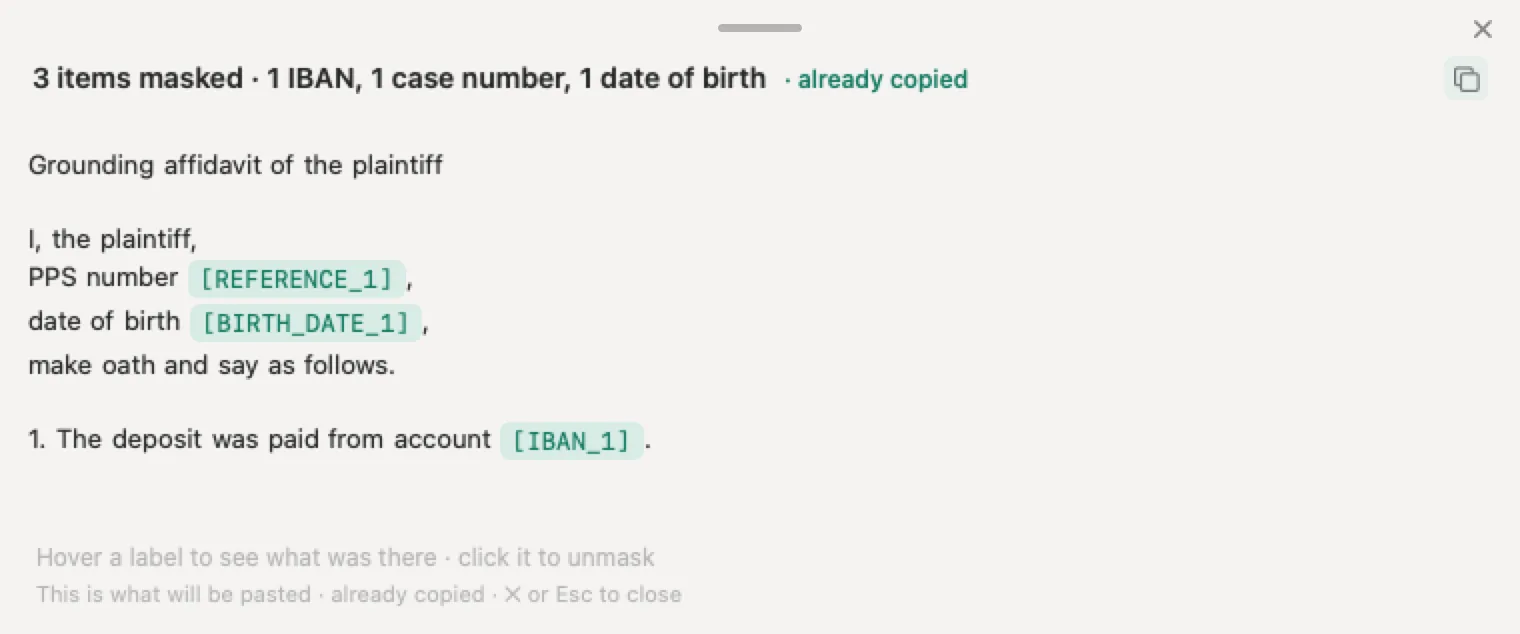
In version 0.2.8, the one available today, it replaces PPS numbers, Eircodes, VAT numbers, dates of birth, IBANs, mobile numbers, email addresses and the names under a signature, and our page for Irish firms shows the same flow on other documents.
What it keeps is on our security page: the map between markers and values stays encrypted on that machine.
Before the deponent swears: a checklist for the file
The direction is long, but for an ordinary litigation practice it comes down to a handful of habits, most of which cost nothing.
- Ask how the draft was made. Before the jurat is signed, the solicitor should know whether any tool touched the evidence, and for what.
- Keep AI off the evidence. Formatting and spell checking are fine under paragraph 28; rewording the client’s account is not, and in the Circuit Court the line is drawn even tighter.
- Flag restricted material. Discovery documents, anything under an order or undertaking and every in camera file should be marked so that nobody uploads them.
- Strip identifiers from what does go. Names, PPS numbers, Eircodes and account numbers come out before a passage leaves the machine, whichever tool the firm licenses.
- Verify every authority by hand. Paragraph 13 means a second chatbot is not a check; a person reads the judgment.
- Write it down. One line on the file saying which tool was used for what is enough to answer the court under paragraph 21.
- Say so in Circuit Court submissions. Under CC34, AI use on submissions is acknowledged in the document itself.
None of this replaces an office AI policy; it is what such a policy should say about litigation. For the firm deciding which tools may be used at all, our template and the Irish guide to Anthropic’s terms are the next two things to read.
Sources
Checked 23 September 2026.
- High Court, Practice Direction on the Responsible Use of Generative Artificial Intelligence in Court Documents, HC 142, signed by Barniville P on 29 July 2026, in operation from 1 September 2026. Paragraph 3 on scope; paragraph 10 on confidentiality and privilege; paragraphs 12, 13 and 18 on verification; paragraph 17 on the solicitor’s duty; paragraphs 21 to 31 on disclosure and declarations, with the text of the paragraph 27 declaration; paragraph 32 on orders and undertakings; paragraphs 33 to 37 on errors and sanctions.
- Court of Appeal, Practice Direction on the responsible use of Generative Artificial Intelligence in Court documents, CA16, signed by Costello P on 11 August 2026, in operation from 1 September 2026. Paragraph 1 on alignment with HC 142.
- Circuit Court, Practice Direction on the Responsible Use of Generative Artificial Intelligence in Court Proceedings and Documents, CC34, issued by Keenan Johnson, President of the Circuit Court, in effect from 21 September 2026. Paragraph 2 on affidavits; paragraph 5 on acknowledging AI in submissions; paragraph 8 on undertakings and the in camera rule; paragraph 9 on one working day; paragraphs 10 and 11 on sanctions.
- Court of Appeal, Guerin v O’Doherty [2026] IECA 48, judgment of Costello P, 26 March 2026. Paragraph 72 on authorities that did not exist; paragraph 74, the five principles, including informing the other parties and the court; paragraph 76 on the absence of guidance at the time.
- Courts Service, Using AI to prepare documents for court, guidance for people who are not lawyers. The declaration wording with “by way of”; the warning about court orders and undertakings.
- Practice directions search on courts.ie. A keyword search for “artificial”, “generative” or “intelligence” on 23 September 2026 returned HC 142, CA16 and CC34 only.
- Law Society of Ireland, guidance on the use of generative artificial intelligence. Privilege as the client’s; no client data without appropriate safeguards; citing case law among unsuitable tasks; no positive duty to disclose GenAI use to clients, and the terms and conditions letter.
- Law Society Gazette, Practising legal professionals in Ireland now at 16,089, 14 July 2026. The LSRA figures: 16,089 practising at the end of 2025, of whom 12,961 solicitors and 3,128 barristers.
- Legal Services Regulation Act 2015, Irish Statute Book. The Act under which a practitioner may be referred to the LSRA.
Common questions
What does Practice Direction HC 142 require?
It requires anyone swearing an affidavit or making a witness statement in the High Court to state near the top that the substance of their evidence was not produced by generative AI, and experts to sign a similar line. Anything else AI helps with must be checked by a person. It has applied since 1 September 2026, to old and new cases. Nonimo deals with another part: the client details a tool reads before anyone drafts.
Can I use ChatGPT to draft an affidavit in Ireland?
Not for the evidence itself. Under paragraph 27 of HC 142 the deponent states that AI did not alter, embellish, strengthen, dilute or rephrase what they say, and the Circuit Court's CC34 says AI should not be used on affidavits beyond administrative tasks. Formatting and spell checking remain fine. Nonimo does not change that answer; it only takes client identifiers out of text you do send.
Does using AI for spell checking stop me making the declaration?
No. Paragraph 28 of HC 142 says administrative or ancillary use unconnected to the substantive content, such as formatting or spell checking, does not prevent the declaration. The risk lies in tools that suggest rewording, which sit closer to rephrasing. Keep them off the body of the evidence. Nonimo writes nothing at all: it swaps identifiers for placeholders and puts them back when the reply arrives.
Must I tell the court I used AI for legal submissions?
In the High Court, only if the court directs it, under paragraphs 21 and 22 of HC 142, though you must verify every authority. In the Circuit Court, CC34 asks for the use to be acknowledged in the submission itself. The Court of Appeal said in Guerin v O'Doherty that the other side and the court should be told. Nonimo keeps no record of what went where, so the file note is yours to keep.
Does HC 142 apply to proceedings that started before September 2026?
Yes. Paragraph 3 applies it to all proceedings before the High Court whenever they were instituted, and to every court document prepared after 1 September 2026. What matters is when the document was prepared, not when the summons issued. An affidavit sworn this month in a 2023 case needs the declaration. Nonimo works on any passage you select, in old matters as well as new ones.
Can I put documents obtained on discovery into ChatGPT?
Usually not, where they are covered by a court order or an express or implied undertaking. Paragraph 32 of HC 142 says AI tools should not be used on such documents if that would involve, or create a risk of, disclosure contrary to the order or undertaking. Whether a contracted tool meets that test is the firm's judgment. Nonimo removes identifiers from a passage; it does not lift the restriction.
What happens if AI invents a case in my submissions?
The court can order costs against the party, disregard the document or strike out the claim or defence, under paragraph 35 of HC 142, and paragraph 36 allows a referral of the practitioner to the Legal Services Regulatory Authority with personal costs. In Guerin v O'Doherty the Court of Appeal saw fictitious authorities filed by a litigant in person. Nonimo does not check citations; a person has to.
Could a prompt to an AI tool be disclosed to the other side?
It could. Paragraph 10 of HC 142 lists among the known risks that information entered into AI tools, search results included, may be required to be disclosed in legal proceedings. A prompt that retells the client's account is a document like any other. Nonimo swaps names, birth dates, IBANs and similar details for placeholders before the text is sent, so the stored prompt holds fewer of them.