PHI vs PII: what's the difference for employers?
· Updated

Joaquín Trapero in AI and privacy expert, and founder of Nonimo.
A doctor’s note in a personnel file feels like PHI. It names a condition and carries a clinic’s letterhead. Under HIPAA it almost never is, and that single label is where many HR teams start sorting their records into the wrong drawer.
PII is the wider idea: anything that points to a person. For an employer, the useful question is which rule follows each record and whether that rule lets it leave the building. The leaving part has its own checklist, our US list of identifiers to remove before sharing, field by field.
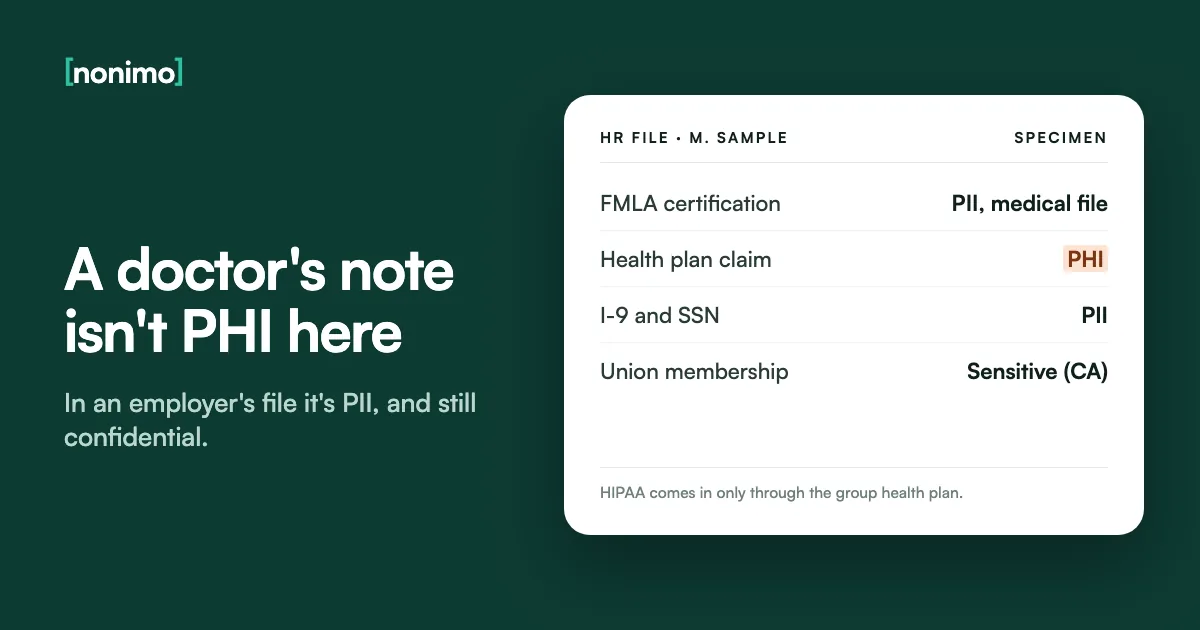
An HR file holds PII, and almost none of it is PHI. HIPAA's PHI definition excludes employment records an employer holds, so PHI reaches HR only through a covered group health plan. Medical notes in it stay confidential under the ADA, GINA and FMLA, and in California much of it is sensitive personal information.
PHI vs PII: the two definitions side by side
PII has no single statute behind it. The federal definition most people quote is in OMB Circular A-130, written for agencies: information that can distinguish or trace someone’s identity, alone or combined with other linkable data. A name qualifies. So does an employee ID, for anyone who can look it up.
PHI has an owner. HIPAA defines it in 45 CFR 160.103 as individually identifiable health information, then lists what it leaves out. Two facts decide the label: who created or received the record, and in what role. The words on the page never settle it alone.
Picturing PHI as a smaller circle inside PII gets employers into trouble, so I skip that picture and ask who holds the paper. The words for what you do to a record afterward, de-identified or anonymized, are a separate vocabulary, sorted in our note on de-identified versus anonymized data.
| PII | PHI | |
|---|---|---|
| Where it's defined | OMB Circular A-130; NIST's glossary repeats it | 45 CFR 160.103, the HIPAA definitions |
| What it covers | Anything that distinguishes or traces a person, alone or once linked | Identifiable health information created or received by a provider, health plan, employer or clearinghouse |
| Who it binds | Federal agencies directly; private employers only through other laws | Covered entities and their business associates |
| What it leaves out | Nothing by definition | Employment records held as employer, FERPA education and student treatment records, people dead more than 50 years |
| An HR example | Home address, badge photo, employee ID | Claims data your plan's administrator sends the benefits team |
Are employee medical records PHI? The employment records exclusion
The HIPAA definition of identifiable health information names employers in its first clause: information created or received by a provider, a health plan, an employer or a clearinghouse. Then the definition of PHI, in paragraph (2)(iii), takes out employment records held by a covered entity in its role as employer.
HHS says it plainly on its page for workers: the Privacy Rule doesn’t protect employment records, even health-related ones. An employer may ask an employee for a doctor’s note for sick leave or workers’ compensation. The doctor, though, can’t send that information to the employer without the patient’s authorization unless another law requires it.
Role is what trips up hospitals. A nurse’s sick note in HR is an employment record; her chart from the night she was admitted is PHI. I would keep those in separate systems with different people on each, since the chart answers to HIPAA and its business associate rules for AI tools.
Is this record PHI?
Answer for one document in your HR files.
Did it reach you from your group health plan, its insurer or its administrator, for plan business?
Did a hospital or clinic your organization runs create it while treating this person as a patient?
Based on 45 CFR 160.103 and HHS's page on employers and health information in the workplace.
When PII becomes PHI at work: the group health plan
There’s one door through which PHI reaches an ordinary employer: the group health plan it sponsors. The plan is a covered entity in its own right, separate from the company. What the plan’s insurer or administrator sends to the sponsor stays PHI, held for the plan, even when the readers sit in HR.
Not every plan counts. HIPAA’s definition covers a plan with 50 or more participants, or one administered by someone other than the employer that set it up. A small plan the company runs itself falls outside. Put your own plan into the check below.
Is your plan a HIPAA group health plan?
Yes. The plan is a covered entity, and claims data it sends HR is PHI held for the plan.
No. Under 50 participants and run by the employer itself, it falls outside HIPAA's definition. Medical details from it still fall under the ADA and state law.
Test from the definition of group health plan in 45 CFR 160.103; participants are counted as ERISA defines them. The starting numbers are only an example.
When the plan does count, 45 CFR 164.504(f) builds a wall. The plan documents name which employees may see PHI and limit them to plan administration, and the sponsor certifies it won’t use the data for employment decisions. A claims report pasted into a chatbot with no BAA turns into the breach question.
If I ran benefits at a self-funded company, the claims export would never share a folder with the leave files. Checking one against the other is the temptation that certification exists to stop.
ADA, GINA and FMLA: the confidential medical file
Leaving HIPAA doesn’t leave a record unprotected. Three federal employment laws take over, each with its own size threshold. They don’t say PHI or PII. They speak of a confidential medical record, kept on separate forms and in separate files from the personnel file.
The ADA rule, 29 CFR 1630.14(c), names three groups who may be told, and the EEOC’s guidance applies it to medical details employees volunteer, too. GINA’s list runs to six cases, and family medical history counts as genetic information. An AI vendor appears on neither list.
This table fits into a staff AI policy as a single line, and mine would read: nothing from the separate medical file goes into a general AI tool until the person in it can no longer be identified.
| Rule | Applies to | What goes in the separate file | Who may be told |
|---|---|---|---|
| ADA, 29 CFR 1630.14(c) | Employers with 15 or more employees | Medical condition or history from inquiries and exams | Supervisors about restrictions and accommodations; first aid and safety staff; government investigators |
| GINA, 29 CFR 1635.9 | Employers with 15 or more employees | Genetic information, including family medical history | Six cases only: the employee on written request, a compliant health researcher, a court order, government investigators, FMLA certification, a public health agency about a contagious disease |
| FMLA, 29 CFR 825.500(g) | Private employers with 50 or more employees in 20 workweeks; public agencies of any size | Certifications and medical histories of employees and their family members | The ADA list where the ADA applies; GINA's rules for family history |
| California, Civil Code 56.20 | Employers that receive medical information | Procedures to keep it confidential | No use or disclosure without the employee's authorization, except listed cases |
Sensitive personal information: which state laws reach employees
State consumer privacy laws add a third label, sensitive personal information or sensitive data. Most were written for shoppers, not staff. Virginia’s defines a consumer as someone acting in an individual or household context and excludes anyone acting in an employment context. Washington’s My Health My Data Act carries the same exclusion.
California is the exception. The CCPA’s exemption for employee and applicant data became inoperative on January 1, 2023, so a CCPA business owes its California workers the rights it owes customers. Our guide to California privacy law and AI covers which companies count as a CCPA business.
Three state definitions, read for an employer
Yes, since January 1, 2023, if the employer is a CCPA business and the worker is a California resident.
Social Security, driver's license, state ID and passport numbers; account logins and financial account or card numbers together with the code or password that opens them; precise geolocation; racial or ethnic origin, citizenship or immigration status, religious or philosophical beliefs, union membership; contents of mail, email and texts not addressed to the business; genetic and neural data; biometrics used to identify; health; sex life or sexual orientation.
Name, home address and date of birth: ordinary personal information.
No. A consumer acting in a commercial or employment context is outside the definition.
Racial or ethnic origin, religious beliefs, a mental or physical health diagnosis, sexual orientation, citizenship or immigration status; genetic or biometric data used to identify; a known child's data; precise geolocation.
No. The My Health My Data Act excludes an individual acting in an employment context.
Consumer health data of Washington residents, or collected in Washington, when people act as customers.
Cal. Civ. Code 1798.140(ae) and 1798.145(m)(4); Va. Code 59.1-575; RCW 19.373.010.
Two exemptions change the sort. The CCPA leaves out PHI collected by a covered entity or business associate, so your plan’s claims data answers to HIPAA. It also leaves out medical information governed by California’s CMIA, whose section 56.20 bars employers from using or disclosing employees’ medical information without authorization.
With staff in several states, I would plan around California’s list even for people outside it, since a payroll register rarely splits cleanly by state. The Washington health data guide covers the customer data that law does reach.
PHI, PII or sensitive: classify the records in your HR files
Here is that sort applied to paper an HR office holds. Filter by label; a record can carry more than one. The California column applies only when your company is a CCPA business and the employee lives in California.
The rows that worry me are the dull ones. A payroll register doesn’t look medical, yet its dues column reveals union membership and its SSN column sits on the same sensitive list. For Social Security numbers before AI, the safe default is that the column never leaves.
Where each HR record sits
| Record | PHI? | Medical file rule | California sensitive? | Before it goes anywhere |
|---|---|---|---|---|
| Claims report from your self-funded plan's administrator | Yes, held for the plan | The 164.504(f) wall instead | No: the CCPA exempts PHI | Only tools under the plan's BAA, never for employment decisions |
| A nurse's chart from her stay at the hospital she works for | Yes, held as provider | No | No: exempt as PHI | The 18 identifiers come out |
| Doctor's note for sick leave | No | ADA | Usually not: it's CMIA medical information under Civil Code 56.20, which the CCPA exempts | Name, dates and provider out |
| FMLA certification, Form WH-380-E | No | FMLA and ADA | Usually not: written by a provider, so CMIA and 56.20 instead | Name, dates and provider out |
| Leave to care for a parent with cancer | No | GINA: family medical history | Likely, as health; a provider's note attached to it falls under 56.20 | Both names out, relative included |
| Disability accommodation request in the employee's own words | No | ADA | Likely, as health; supporting medical paperwork falls under 56.20 | Identity out; keep the restriction the task needs |
| Schedule change requested for Friday prayer | No | No | Yes: religious beliefs | Name out |
| Form I-9 with document copies | No | No | Yes: immigration status, document numbers | I-9 copies stay as they are; one sent elsewhere can carry a watermark on the Green Card copy |
| Passport copy for a work trip | No | No | Yes: passport number | Cover the number and coded lines, or watermark the travel agent's copy |
| Payroll register with SSNs and union dues | No | No | Yes: SSN, union membership | Mask the CSV export or delete the columns in Excel |
| New hire's Social Security card copy | No | No | Yes: SSN | Watermark it for the payroll file |
| Driver's license copy for a driving job | No | No | Yes: license number | Mark whose file the copy is for |
| GPS log from a delivery van | No | No | Yes: precise geolocation | Driver ID and exact points out |
| Emergency contacts and home addresses | No | No | No | Which employee data AI may see |
| Applications run through screening software | No | No | No, unless they reveal a listed category | Illinois notice rules if you hire there |
Sources: 45 CFR 160.103 and 164.504(f); 29 CFR 1630.14(c), 1635.9 and 825.500(g); Cal. Civ. Code 1798.140(ae), 1798.145(c) and 56.20. California column assumes a CCPA business and a California resident.
Does PHI require more protection than PII before AI?
Not as a rule. In an employer’s hands, the tightest limits often sit on records that aren’t PHI at all: six cases for a caregiver leave request under GINA, three groups for an accommodation under the ADA. The label tells you which list to read, and the list tells you who may see the text.
None of those lists mentions software, and the regulations don’t say whether sending text to an AI vendor counts as disclosure. What the vendor does with the prompt afterward is a separate question about sharing and training.
California adds a risk assessment before processing sensitive personal information, under the CPPA rules in force since January 1, 2026. Processing employees’ data solely for pay, work authorization, benefits, required accommodation or wage reporting is exempt. Whether an AI summary of an accommodation file stays inside “solely” is something I’d put to counsel.
Before one HR record goes into an AI tool
Tick what's true of the text you're about to paste.
0 of 5 marked
Nothing marked: ordinary PII. Names and contact details still come out before pasting.
Each line above is a rule attached to this record. Clear them before you paste.
Software handles most of that sweep, and our comparison of PII redaction tools shows what each one catches. Someone who knows the workplace still reads the result, because a rare condition in a team of six points to one person as surely as a name.
The identity has to stay with the text
- A model your company hosts, with its costs
- A data vault that tokenizes inside your own software
Only the substance has to travel
- Remove the identifiers on the employee's computer, then paste
- In a city or county HR office, a prompt can become a public record someone requests later
Law firms and CPA firms holding a client’s HR file
The same records travel to outside firms. Defense counsel receives the accommodation letters and the charge; a CPA firm running payroll sees every dues deduction. Neither becomes a HIPAA covered entity, though a firm becomes a business associate when a covered entity hires it for work involving PHI.
The labels follow the paper: a client’s FMLA file is still an employment record at the firm, and its staff are still California consumers if the client is a CCPA business. Its own duty runs to the client, so the AI clause in an engagement letter says how those files meet AI tools.
I wouldn’t trust redaction alone to settle privilege in a litigation file, and our guide on redaction and privilege shows where it stops.
| Who holds it | What arrives | Label it keeps | |
|---|---|---|---|
| Employment defense counsel | Personnel file, accommodation letters, EEOC charge | Employment record; ADA or GINA medical file; California sensitive | Nonimo for law firms |
| Counsel once the charge becomes a lawsuit | The same file, now in discovery | Unchanged, plus court rules | Disclosing AI use to the court |
| CPA firm running payroll | Registers with SSNs, dues, garnishments | California sensitive for a CCPA client | Nonimo for CPA firms |

Before you paste: the name stays, the diagnosis travels
Sorting the file this way leaves most HR text usable. The medical fact or the category is often what the task needs; the employee’s identity rarely is. That’s the part to take out on your own computer, before any vendor holds it, and the original record keeps its legal label.
Where a record lands on this map depends on facts no article can see, such as who administers your plan or where each employee lives. Take it as general information, and have employment counsel confirm the PHI and California columns against your own files.
A caregiver leave memo, before and after
Rosalind Achterberg, (608) 555-0164, r.achterberg@example.org, 310 Quillback Lane, Madison, WI 53703, asks for intermittent leave from December 1 to care for her father during chemotherapy.
[PERSON_1], [PHONE_1], [EMAIL_1], [ADDRESS_1], asks for intermittent leave from December 1 to care for her father during chemotherapy.
Invented example: 555-0100 to 555-0199 is reserved for fiction and example.org is a documentation domain. Marked: the father's treatment stays because the task needs it, and it is still GINA information, so read it before sending.
I’d leave the diagnosis in and the person out. For HR desks that draft with AI every week, Nonimo’s app for US offices swaps the identifiers for placeholders on the computer and restores them in the reply.
The mapping between placeholders and real values never leaves that computer, as our security page explains.
For a whole HR team, Nonimo for organizations covers the rollout.
Sources
- eCFR, 45 CFR 160.103: PHI and its exclusions, including employment records held as employer; group health plan test (50 participants or outside administration). 164.504(f) on the plan sponsor wall is on the same site.
- eCFR, 29 CFR 1630.14: ADA confidential medical files and the three exceptions. GINA’s 29 CFR 1635.9 and the FMLA’s 825.500(g) are on the same site.
- HHS, Employers and health information in the workplace: employment records outside the Privacy Rule; doctor’s notes; provider authorization (read via an Internet Archive copy).
- OMB, Circular A-130: the federal definition of personally identifiable information.
- NIST CSRC, glossary entry for PII: the same definition across NIST publications.
- EEOC, disability-related inquiries and medical exams of employees: confidentiality of medical information, including what employees volunteer.
- EEOC, which federal laws apply to a small business: the 15-employee threshold for the ADA and GINA.
- U.S. Department of Labor, Fact Sheet 28, the FMLA: covered employers.
- California Civil Code, 1798.140: sensitive personal information at (ae); 1798.145 holds the employee exemption’s end and the exemptions for PHI and CMIA medical information (read via an Internet Archive copy).
- California Civil Code, 56.20: employers’ duties for employees’ medical information (read via an Internet Archive copy). The CPPA’s risk assessment rule is 11 CCR 7150.
- Code of Virginia, 59.1-575: consumer excludes the employment context; sensitive data.
- Revised Code of Washington, 19.373.010: My Health My Data Act definitions, including the employment exclusion.
Checked on November 7, 2026.
Related guides
Common questions
What is the main difference between PII and PHI?
PHI is identifiable health information held under HIPAA's rules. PII is anything that identifies someone. The holder decides: a diagnosis in a clinic's chart is PHI, and the same diagnosis in an employer's leave file is not.
Are employment records considered PHI?
No. HIPAA's definition of PHI excludes employment records a covered entity holds as employer. That covers a hospital's HR file on its own nurses; a nurse's chart from her own hospital stay is still PHI.
Are employers exempt from HIPAA?
Mostly, because HIPAA binds health plans, clearinghouses and providers that bill electronically. A company's group health plan is a covered entity, though, and plan data reaching HR stays PHI that can't drive employment decisions.
Does PHI require more protection than PII?
Not always, because the rules follow the holder, not the label. A caregiver leave request in an HR file isn't PHI, yet GINA lets the employer disclose it in only six listed cases.
Do employers have access to employee medical records?
Only what the employee hands over or a law requires. An employer may ask for a doctor's note for sick leave, but the provider needs the employee's authorization to send records directly.
Is a home address sensitive personal information?
Not under California's CCPA definition. A home address is ordinary personal information there, while precise geolocation, Social Security numbers, immigration status, union membership and health data are on the sensitive list.
When does PII become PHI?
When a HIPAA covered entity or its business associate holds identifiable health information. For most employers that happens only through a covered group health plan, or an on-site clinic that bills insurers electronically.
What does PHI not cover?
Four kinds of identifiable health information fall outside it. HIPAA excludes FERPA education records, certain student treatment records, employment records a covered entity holds as employer, and records of people dead more than 50 years.